DOHC Front end lowering options

ryewhiskeyneat

New Member
Hey All,
Working on a '79 CB750 dohc. First bike, just gathering ideas right now. I will want to lower the front end and from what I gather here I have a few options. I'd love opinions.
1. Raise the forks in the tree. One problem is the tree on these bikes has the handle bars directly over the forks. It would be fine if I want to use clip-ons but anything else I'd have to use risers or something.
2. Use the method for cutting the forks down that I've found on this forum.
3. Swap forks from say a cb550?
4. Swap the triple tree from another bike to fix the problem in #1?
5. Swap the entire front end?

Again, just gathering ideas. I plan on riding it stock this season and maybe start doing work once winter comes back.
Thanks
 
Learn how your forks work and lower them internally it's a couple hour job the first time including new fork seals which you'll probably need anyway.
Consider the handling changes this is goin to cause as well. Don't "slam it" because it looks cool.
 
Lowering the front end will reduce rake and trail...will make the bike twitchier handling, and more likely to do a tank slapping wobble at speed.

If you are building a bike to sit in front of your house and get admiring looks, any of your solutions will work.

If you are looking for improved handling and performance on a daily rider, than lowering the front is exactly opposite of what you are proposing.

I would try something you can undo. After riding for a season , lower the fork, and see if you like the handling more or less. I think you will find the handling is not as good.
 
spend your time and energy learning to ride take some riders training courses
do not lower the front end, why is explained very well above
if anything once you learn to ride you will likely want to upgrade the forks springs they are usually mushy stock this will get the front end back UP a bit
maybe it has air assist ?
get some good rear shocks stock length
freshen up tires and brakes if needed
lowering the front end also reduces cornering clearance,not a preferable modification on a motorcycle that already lacks clearance
 
Thanks for the responses.
I have a rider's course next weekend. Plan on riding this thing stock for now.
I've seen really cool builds off this platform but It may not be the bike for me in the end.
It was free though so I'll be good to start on.

It's interesting because I have read many times that lowering the front will ruin the handling, yet people are doing it ALL the time.
 
ryewhiskeyneat said:
Thanks for the responses.
I have a rider's course next weekend. Plan on riding this thing stock for now.
I've seen really cool builds off this platform but It may not be the bike for me in the end.
It was free though so I'll be good to start on.

It's interesting because I have read many times that lowering the front will ruin the handling, yet people are doing it ALL the time.
It is usually noob mistake made for the appearance of being cool. here is a LOT to learn about building a safe and well handling motorcycle. Too many people are into a "scene" or going for a particular "look". Does't mean it is smart and many of these riders never know how much worse their bikes handle because they don't have any experience on a bike that does handle well. Lots of people build big stretched choppers that are totally impractical, yet they do anyways. ???
 
ryewhiskeyneat said:
Thanks for the responses.
I have a rider's course next weekend. Plan on riding this thing stock for now.
I've seen really cool builds off this platform but It may not be the bike for me in the end.
It was free though so I'll be good to start on.

It's interesting because I have read many times that lowering the front will ruin the handling, yet people are doing it ALL the time.

750 is too much much machine for a beginner, anyway good luck be safe but you would be way better off on a 250
 
xb33bsa said:
750 is too much much machine for a beginner, anyway good luck be safe but you would be way better off on a 250

Believe me I didn't plan on starting on a 750...it just got dropped in my lap. I'm looking around for something smaller. This bike isn't running yet anyhow, but hopefully will be this weekend.
 
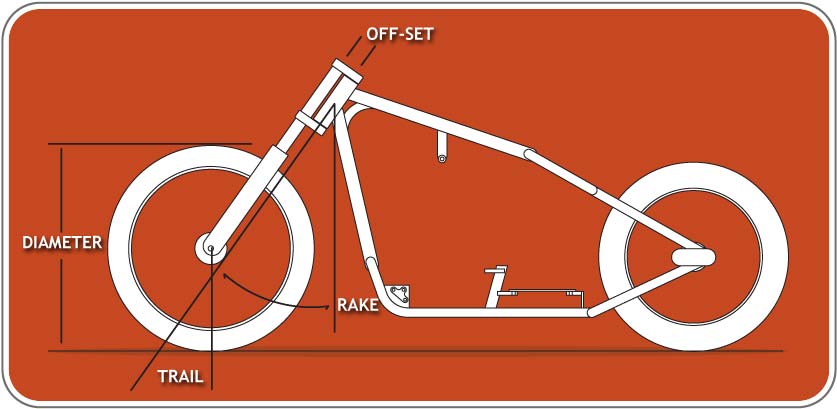
Rake and Trail Explained: We know you were day dreaming about sex when the triangles were floating around the blackboard and you were doodling motorcycles while the teacher was explaining geometry and tangents. Now all these years later when you finally got the money to build your dream bike, all you can do is thumb through pictures of other people’s projects, searching for that “look” blissfully unaware of what all that trigonometry was for. We’re going to show you how to do the calculations. It might explain why shopping carts weren’t meant to go 200 mph.
Your front suspension geometry is defined by the following six variables which are:
OFFSET: Centerline of the top steering neck to the centerline of the top of the fork tubes.
RAKE: The angle in degrees of the steering neck from vertical.
FORK LENGTH: The distance between the top of the fork tubes to the centerline of the axle.
DIAMETER: The diameter of the front tire.
TRAIL: The distance defined by the vertical line from axle to ground and the intersection of centerline of the steering neck and ground.
RAKED TRIPLE TREES: In order to bring trail figures back into line, triple trees with raked steering stems can be used. Usually adjustable in 3, 5, 7 degrees of rake.
HOW TO MEASURE CORRECT TRAIL
Raise the bike to an upright position, using a tape measure, hold the tape straight down from the front axle to the floor. Put a mark on the floor at that point. Then place the tape parallel to the steering neck, following the angle of the steering neck all the way up to the floor. Put a mark here also. Now measure the distance between the two marks and you have your trail measurement. It should read between 2 and 4 inches. Note: If your bike is equipped with a rear suspension, have someone sit on the seat when you make the measurements to simulate your actual riding condition.
TOO LITTLE OR NEGATIVE TRAIL
With too little or negative trail (steering axle mark behind the front axle mark), the bike will handle with unbelievable ease at low speeds, but will be completely out of balance at high speed. It will easily develop a fatal high-speed wobble. EXTREMELY DANGEROUS!
NORMAL TRAIL
Normal trail is somewhere between 3 and 6 inches. The bike will handle easily at both high and low speeds. Flowing smoothly through curves without swaying or wobbling. If you use a very fat rear tire, you should keep the trail as close to 4 inches as possible.
TOO MUCH TRAIL
If the trail is more than 6 inches the bike will handle sluggishly at high speeds. It will seem almost too steady. You will have trouble balancing the bike at lower speeds or on winding roads. It will feel generally sluggish and clumsy.

 
learning to ride first on a small bike is very important to developinhg skills
you can learn to flick a small bike around, skid the tires and whatnot
then when you get on a big heavy bike it is a real eye opener ;)
getting on a dirtbike is actually the very best way to learn riding a motorcycle
having the tires on a slippy surface from day one really sets you up with good reactions
of course riding defensively in traffic i s a seperate crucial skill set
 
If you are over 25 and have a Motorcycle endorsed license, AND you have access to Ducati Demo rides, or BMW, take a Ducati Monster 600cc range bike out for a spin. After that, you will have a frame of reference on good handling. I've ridden the GT1000, Monster 800, Multistrada 1200s...BMW F800GT, and RS1200 Bagger.

Except for the RS1200, the other three bikes handle impeccably. They are cool, calm, collected. Will take turns faster than most people can stand, and feel solid and stable bot slow and at speed.

My NH750 handles well for it's era, but after riding those other bikes, well, it's like the difference between a Lincoln Town Car and a Miata.

The problem, as someone mentioned before, is if you have never ridden a good handling bike, or even your own in stock, well maintained condition, you don;t realize how detrimental most suspension mods are to handling.

If you read about bikes, the manufactures work pretty hard to tailor the suspension and chassis. The frame is a part of the suspension. Putting very strong fron forks, like a GSXR fork, on a CB350 or 360, puts extra stress on the front steering neck and chassis rails. Add to it that many "builders" cut off frame parts (rear hoops, and such, flanges on pressed steel backbone), the frame take more stress than it was originally designed for. If you could watch the steering neck while you ride, you can see it moves and bends when hitting bums, and curves, etc. The reason there aren't more issues with these mods (IMHO) is that most of the cafe racers built are so uncomfortable to ride, that they never really are ridden much.

Look at Bradj's bikes. He isn't just cutting off things and bolting on reaersets. He is adding bracing and tubing to handle stresses. So Bradj, if he ever finishes any of his projects, is doing something much different and better than the majority of "builders".

A CB750 is designed to handle the forces and inputs on the chassis as designed. i won;t say that lowering it is going to make it break, but it adds stresses in a new way, one that the chassis isn't made to take. Generally what happens, is not catastrophic failure, but a chassis that flexes more, and causes wobbly handling, tank slapping oscillations and certain speeds, and such.

Most people are not designing cafe racers, but assembling them....The bikes end up poor handling, uncomfortable, and most times, for sale....

Not many people (but there are a few here) know how to actually improve the handling and reliability of the motorcycle. Take it slowly. You can enjoy riding on a comfortable, reasonably handling bike. Good shocks, progressive springs, fresh, properly weighted fork oil, good swing arm bushings, wheel alignment, and proper spoke tightening and wheel runout, and your bike may not look as delicious as some of the racers here, but it will be faster in the turns, run reliably, and you won't have a crick in your neck for leaning over the tank all day.

You can paint and personalilze the bike, make it your own, without destroying the functionality that makes riding fun.

All this is my opinion, I have no statistics or proof of the above....However, I have been riding since 1972, and I have a slight experience as a diesel mechanic and as a mechanical engineer. XB33a, Teazer, o1marc, Alphadogchopper, bradj, CrazyPJ, and quite a few more, are well experienced, and if you notice, share pretty much the same view.

there's a good saying: You can learn from others mistakes, or learn from your own.......

The bunch of us, as a whole, have made quite a few, and like to help you guys not make your own. We may not always agree, but we wouldn't be speaking out if we didn't know and experience many of the errors we try to help others avoid.

 
There is a very good thread on here about trail, I think it is by sonrier.

It is possible to lower the front and still maintain the same amount of trail although this might take pretty extensive modifications, you may even have to adjust the rake on the bike to be larger depending on what changes you do to the offset on the triple trees. it also depends on where your rear riding height is as well, if you don't have the preload all the way up that will effect your trail

The foot pegs and other clearance issues can be adjusted and are relatively easy in comparison to front end mods, I have seen some really great rear sets on this site especially the 9 to 16 position ones.

Having a functional, road worthy bike is the first step before you modify things, but when it comes to handling the geometry is the key, it isn't all smoke and mirrors.

A good thread also to use on here is the jap bike bible
 
canyoncarver said:
Excellent post and graphic Hoosier.

Best one I could pirate off the internet. ;)
I was a suspension and alignment specialist for two decades back in my Automotive Tech days, THAT's why I have a standing rule to not deviate more than an inch, usually 3/4" on ride height on any of in my builds. Believe it or not, those Factory Engineers knew what they were doing.
 
PLAZACYCLEJOSH said:
... but when it comes to handling the geometry is the key, it isn't all smoke and mirrors.

Geometry of what? The bike is a system. the frame has a spring rate and flexes in certain ways. Loose engine mount bolts can make a bike handle poorly. If you build a bike and decide to remove some inconvenient engine mounts, the frame can twist more than it did before. Many bikes use the motor as a stressed member.

the geometry of the suspension not only includes rake and trail, but tire dimensions, wheel dimensions. Swing arms flex, fork tubes flex.

The frame, is actually a large spring.

You notice that faster bikes tend to use more rigid, cast aluminum frames, that translaters into a higher spring rate fo the frame. The smaller bikes use formed steel backbones, rather than tubes, Ducati uses tubes and the motor....

Manufacturers spend quite a bit of engineering time making sure the frame is strong enough for the suspension, and that the spring rates and geometry of the suspension match the geometry of the frame. Not that there isn't room for improvement, but rules of thumb, cutting tubes off frames, change a lot of characteristics. Some may help, most don't.

Just clearing up that geometry is more than rake and trail. More than the fork and rear shock springs.

Most of the modifications I see done are for cosmetic reasons, not for improved handling. Most lower the bike for an aggressive stance, rather than for better handling. I've seen bikes here with less than an inch suspension travel, with 50 weight oil in the forks so they don't bottom out.

most here are not engineers, but hobbyist, trying to personalize their bike. Nothing wrong with that, but if you are making the bike unsafe, or ruining the handling (unsafe), maybe someone should warn you.

See any problems, for instance, with this rear set install (By a Shop that does these for other people)???
 

Attachments

  • Rear Sets gone wrong.jpg
    Rear Sets gone wrong.jpg
    182.8 KB · Views: 424
I don't think I disagree with any of that really. It really is a matter of there is a bountiful amount of knowledge on this site. There are some who will tell you all of the reasons you shouldn't do something and there are some that will tell you this is what it will take, and this is what you will have to deal with in order to make it happen, it might take some welding, some gusseting, some math, some adjusting, then sitting on the bike, measuring and doing it all over again because of the change in stance when you are on the bike. there are a lot of really good resources here
 
Back
Top Bottom