Texas Two Step Taco

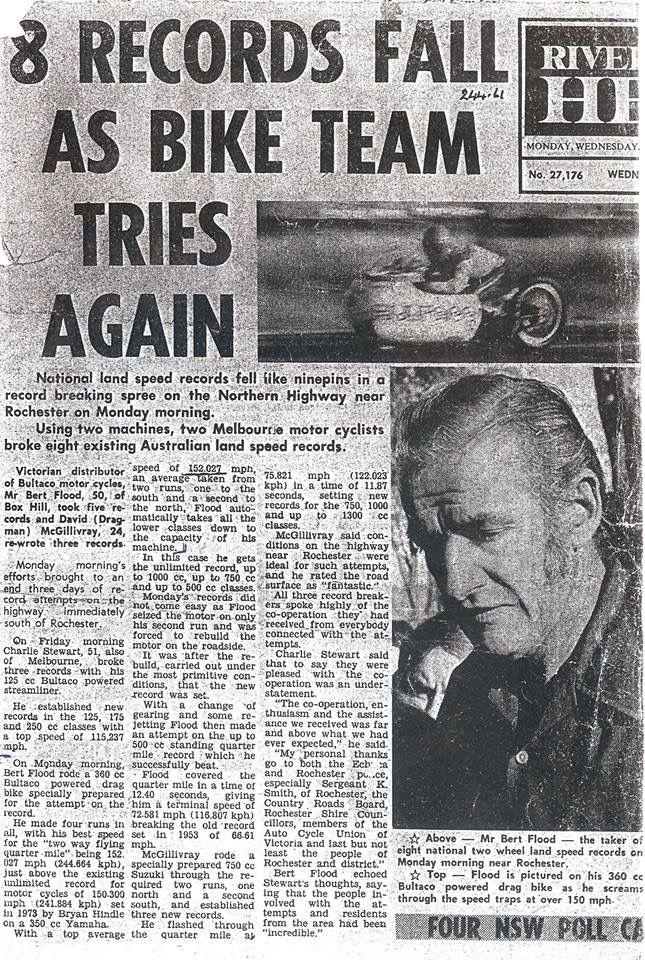
Thought you might find this interesting, I've got some pics of the bike here somewhere, I'll post them if I can find them
0a970035c79f30c852db2fbab8b2e607.jpg
 
I got this off the internet it is Frits Overmars FOS exhaust concept. Ralf Schipmann made a spread sheet for this the Bultaco. Look at the belly on this beast! Was curious about the Venturi at the end of the baffle cone.


Sent from my iPhone using Tapatalk

That sounds right, but bear in mind that there are only two dimensions that are absolutely critical - the tuned length (especially) and the exit diameter. Everything else can be fudged to some degree for practical purposes without a huge power penalty. A good 125 will want a 125mm belly section, and this can usually be accommodated without too much trouble. But with bigger cylinder sizes it often is necessary to adjust the belly size downwards from the ideal just to fit it on the bike. On my own bike I used a 155mm center section and as you can see in the photo it uses up most of the available ground clearance. With the air cooled engine - very similar to yours - I used a 127mm belly section which was about as much as would fit comfortably.

I tested various stinger diameters on the air cooled engine and used a setscrew with the water cooled one to provide adjustable throttling. Interestingly the engines behaved completely differently. The air cooled engine responded badly to stinger size reductions below the ideal, with significant torque reductions. This is in contrast with Jennings notes, where he described outputs rising with smaller stingers right up to the point where the increased piston temps became problematic. The other thing I found with the air cooled engine is that once it started making decent power the EGTs were fairly high at 550 to 650C. The water cooled engine on the other hand is relatively indifferent to stinger size, so although the power drops off slightly either side of ideal it's nowhere near as fussy. I can only assume the more modern port layout is more stable.
 
Found a Facebook post that said he ran Bandido engines. Did he run methanol to cool it?


Sent from my iPhone using Tapatalk

Not sure whether it was Bandido or Pursang engine. Not sure about the fuel either, though there were rumours that some risky and not necessarily legal additives eg. hydrazine were used. We'll probably never know.

Edit: I think it was probably a Bandido, there's a pic online of the bike without the fairing, pretty fuzzy but looks like Bandit to me.
 
Last edited:
That sounds right, but bear in mind that there are only two dimensions that are absolutely critical - the tuned length (especially) and the exit diameter. Everything else can be fudged to some degree for practical purposes without a huge power penalty. A good 125 will want a 125mm belly section, and this can usually be accommodated without too much trouble. But with bigger cylinder sizes it often is necessary to adjust the belly size downwards from the ideal just to fit it on the bike. On my own bike I used a 155mm center section and as you can see in the photo it uses up most of the available ground clearance. With the air cooled engine - very similar to yours - I used a 127mm belly section which was about as much as would fit comfortably.

I tested various stinger diameters on the air cooled engine and used a setscrew with the water cooled one to provide adjustable throttling. Interestingly the engines behaved completely differently. The air cooled engine responded badly to stinger size reductions below the ideal, with significant torque reductions. This is in contrast with Jennings notes, where he described outputs rising with smaller stingers right up to the point where the increased piston temps became problematic. The other thing I found with the air cooled engine is that once it started making decent power the EGTs were fairly high at 550 to 650C. The water cooled engine on the other hand is relatively indifferent to stinger size, so although the power drops off slightly either side of ideal it's nowhere near as fussy. I can only assume the more modern port layout is more stable.

This helps me a lot! Two things. While building the chamber I was saying to myself there are too many variables. You have to build the chamber short and tune it to length on the dyno. Got it! Not putting a stinger on the end but a sleeve to tune the correct stinger/venturi on the dyno. My belly is 132mm.


Sent from my iPhone using Tapatalk
 
I hadn't seen that video before.

Clever stuff for the time. Karts use a replaceable header to tune the pipe for different tracks.

BTW, Rod Tingate is a master metal worker and repaired the tank of one of our TZ's after my son threw it on the ground at high speed at Broadford a few years back. I think I still have a pair of his clipons here somewhere.

Just chewing the cud. “Karts use to have a replaceable header.” If you watch the Tingate video you can see the cable attached to the header and he talks about it being attached to the throttle.

I googled kart and adjustable expansion chamber and found this... https://www.vintagekartforum.com/showthread.php?tid=1913

BB says that he has made 1/2” adjustments to the header and it has and will totally change the pipe. Tingate confirmed that. Short header more top end and longer better bottom end...kinda sounds like the cb175 carb intake length results?


I am thinking of this as a diagnostic tuning tool only to get to the correct tuned length. Then we could make many chambers to test. I want to do the 8” belly one for grins. Bill wanted me to just build a straight chamber first since it is easier to make but the front wheel is in the way. I should have listened and just mounted and front axel to the dyno.

I am just thinking out loud. It seems like a lot of wasted time and effort not to be able to modularly tune a chamber.


Sent from my iPhone using Tapatalk
 
I would try to keep things simple. Forget tunable length headers and venturi stingers and so on. Focus on getting a basic pipe together and test it. Then adjust that pipe bwased on what the dynno tells you. For example if peak revs are too low, cut some out of the belly section, weld it up and try again and if it doesn't change, that's not the issue.

If peak power is still low, work out time-area for each port and see which is insufficient. Rinse and repeat.
And stay off the internet. Too many different ideas to chase through and try to reverse engineer and many videos are incorrect or don't apply to the state of tune of your motor.

Length is just one parameter. What if the tuned length is correct but teh divergent cones are the wrong angles or the stinger is way too large or too small. MOTA vX has an exhaust optimization process that is very interesting. If you have a fast enough 4 core Intel PC, you will love it. With MOTA you can simulate dozens of pipes in one evening where it would take months the old way. But you do have to test some in the real world to calibrate your data.

K.I.S.S. as they say.

Ok off to the shop to weld.


Sent from my iPhone using Tapatalk
 
I would try to keep things simple. Forget tunable length headers and venturi stingers and so on. Focus on getting a basic pipe together and test it. Then adjust that pipe bwased on what the dynno tells you. For example if peak revs are too low, cut some out of the belly section, weld it up and try again and if it doesn't change, that's not the issue.

If peak power is still low, work out time-area for each port and see which is insufficient. Rinse and repeat.
And stay off the internet. Too many different ideas to chase through and try to reverse engineer and many videos are incorrect or don't apply to the state of tune of your motor.

Length is just one parameter. What if the tuned length is correct but teh divergent cones are the wrong angles or the stinger is way too large or too small. MOTA vX has an exhaust optimization process that is very interesting. If you have a fast enough 4 core Intel PC, you will love it. With MOTA you can simulate dozens of pipes in one evening where it would take months the old way. But you do have to test some in the real world to calibrate your data.

K.I.S.S. as they say.

This. Exactly. Read and memorize. The only thing I'd add is I'd take stock of what you have now re porting and so on before you go any further so you can rectify any deficiencies before making the pipe.

"And stay off the internet" Best advice ever.
 
Porting was done by Doug Flannery so I will have to defer to his expertise.


Sent from my iPhone using Tapatalk
 
This. Exactly. Read and memorize. The only thing I'd add is I'd take stock of what you have now re porting and so on before you go any further so you can rectify any deficiencies before making the pipe.

"And stay off the internet" Best advice ever.

Well I did find your string on the internet and don’t regret it for a second ;)


Sent from my iPhone using Tapatalk
 
Doug knows what he's doing, so let's assume for now that the ports are just where they need to be. Just make the pipe to work with his ports and it should start to come together.
 
Our welding coach for team treachery is James Ritchie son of beloved H2 tuner Chris Ritchie RIP we are using 3/32 tungsten ground to a very sharp point with a large gas lens. We are are welding 20 gauge cold rolled with 35 amps on pulse with .045” filler rod. We are using rare earth tungsten. We will be back purging the chamber. We will be welding red with a Lincoln Electric Precision TIG. Here is a video of James Welding titanium expansion chambers for BB’s H2
IMG_6439.jpg


Sent from my iPhone using Tapatalk
 
John... “the length” and the “stinger size” collar to test multiple stinger sizes.
IMG_6496.jpg


Sent from my iPhone using Tapatalk
 
Nice. Stinger length isn't very important, diameter is. Looks like you'll be able to alter the belly length easily, good work. Wondering which head you'll use for dyno testing - if it's the new one do you have some sort of plan in place to keep it cool? It'll take more than a big fan..

At the risk of stating the obvious you need a plan for your testing. The first thing I'd do is find a main jet that is unmistakably rich - ie. stuttering at full noise. This will give you a reference point for jetting and also confirm the fuel supply is adequate. Keep detailed notes and record your peak torque and hp figures along with the rpms for each run. Don't worry about what it does at anything other than WOT at this stage, the main objective will the pipe. Use a jet that isn't too far below a rich stutter, even if it means you lose a hp or two over the best hp jet - you want to be about in the middle of the two settings. Do the same with timing - adjust it a couple of degrees at a time both ways to find the best torque and hp reading. You'll probably find it'll run well over a range of a few degrees, but the torque curve will be moved up or down a little as the timing changes. Just like jetting, you want to be just a little on the safe or retarded side of the absolute maximum power.

Next is checking the pipe length. How does the peak power rpms compare with your target rpms? For maximum power the target rpms should be the maximum that the porting (and carb) will support, don't get too over optimistic here or you'll lose performance, so be realistic. If the rpms are lower than the target you'll need to shorten the pipe and vice versa. The tuned length is roughly the distance from the port window to halfway along the baffle cone, so adjust this distance in proportion to the desired change in peak rpms. In other words to increase the rpms by 10% you'd shorten the tuned length by 10%. Once you get this done you can focus on the stinger size. And finally, once you get the pipe doing what you want you should go back and fine tune the jetting and timing.

Good luck, it looks like you're on the right track.
 
A couple of files that may help: one is a gearing/rpm/speed spreadsheet. It's for a 5 speed so if your bike is 4 speed just put the same figures into both the 4th and 5th gear cells. The other is a basic carb tuning guide I did for another forum - I doubt there is anything in it you don't already know but I'll throw it in anyway.

Edit- the forum software doesn't like the spreadsheet filetype, so download and change the filename extension from .pdf to .xls The other text file should be fine as is.
 

Attachments

Back
Top Bottom
