
John Murray
Been Around the Block
Thought you might find this interesting, I've got some pics of the bike here somewhere, I'll post them if I can find them
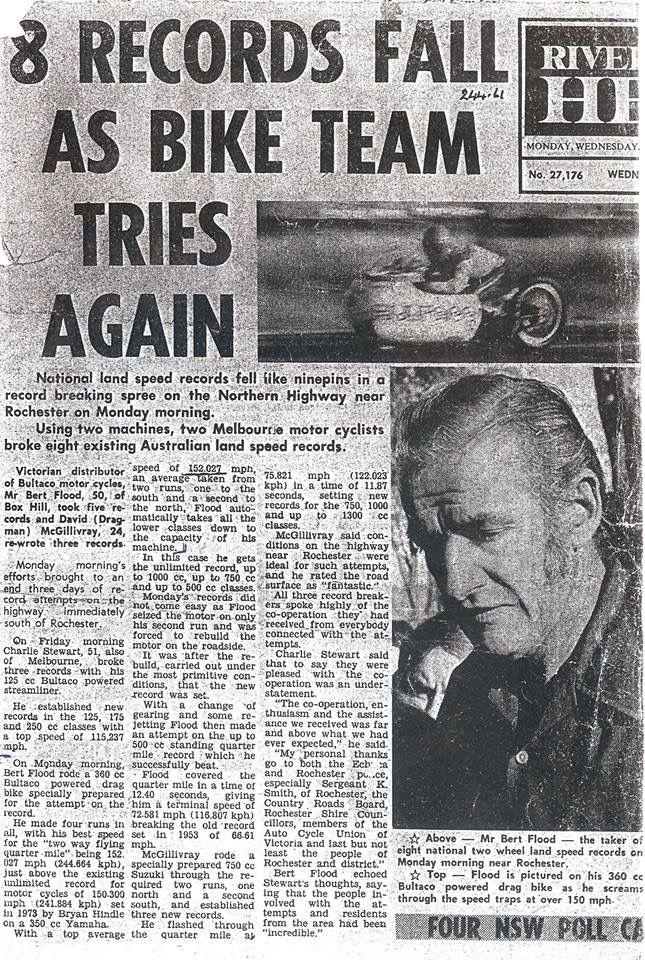


Thought you might find this interesting, I've got some pics of the bike here somewhere, I'll post them if I can find them
View attachment 224528
I got this off the internet it is Frits Overmars FOS exhaust concept. Ralf Schipmann made a spread sheet for this the Bultaco. Look at the belly on this beast! Was curious about the Venturi at the end of the baffle cone.
Sent from my iPhone using Tapatalk
Found a Facebook post that said he ran Bandido engines. Did he run methanol to cool it?
Sent from my iPhone using Tapatalk
That sounds right, but bear in mind that there are only two dimensions that are absolutely critical - the tuned length (especially) and the exit diameter. Everything else can be fudged to some degree for practical purposes without a huge power penalty. A good 125 will want a 125mm belly section, and this can usually be accommodated without too much trouble. But with bigger cylinder sizes it often is necessary to adjust the belly size downwards from the ideal just to fit it on the bike. On my own bike I used a 155mm center section and as you can see in the photo it uses up most of the available ground clearance. With the air cooled engine - very similar to yours - I used a 127mm belly section which was about as much as would fit comfortably.
I tested various stinger diameters on the air cooled engine and used a setscrew with the water cooled one to provide adjustable throttling. Interestingly the engines behaved completely differently. The air cooled engine responded badly to stinger size reductions below the ideal, with significant torque reductions. This is in contrast with Jennings notes, where he described outputs rising with smaller stingers right up to the point where the increased piston temps became problematic. The other thing I found with the air cooled engine is that once it started making decent power the EGTs were fairly high at 550 to 650C. The water cooled engine on the other hand is relatively indifferent to stinger size, so although the power drops off slightly either side of ideal it's nowhere near as fussy. I can only assume the more modern port layout is more stable.
I hadn't seen that video before.
Clever stuff for the time. Karts use a replaceable header to tune the pipe for different tracks.
BTW, Rod Tingate is a master metal worker and repaired the tank of one of our TZ's after my son threw it on the ground at high speed at Broadford a few years back. I think I still have a pair of his clipons here somewhere.

I would try to keep things simple. Forget tunable length headers and venturi stingers and so on. Focus on getting a basic pipe together and test it. Then adjust that pipe bwased on what the dynno tells you. For example if peak revs are too low, cut some out of the belly section, weld it up and try again and if it doesn't change, that's not the issue.
If peak power is still low, work out time-area for each port and see which is insufficient. Rinse and repeat.
And stay off the internet. Too many different ideas to chase through and try to reverse engineer and many videos are incorrect or don't apply to the state of tune of your motor.
Length is just one parameter. What if the tuned length is correct but teh divergent cones are the wrong angles or the stinger is way too large or too small. MOTA vX has an exhaust optimization process that is very interesting. If you have a fast enough 4 core Intel PC, you will love it. With MOTA you can simulate dozens of pipes in one evening where it would take months the old way. But you do have to test some in the real world to calibrate your data.
K.I.S.S. as they say.
This. Exactly. Read and memorize. The only thing I'd add is I'd take stock of what you have now re porting and so on before you go any further so you can rectify any deficiencies before making the pipe.
"And stay off the internet" Best advice ever.
