
Cb550 valve-TDC question

work9to5

See you in the wind.
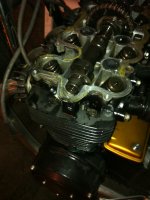
I just want to double check myself on this one. Re doing the top end on a 550. If the cam is in this position (pic below) with both lobes facing up this is the cylinder that is at TDC, correct? Assuming that timing is right and crank is turned to T1-4, which it is.

I'm double checking myself because I'm about to do a valve adjust after an engine overhaul and this is something I've screwed up/questioned myself after the fact if in fact I did it right. If lobes are both facing up and timing is correct this is the cylinder that is at TDC the one I valve adjust first, then do a 360 rotation and adjust the other side T1-4 correct?
 

Attachments

  • photo (2).JPG
    photo (2).JPG
    164.1 KB · Views: 286
the picture is terrible almost too hard to see ,what did you take it with a potato?
but the cam lobes would be pointing up or down at tdc you still need to make sure you are excactly on the marks
 
xb33bsa said:
the picture is terrible almost too hard to see ,what did you take it with a potato?
but the cam lobes would be pointing up or down at tdc you still need to make sure you are excactly on the marks
Always appreciate your humor xb, and yes my potato phone is a bit vintage like my bikes ;) I am exactly on the marks with reference to the cam notch being where it's supposed to be and the indicator being set at T1-4. As far as the lobes... what I'm trying to get clarification on is, If engine is set at T1-4 and both lobes are facing up (on cylinder 4) do you adjust the valves on the cylinder 1 in that position or cylinder 4? I'm guessing cylinder do cylinder 1 first then rotate 360 and do the other side. Correct?
 
your rockers make contact up top so the lobes must be facing down for there to be lash to adjust ;)
both positions lobes up or down are at tdc, what you are looking for is tdc on the compression stroke
both rockers loose and adjustable only in this position

it helps a ton if you keep in mind the cam is rotating timed to the crank at 1/2 speed
so 360 at the crank = 180 at the cam
 
It may also be helpful to understand that it is largely immaterial exactly where the cam is, or the crank, in so far as needing some particular position of either. The position laid out in manuals is in general so that you can test/adjust as many valves as possible with a single position of the crank/cam(s) which expedites the servicing. All that is really needed for nearly any engine is to simply make sure the follower (rocker, lifter, shim, etc) is on the heel of the cam, that is, on the circular portion which does not contain any of the lobe. As long as this condition is present, it doesn't matter about anything else. The idea is to set the clearance wide enough so that regardless of engine temperature, there is always at least some clearance between the cam's base circle and the mechanism that actuates the valve. This ensures that valve will be completely closed when not being opened by the lobe. Since a lot of the cam's profile (for non roller profiles) is the constant (lack of) lift base circle, there is rather a lot of rotation in which clearance can be properly set, which accounts for the fact that, in the right position, you can adjust numerous valves despite the individual cam profiles are in different positions for the various valves; All the adjustable valves have their followers on the base circle, so they all can be adjusted with the cam in that particular position. The upshot is that you don't have to know, or figure out, where the crank/cam(s) have to be rotated/aligned to in order to adjust numerous valves at a time. You only need the correct clearance for the valve you're working on (intake or exhaust - they are usually different) and then to make sure that that particular valves follower is riding on the base circle of the cam. It is slightly more tedious doing only one at a time, but eliminates any doubt about getting the correct lash if you are unsure of a speedier procedure.
 
Back
Top Bottom