
You are using an out of date browser. It may not display this or other websites correctly.
You should upgrade or use an alternative browser.
You should upgrade or use an alternative browser.
CL CB 160/175/200 cam specs
- Thread starter acm177
- Start date


Cylinder heads are different on 160 - sloper 175 - vertical 175 and 200 all different. 160 and sloper 175 have low ports. vertical motors have higher ports and flow better. Combustion chamber shapes are different on them all and piston crowns are also different.
160 cam has less lift than 175/200. CB160 is 3.7/3.4mm and 175/200 are 3.9/3.7 more or less. CB200 cam has bolt on sprocket with 34 teeth and CB 160 and 175 have pressed on sprocket with 32T. I'd need to check that again, but the 200 has 2 more teeth than a 160/175 so that isn't a straight swap. The 200 also is oiled differently and tends to fail.
Most 175/200 cams have a slot in the end to drive the tacho gearbox. CB160 do not.
160 and all 175 cranks are similar and share the same rods but crank weights are very different. CB200 has longer rods, taller block, 1mm larger wrist pin and taller pistons.
200 also has a bigger oil pump piston.
160 cam has less lift than 175/200. CB160 is 3.7/3.4mm and 175/200 are 3.9/3.7 more or less. CB200 cam has bolt on sprocket with 34 teeth and CB 160 and 175 have pressed on sprocket with 32T. I'd need to check that again, but the 200 has 2 more teeth than a 160/175 so that isn't a straight swap. The 200 also is oiled differently and tends to fail.
Most 175/200 cams have a slot in the end to drive the tacho gearbox. CB160 do not.
160 and all 175 cranks are similar and share the same rods but crank weights are very different. CB200 has longer rods, taller block, 1mm larger wrist pin and taller pistons.
200 also has a bigger oil pump piston.

Texasstar
Can't is a four letter dirty word
Teazer what is the solution for the 200 cam failure? Is this a good solution? http://www.dotheton.com/forum/index.php?topic=43921.0teazer said:Cylinder heads are different on 160 - sloper 175 - vertical 175 and 200 all different. 160 and sloper 175 have low ports. vertical motors have higher ports and flow better. Combustion chamber shapes are different on them all and piston crowns are also different.
160 cam has less lift than 175/200. CB160 is 3.7/3.4mm and 175/200 are 3.9/3.7 more or less. CB200 cam has bolt on sprocket with 34 teeth and CB 160 and 175 have pressed on sprocket with 32T. I'd need to check that again, but the 200 has 2 more teeth than a 160/175 so that isn't a straight swap. The 200 also is oiled differently and tends to fail.
Most 175/200 cams have a slot in the end to drive the tacho gearbox. CB160 do not.
160 and all 175 cranks are similar and share the same rods but crank weights are very different. CB200 has longer rods, taller block, 1mm larger wrist pin and taller pistons.
200 also has a bigger oil pump piston.
If the oil holes are all clear, there shouldn't be too much of a problem. Admittedly I have not spent a whole lot of time inside a racing CB200 motor to see if there's a weak link that they don't share with smaller siblings. I'll look when I have a moment. We did fry one CB160/cl175 top end when the screw in the oil filter came loose and lost pressure.
A common "fix" for racing CB160-200 and CB350 motors is to bore the cam towers to take needle roller bearings. I have one set like that and the rest I like to use CB160 cam towers if possible because they have bronze sleeves.
I did read of a ball bearing conversion but never sat down to work out how the owner persuaded oil to travel inside the cam to the rocker arms.
We drain oil after one day at the track to see what's going on and to watch for problems. That's not exactly a suitable approach on the street. If I were doing LSR runs, I'd probably change oil after each run just to be sure....
The key is to be sure that the cams get enough volume and pressure oil.
A common "fix" for racing CB160-200 and CB350 motors is to bore the cam towers to take needle roller bearings. I have one set like that and the rest I like to use CB160 cam towers if possible because they have bronze sleeves.
I did read of a ball bearing conversion but never sat down to work out how the owner persuaded oil to travel inside the cam to the rocker arms.
We drain oil after one day at the track to see what's going on and to watch for problems. That's not exactly a suitable approach on the street. If I were doing LSR runs, I'd probably change oil after each run just to be sure....
The key is to be sure that the cams get enough volume and pressure oil.
I ended up getting my hands on a 200 and noted that the vertical oil passage hole on the points side of thwe case doesn't exist on the 200. If you examine the 200 can holders/bearings, you can also see that the oiling hole is missing to the bearing surface. The 200 relied on pushing oil from the tach drive side bearing through the cam to the points side bearing.
The 175 had provisions to feed the points side bearing via the vertical oil passage pinholes. There are two pinholes in the top of the case instead of the 200s single pinhole.
So with that information, I just decided to get some bearings that were within spec according to the manual.
The 175 had provisions to feed the points side bearing via the vertical oil passage pinholes. There are two pinholes in the top of the case instead of the 200s single pinhole.
So with that information, I just decided to get some bearings that were within spec according to the manual.
Texasstar
Can't is a four letter dirty word
"The development of the Honda racers followed a certain pattern, going through a test phase in three stages. First the lubrication system is checked, so that any part that could suffer a premature death through a deficiency of oil can be supplied with a bit more of it."teazer said:If the oil holes are all clear, there shouldn't be too much of a problem. Admittedly I have not spent a whole lot of time inside a racing CB200 motor to see if there's a weak link that they don't share with smaller siblings. I'll look when I have a moment. We did fry one CB160/cl175 top end when the screw in the oil filter came loose and lost pressure.
A common "fix" for racing CB160-200 and CB350 motors is to bore the cam towers to take needle roller bearings. I have one set like that and the rest I like to use CB160 cam towers if possible because they have bronze sleeves.
I did read of a ball bearing conversion but never sat down to work out how the owner persuaded oil to travel inside the cam to the rocker arms.
We drain oil after one day at the track to see what's going on and to watch for problems. That's not exactly a suitable approach on the street. If I were doing LSR runs, I'd probably change oil after each run just to be sure....
The key is to be sure that the cams get enough volume and pressure oil.
-The History of Honda Four Stroke Racing
Teazer my son sent u a note in the other string and I think it got lost in the shuffle.

He wanted to know if that was you on the bike?
"The key is to be sure that the cams get enough volume and pressure oil."
Should we install an oil pressure gauge on the head?
Attachments

Texasstar
Can't is a four letter dirty word
thanks Teazer. Found a few choices for oil sensorsteazer said:Nope. That's my wife on her 250. She has a matching 181cc CB160 with a CL155 sloper motor in it. I haven't raced for a long time and I just look "large" on her bikes.
This is me

Attachments



Texasstar
Can't is a four letter dirty word
on the inside of the cam housing is a spiral channel for the oil to lubricate the cam housing. Is this channel necessary for the needle bearings?teazer said:If the oil holes are all clear, there shouldn't be too much of a problem. Admittedly I have not spent a whole lot of time inside a racing CB200 motor to see if there's a weak link that they don't share with smaller siblings. I'll look when I have a moment. We did fry one CB160/cl175 top end when the screw in the oil filter came loose and lost pressure.
A common "fix" for racing CB160-200 and CB350 motors is to bore the cam towers to take needle roller bearings. I have one set like that and the rest I like to use CB160 cam towers if possible because they have bronze sleeves.
I did read of a ball bearing conversion but never sat down to work out how the owner persuaded oil to travel inside the cam to the rocker arms.
We drain oil after one day at the track to see what's going on and to watch for problems. That's not exactly a suitable approach on the street. If I were doing LSR runs, I'd probably change oil after each run just to be sure....
The key is to be sure that the cams get enough volume and pressure oil.

Bert Jan
Holy Modification Batman
Texasstar said:on the inside of the cam housing is a spiral channel for the oil to lubricate the cam housing. Is this channel necessary for the needle bearings?
spiral channel? Whats that? I only did the bearing conversion on the points side. To mod the right cover for oilfeed AND bearing is some other shit.. I could be done and i'm sure i will in the future btw/
Texasstar
Can't is a four letter dirty word
they are in both cam housingsBert Jan said:spiral channel? Whats that? I only did the bearing conversion on the points side. To mod the right cover for oilfeed AND bearing is some other shit.. I could be done and i'm sure i will in the future btw/
Attachments
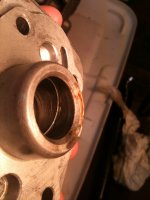

Texasstar said:on the inside of the cam housing is a spiral channel for the oil to lubricate the cam housing. Is this channel necessary for the needle bearings?
NO. It is bored out (of its mind LOL) to take the needle roller outer shell.
Texasstar
Can't is a four letter dirty word
Sorry the word i have been told is optimization or what the Japanese call Kaizen. A gradual small improvement that requires a million questions from every angle. If we make an improvement is it really an improvement or did we just create a problem? that is why i like to ask the Dr. Phil question, "well how is that workin for ya?" Two americans brought TQM to Japan. Until then the Japanese manufacturing was a joke and pretty much like the Chinese are today. Honda was OCD about Kaizen. So I figured those spiral channels were there for a reason and I don know if the 175 has them.teazer said:NO. It is bored out (of its mind LOL) to take the needle roller outer shell.
I love mods like this you can carry forward. Will work on a new head and with our megacycle cam (what i want when my kids ask what I want for Father's Day)
OK why does a 175 spin at 10500 rpm and a 200 spins at 9000 rpms? We want the 1500 rpms back
my daughter wants us to build her a cafe racer also and I am negotiating on a 72 cl175 as we speak. I am also gonna compare the cr72 77 racing mods to the cb72 77 specs since Honda has used racing to find the limits so the can pull back for a mean in their production bikes. The new 2013 cbr250r has only 5 more hp than the 175 @25hp and a top speed of 130. The difference? Dohc, fuel injection, electronic ignition, etc. I found a couple of guys who have made the replica and one who used a Suzuki dohc head.
Attachments
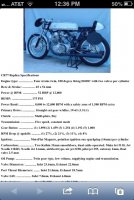
Just remember that a cam is soft and rollers are hard. I had the bearing surfaces sleeved on the last cam I had ground and modified.
CB77, nice but heavy and slow. CR77 completely different animal. I built and raced a CR93 many years ago for a client. That bike was beautiful.
That helical groove is the same as in most plain bushes of that design. It helps to bring oil in through the whole length of the bearing. Check out Triumph twin camshaft bushes and you will see the same thing.
CB77, nice but heavy and slow. CR77 completely different animal. I built and raced a CR93 many years ago for a client. That bike was beautiful.
That helical groove is the same as in most plain bushes of that design. It helps to bring oil in through the whole length of the bearing. Check out Triumph twin camshaft bushes and you will see the same thing.
Texasstar
Can't is a four letter dirty word
I finally found the 175 cam specs
KO
Intake opens 10 degrees
closes 40
Exhaust open 40
closes 10
Your cb175ko has an Overlap of 20.00 degrees and has in Intake Duration of 230.00 degrees. The Exhaust Duration is 230.00 degrees. Your Lobe Separation Angle is 105.00 degrees. The Inlet Cam has an Installed Centerline of 105.00 degrees ATDC. The exhaust cam has an Installed Centerline of 105.00 degrees BTDC.
K3/K4
Intake opens 10 degrees
closes 30
Exhaust open 40
closes 10
Your cb175k3 has an Overlap of 20.00 degrees and has in Intake Duration of 220.00 degrees. The Exhaust Duration is 230.00 degrees. Your Lobe Separation Angle is 102.50 degrees. The Inlet Cam has an Installed Centerline of 100.00 degrees ATDC. The exhaust cam has an Installed Centerline of 105.00 degrees BTDC.
CB200
Intake opens 5 degrees
closes 35
Exhaust open 40
closes 5
Your cb200 has an Overlap of 10.00 degrees and has in Intake Duration of 220.00 degrees. The Exhaust Duration is 225.00 degrees. Your Lobe Separation Angle is 106.25 degrees. The Inlet Cam has an Installed Centerline of 105.00 degrees ATDC. The exhaust cam has an Installed Centerline of 107.50 degrees BTDC.
KO
Intake opens 10 degrees
closes 40
Exhaust open 40
closes 10
Your cb175ko has an Overlap of 20.00 degrees and has in Intake Duration of 230.00 degrees. The Exhaust Duration is 230.00 degrees. Your Lobe Separation Angle is 105.00 degrees. The Inlet Cam has an Installed Centerline of 105.00 degrees ATDC. The exhaust cam has an Installed Centerline of 105.00 degrees BTDC.
K3/K4
Intake opens 10 degrees
closes 30
Exhaust open 40
closes 10
Your cb175k3 has an Overlap of 20.00 degrees and has in Intake Duration of 220.00 degrees. The Exhaust Duration is 230.00 degrees. Your Lobe Separation Angle is 102.50 degrees. The Inlet Cam has an Installed Centerline of 100.00 degrees ATDC. The exhaust cam has an Installed Centerline of 105.00 degrees BTDC.
CB200
Intake opens 5 degrees
closes 35
Exhaust open 40
closes 5
Your cb200 has an Overlap of 10.00 degrees and has in Intake Duration of 220.00 degrees. The Exhaust Duration is 225.00 degrees. Your Lobe Separation Angle is 106.25 degrees. The Inlet Cam has an Installed Centerline of 105.00 degrees ATDC. The exhaust cam has an Installed Centerline of 107.50 degrees BTDC.
Attachments


Texasstar
Can't is a four letter dirty word
I think the kids are gonna get us one for Father's Day! Since this is all new I want to know what changes honda made over time and how that impacted performance. After looking at the cam specs now i want to know the difference between the KO 175 and K3 and 4? More research. There seems to be no doubt they moved away from performance...in the 70's. When I was younger I just wanted the answer, now the resounding "why" goes off in my head. You have been a wealth of wisdom and information...we would have never received an education like this from an adult Ed course. My Boss laughs at me cause I will beat an issue to death from evry perspective...thanks!teazer said:Try a Megacycle 135-X1 and higher compression for a nice warm motor.
Try not to drive yourself mad while doing that. Sometimes the reasons and facts cannot be reverse engineered.
With a Cam Doctor you could get lift curves and cam acceleration rates without doing all the hard work in a spreadsheet, but in the final analysis, all the facts are not available. For example Honda quotes the same HP at the same revs and has changed the cam specs. Does that mean that they simply changed the lift curves or the silencing ramps or both and does the valve stay open longer or for less time.
You could analyze cam profiles and then test them back to back on a dyno and that would be interesting and entertaining but in the end would make no difference to your performance of your bike.
Must be that Dutch-Calvanistic individualism at work there somewhere. : :-\
Knowledge is always good and the pursuit of knowledge is a journey of its own that needs no justification. It sometime benefits from lubrication though
With a Cam Doctor you could get lift curves and cam acceleration rates without doing all the hard work in a spreadsheet, but in the final analysis, all the facts are not available. For example Honda quotes the same HP at the same revs and has changed the cam specs. Does that mean that they simply changed the lift curves or the silencing ramps or both and does the valve stay open longer or for less time.
You could analyze cam profiles and then test them back to back on a dyno and that would be interesting and entertaining but in the end would make no difference to your performance of your bike.
Must be that Dutch-Calvanistic individualism at work there somewhere. :
:-\ Knowledge is always good and the pursuit of knowledge is a journey of its own that needs no justification. It sometime benefits from lubrication though