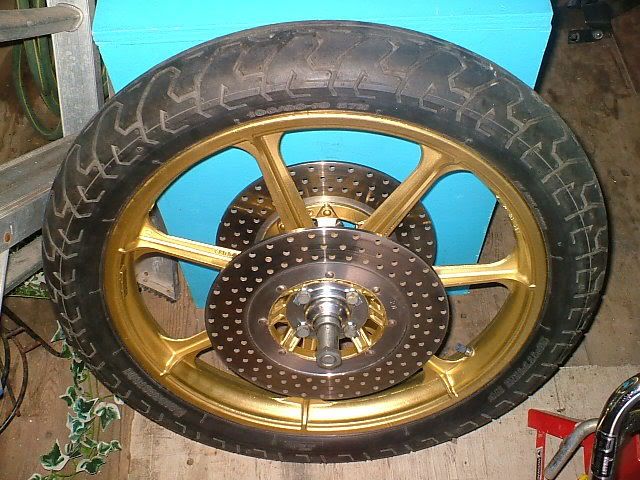
Get Your Rotors Drilled

904cafe

Been Around the Block
Hey guys, just a heads up. If your looking to get your factory rotors drilled and you don't trust yourself, there is a guy on ebay who will do it. You just ship him your rotor(s) and he does it and them ships them back... not sure about all the details but I figured I would show the link to you guys and you can determine for yourselves!

http://cgi.ebay.com/ebaymotors/HONDA-CB200-CB350-CB400-CB450-BRAKE-DISC-ROTOR-MACHINE_W0QQcmdZViewItemQQcategoryZ111105QQihZ020QQitemZ300273850894QQrdZ1QQsspagenameZWDVW
 
It may be just me, but drilling holes willy-nilly into a brake rotor is a bad idea. Drilling holes changes the stress concentration in a material and can actually cause the metal to shear.

There is really only 1 thing you should never skimp on, and that's your safety.
 
I agree and that's why I asked for insight. I personally have no intention on using this, just informing. As cool as it looks, I would hate for my disc to crack or even shatter one day under hard braking.
 
Drilled rotors are considerably lighter, reducing unsprung weight, allowing the forks to do a better job of keeping the tire on the road. Drilling also helps cool discs, and pads by pulling pockets of air across the pads. (Overheated pads transfer heat to the caliper piston, heating up the fluid which causes it to expand and may seize the brake.) Drilled discs also dissipate water better if you get caught in the rain. Drilled rotors on on all the vintage road racers with good reason.
I've had drilled rotors on several bikes, and I can account for over 120,000 miles on drilled discs since 1978, and never even heard of cracked or shattered discs. I have seen lots of rotors that were scored because people don't always prep the rotor when they put on new pads, or let the pads wear too thin, and heat up the rotor. The only disc I've had trouble with is the solid one on my CB500T. I rebuilt the caliper, replaced the pads, adjusted to spec, replaced the master cylinder, and it just won't seat properly, and takes a hulk like grip to get any action out of it. So it's being replaced with a TLS 8).
I've never had rotors serviced by anyone, and don't have any experience with the vendor on eBay, but I have replaced old rotors that were at their min.
My Kawasaki Concours tips the scales at 595lbs bone dry, add seven+/-gal of fuel, 4qt oil, me, and camping gear, and your looking at over 800lbs. Still, it's no sled. The Concours is well known for eating up miles of twisty roads with ease, and I thoroughly enjoy hearing the tire scrub while I'm zigzag my way through the Smokies. So those brakes get a good workout, and never failed me.

I know, you really didn't ask for all this, but dammit I felt so stupid after that "Bake Swap" posting. :P
 
Brown Bomber said:
Drilled rotors are considerably lighter, reducing unsprung weight, allowing the forks to do a better job of keeping the tire on the road. Drilling also helps cool discs, and pads by pulling pockets of air across the pads. (Overheated pads transfer heat to the caliper piston, heating up the fluid which causes it to expand and may seize the brake.) Drilled discs also dissipate water better if you get caught in the rain. Drilled rotors on on all the vintage road racers with good reason.
I've had drilled rotors on several bikes, and I can account for over 120,000 miles on drilled discs since 1978, and never even heard of cracked or shattered discs. I have seen lots of rotors that were scored because people don't always prep the rotor when they put on new pads, or let the pads wear too thin, and heat up the rotor. The only disc I've had trouble with is the solid one on my CB500T. I rebuilt the caliper, replaced the pads, adjusted to spec, replaced the master cylinder, and it just won't seat properly, and takes a hulk like grip to get any action out of it. So it's being replaced with a TLS 8).
I've never had rotors serviced by anyone, and don't have any experience with the vendor on eBay, but I have replaced old rotors that were at their min.
My Kawasaki Concours tips the scales at 595lbs bone dry, add seven+/-gal of fuel, 4qt oil, me, and camping gear, and your looking at over 800lbs. Still, it's no sled. The Concours is well known for eating up miles of twisty roads with ease, and I thoroughly enjoy hearing the tire scrub while I'm zigzag my way through the Smokies. So those brakes get a good workout, and never failed me.

I know, you really didn't ask for all this, but dammit I felt so stupid after that "Bake Swap" posting. :P

To clarify, i do not mean disc's that were designed to be drilled, and came pre-driled or slotted. Those are perfectly fine, the material chosen, and the hole pattern is designed to accommodate the additional stress. Drilling disc's on the other hand that were not meant for it is outright dangerous. You have no idea of the micro fractures in the metal as is, and like i said before drilling a hole into a surface will increase the stress in that region, which under hard braking could cause the disc to fracture.

At the end of the day, do what you want, but know the risks you're taking. Your personal experience may be one thing...but physics are physics.
 
I had the rotors on my 650 drilled in the '80s.
My bike did not want to stop in the rain and I had to do something.
I've had no problems with them over the years and close to 50000 kms.

WinterModsFrontWheelOnly.jpg
 
IDK what to think. I guess it all comes down to who does it and how!? It's just one of those topics where everyone has his own opinion. I would like to do it, mainly for the look, since my little CB200 doesn't need ample stopping power anyways. Still in question I guess. Yours shure do look sweet though 78kz!
 
Might be better to have them turned after you drill, so you have a perfect finish after you punch holes in it, not before.
 
Back
Top Bottom