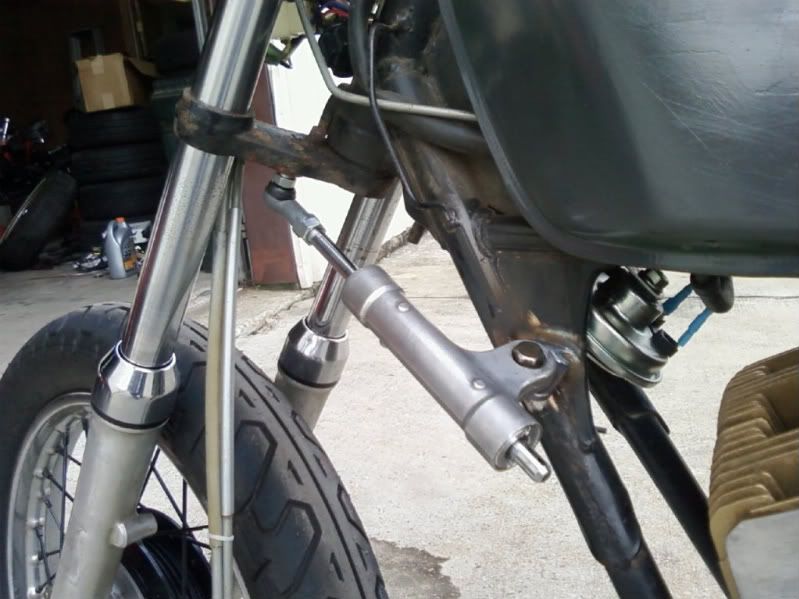
It does not matter at all, but it depends on the specific damper. Some upper triple tree dampers (dampeners I suppose is actually correct) are simply too short throw (and small) to be practical for "side" mounting, but there are some basics to pay attention to.
First, the distance from the steering pivot should enable the piston to make nearly it's complete travel when moving the steering lock to lock. Never allow the damper to be a steering stop. When the steering is centered, the angle between a line drawn through the steering pivot and the end of the damper, and a line drawn through the two ends of the damper must be 90 degrees when viewed looking through the steering stem bearings. This is the point where the damper will have the most leverage over the steering, and the effort will be close to the same going in either direction. The damper really is only important when the steering is straight ahead, so this 90 degrees is important. I see a lot of top mounted units with bad geometry, and I suspect that most of these factory installations are more for sales than an actual need to forestall the dreaded speed wobble most of us need the added damper for on older more bendy chassis. Most have very strong damping, and very short throw, which they have to have for the geometry if they are to do anything. They are very easy to adjust on the fly, though I've never had issue with reaching down to a side mount personally.
lastly, though most have spherical joints that allow for misalignment, when viewed from the side, the angle between the damper and the rake should be 90 degrees. Hope this helps.