Mod- Simple Hidden Keyless Ignition

Redliner

Over 1,000 Posts
I've seen many attempts to hide ignitions and they go one of two ways.

1. Doy, I'm going to put the switch under the seat.
I'm not sure what anybody is trying to accomplish with this approach other than making it difficult and awkward to aim a key into the slot blindly. Clean look? You could accomplish that and put it in sight, I'm sure.

2. I'm is so smart, I'm going to hide a toggle switch where nobody will find it and there will be no key at all!
Great, so if a crook who knows anything about the cafe "scene" stumbles upon a "nice" bike with no sign of an ignition switch, they know to feel under the tank, flip the switch, and be on their way. God forbid you have a scorned ex that knows your secret...

So I combine the best of the ole faithful key ignition, with the convenience of keyless.

I'm basing this design off of many Honda switches which have three positions:

1. Off-nothing works
2. Run-circuit from battery is closed
3. Park-key can be removed. Circuit to tail light is closed, draining your battery for no real practical purpose

Keeping in mind that my bike is kick-start only, my switch will be used as such:

1. Off-nothing works
2. Run-circuit from battery is closed
3. Park-key can be removed. Circuit from battery is closed only while pressing a hidden momentary switch

So I would typically use it in my every day ride. I get home and park the bike in back. I leave it in "Park". When I take it out the next morning, I don't need to dig out my key, but it does come along to allow me to switch positions should I choose. So just leave it tucked away, hop on, hold the hidden button while kick-starting.
Drive to the corner store, hit the kill switch and the bike is secure via obscurity. Return to it and start her up right away.
Now stop at work, I suppose, and pull the key out to place the ignition in off, lock the wheel, or both. Even if your ex knows where you work, she'll be foiled by the ignition switch.
Before the ride home, flip the ignition to Park, remove the key, then don't worry about digging it out again until many more miles.

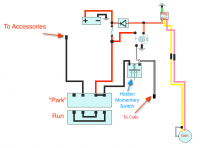
When holding the momentary switch, you're closing a circuit to the coils from the battery. Once you kick the bike and it starts, the generator supplies power to a relay, which closes a circuit to the main hot from the battery, thus when you let go of the button the generator continues to maintain a closed relay :)

I unno, I'm pretty new to electronics. Thoughts?
 

Attachments

  • hidden ignition.png
    hidden ignition.png
    62.4 KB · Views: 6,305
This seems like a solution in search of a problem. What are you doing that is not already handled by the ignition switch and/or kill switch?
 
Sonreir said:
I'm assuming the white wire is to the coils?

Also, your diode is backwards.

Yes the white wire goes to the coils and has a diode so that when you hold the hidden button, it does not allow power back to the hot and so does not allow any lights to come on to indicate that you've found a button :P

Backwards? I want the charging system to work normally, however I want the battery to not power the relay once the charging system stops. You're saying if the diode is reversed it will accomplish this?
 
Redliner said:
Yes the white wire goes to the coils and has a diode so that when you hold the hidden button, it does not allow power back to the hot and so does not allow any lights to come on to indicate that you've found a button :P

Backwards? I want the charging system to work normally, however I want the battery to not power the relay once the charging system stops. You're saying if the diode is reversed it will accomplish this?

With the current configuration of the diode, no power is going to make it to the battery from the R/R.

Also, how are the coils going to get power without the button being pressed permanently?
 
Hold the button and power goes ONLY to the ignition system at that point. Kick the bike and the ignition system will...ignite thins. Now that the bike is spinning enough to generate a current to the relay via the red/white charging wire, it closes the switch that allows power from the battery to the black (hot) in the harness.

So by starting the bike you are charging, and by charging you are closing the switch.

If the system fails, hold the button and it bypasses the relay. Then pull off the road, pull out the trusty key, and switch over to Run.

About the diode, I thought power flowed TO positive. Isn't the charging system supposed to flow to the positive side of the battery?
 
Redliner said:
Hold the button and power goes ONLY to the ignition system at that point. Kick the bike and the ignition system will...ignite thins. Now that the bike is spinning enough to generate a current to the relay via the red/white charging wire, it closes the switch that allows power from the battery to the black (hot) in the harness.

So by starting the bike you are charging, and by charging you are closing the switch.

If the system fails, hold the button and it bypasses the relay. Then pull off the road, pull out the trusty key, and switch over to Run.

About the diode, I thought power flowed TO positive. Isn't the charging system supposed to flow to the positive side of the battery?

If the white wire is to your coils, then the only path it can take is via your momentary switch. That means the bike doesn't run unless the button is pressed. I think you want the relay to bypass the button? Something like this?


And yes, power from the charging system to the positive terminal of the battery, that's why you need to flip the diode. With the current polarity, you're preventing that from occurring. Additionally, you're allowing power to flow from the positive terminal of the battery to the relay, effectively powering your coils 100% of the time (regardless of what your button is supposed to be doing).
 

Attachments

  • Untitled.png
    Untitled.png
    46.7 KB · Views: 3,450
Rich Ard said:
This seems like a solution in search of a problem. What are you doing that is not already handled by the ignition switch and/or kill switch?

1. You can dismount and walk away from the bike without the possibility of forgetting the key. I know it happens as I'm sure we've all walked by a bike with a key in the ignition at one point in public car parks.

2. When in the Park position, you can never forget to shut the ignition off and melt the coils. It is off so long as the bike is off!

3. If you are going to leave the bike unattended in a less secure area, you can switch it to off and so even if a really REALLY clever thief finds your button, it's of no use to them.

4. I hate using the key, personally.

Convenience, if not laziness, and security by obscurity should you choose.
 
I'm not arguing, I'm learnering. I thought that diode symbols were reversed because Edison had a 50/50 shot at being right...and lost that gamble.

Sonreir, the black and white wire goes to the coils, and the regular black hot in the harness goes to the coils as well so that when the relay closes the bike and ignition are functioning normally.

That said, if I power the coils with either/both the white/black and regular black (hot), then when I press the button, again the lights will come on. I want to have a diode so that I can power the coils by the white/black but keep the black from being hot until the relay closes.
 
Having a hard time picturing that one with the existing diagram. Might need to rework this a bit.

Lemme see if I understand...
  • Three position ignition switch - on/park/off
  • On - Bike functions as normal
  • Park - Bike functions as normal, but only when the engine is running. Requires depressing the momentary switch in order to start the engine (kick only?)
  • Off - Everything turned off (normal functionality)

Is that correct?
 
You're exactly right, mate.

Here's the revision. If the diode is backwards, I'm still learning :P

This illustrates that power can be supplied to the coil via the black (hot) or the black/white (hot after button) without allowing the momentary switch to power the black wire and thus to not allow the momentary switch to power any lights. The lights can only work once the bike is running.
 

Attachments

  • ignition.jpg
    ignition.jpg
    142.8 KB · Views: 2,668
Diode on the black wire isn't necessary and the diode on the red/white is still backwards.

Also, in the current configuration, just kicking the bike over will bypass your switch and cause the bike to run, so the momentary switch is entirely redundant in this setup.
 
If I choose a relay that opens at a higher current, wouldn't that make it so that the bike has to at least be at idle (minimum 900 RPM) to close the relay?

Why is the diode unnecessary? I don't want the lights to come on when I press the button, ONLY the ignition. Wouldn't power from the black/white make the black hot and thus power the accessories?

There are many bikes that don't allow accessories to be powered on until the bike is running. I'd like to take that and remove the starter motor from the equation and add the ignition to the list of things that are powered by the accessory relay. Add to that a momentary switch for starting.
 
Had a friend who went ignition less on his cb750 brat several years ago. His solution to the security issue was to simply use several relays in series, each activated by a different already existing switch on the bike. If they weren't selected in the correct order, no start. He used the foot brake, the hand brake, the clutch and the horn if memory serves- and no, I never figured out the order!
 
Actually, the second diode is necessary if he doesn't want the accessories to turn on when the button is depressed. And he would have to make sure that the diode is between the accessories and the ignition.
 
Wahoo, I considered something like that. But I doubt anybody would know to hold the button while kicking, even if they did find the button. And believe me, you nor anybody else would without dismantling the bike. Even then you'd likely overlook it :P

And what thief would kick the bike for very long while looking for an unfindable button? XD
 
Redliner said:
If I choose a relay that opens at a higher current, wouldn't that make it so that the bike has to at least be at idle (minimum 900 RPM) to close the relay?

I could definitely be wrong, but I don't think they make current-sensitive relays right off the shelf. The idea behind a relay is that they're triggered with a fairly low current so that they can switch higher current devices. If I am wrong, this is a very good solution to the problem.

[quote author=Redliner]Why is the diode unnecessary? I don't want the lights to come on when I press the button, ONLY the ignition. Wouldn't power from the black/white make the black hot and thus power the accessories?[/quote]

Ignore my earlier post. You're correct.

[quote author=Redliner]There are many bikes that don't allow accessories to be powered on until the bike is running. I'd like to take that and remove the starter motor from the equation and add the ignition to the list of things that are powered by the accessory relay. Add to that a momentary switch for starting.[/quote]

The issue is that the accessory choice matters. If someone kick starts a bike with a relay that prevents the headlight from working until the bike is running, then no biggie. If the bike isn't turned on then the headlight comes on for a second and then turns off again. If that accessory is the coils, then you'd just negated the need for an ignition switch and that kind of is a big deal. Because when you kick the bike over, the relay gets power to the coils and the bike starts running (which keeps the relay engaged, which keeps power going to the coils).
 
Sonreir said:
I could definitely be wrong, but I don't think they make current-sensitive relays right off the shelf. The idea behind a relay is that they're triggered with a fairly low current so that they can switch higher current devices.

What about some load-sensitive switch, which would then power the relay? So that only at a minimum of about 900 RPM (a very very low stumbly idle) would the generator make enough power to switch it on.

I'll have to measure how much power I can possibly get out of kicking vs how much it generates during a low idle. I can't think of any other way to tell that the bike is running other than a computer with a CPS. That's out of the question on this build. ::)
 
Back
Top Bottom