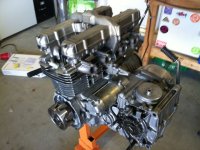
Top End Rebuilt need some help guys

mhallman25

New Member
Hey Guys. My name is Matt.
This is my first time rebuilding a motorcycle engine. I could really use some help and knowledge.

Take a look at the first picture. I am really worried that when I put this motor back together, that the timing is going to be off. Can someone please confirm if the motor is TDC? I have the manual, just a little worried.

Second, is there anything specifically with this engine as far as rebuilding the top end, that I need to know. Problems or easier ways of doing things...

Third, do I need to buy specifically the KZ 650 piston ring compressor tool to get the pistons back in the block? Part no: 57001-531

Fourth and final, I want to do a stage one port and polish on the head. Just very basic, removing manufacturer casting residue. Would there be a benefit to me upgrading valves and springs if I am not going to bore out the motor?

Thanks for all your help and would love to hear your opinions.

Matt
 

Attachments

  • IMG_1255.jpg
    IMG_1255.jpg
    35.6 KB · Views: 449
  • IMG_1246.jpg
    IMG_1246.jpg
    61.5 KB · Views: 428
  • IMG_1267.jpg
    IMG_1267.jpg
    60.6 KB · Views: 449
  • IMG_1272.jpg
    IMG_1272.jpg
    51 KB · Views: 555
some more pictures
 

Attachments

  • IMG_1262.jpg
    IMG_1262.jpg
    63.7 KB · Views: 679
  • IMG_1263.jpg
    IMG_1263.jpg
    58.3 KB · Views: 687
  • IMG_1251.jpg
    IMG_1251.jpg
    65.2 KB · Views: 649
  • IMG_1254.jpg
    IMG_1254.jpg
    63 KB · Views: 663
Timing is right. Why did you disassemble the engine?
Did you research the availability of 650 piston rings before you
tore down the engine? If you can't find rings I might have a source.
If not you will need to go with a Wiseco big bore @ 700cc/2mm
over. Then you could go with 750 valves and cams with some port
cleanup. For a stock rebuild there is little need for any cylinder
head modifications. Then there is always the 810 swap. You need to
Go to KZRider.com , sign up and do some searching, all the info you will
ever need. VM26 carbs from a 900/1000 and a 4/1 pipe will wake up
the beast.

.
 
I torn it down because I wanted to start from scratch the odometer was at 10,000 which I know isn't a lot but I wanted a good starting point and yes I have new rings for it do any of you guys have a dyna s upgraded ignition system if so how do you like it ?
 
sounds like you're in over your head

get a shop manual for it, you can usually find them online, they're 2-300 pages and more comprehensive than a haynes or clymer

if you have new rings for it is it because the engine was burning oil or had low compression? what are your goals with the engine besides the minor port? I think you shouldn't even worry about the port and concern yourself with putting it back together properly. I'd start with the manual, if the rings haven't been taken off the pistons yet, I'd leave them be unless it was burning oil
 
I do have the manual and I don't know if it leaked I have never run the engine so I probably shouldn't even take the valves apart, does it matter how much carbon build up there is on them. the old rings look awesome as you can see from the picture I don't I guess I should just put all this back together?
 

Attachments

  • IMG_1274.jpg
    IMG_1274.jpg
    63.1 KB · Views: 549
  • IMG_1273.jpg
    IMG_1273.jpg
    43.4 KB · Views: 560
You took apart the engine before ever trying to run it?

I'll be back later.

Just a point, though, there was no reason to do this. Running it for another 10k as is, assuming it ran well, while learning to keep maintenance up, would have been the wiser move. Then, at 20k, learning how to test adn set valve clearances on a bucket-over-shim system like your bike woulda been a good learning experience, and so on from there.

But, too late for that.
 
You can either dig yourself out or fork over a few hundred bucks to have a mechanic put it all back together.

If you decide on the former, read through the official Kawi manual (not the Clymer or the Hanes) several times to make sure you at least have the gist.

Then you ask questions if/when you get stuck.

It's not rocket science, but you can't hurry it (especially not your first time).

You're definitely going to need a torque wrench and a micrometer. I suggest getting the bores looked at by a machinist while you have everything apart. Highly unlikely anything will need to be done to them, but they might do with a quick hone job since everything is already apart.

While you're waiting, you should test the valves for leakage. Put the head up onto one side so that the intake ports are pointing up and the exhaust ports are flat on your work bench. Put a few tablespoons of acetone, alcohol, or gasoline into each intake port. Wait five minutes and then inspect the inside of each combustion chamber. If you notice ANY liquid at all, you're going to need your valves lapped at the very least, or a valve job if they're leaking more than just a little bit. Repeat with the exhaust ports.
 
mhallman25 said:
I am seriously considering since I am all ready here and have to spend some money what about a big bore kit?

Figure out the engine first, then worry about upgrades. You need a solid baseline from which to start. Throwing parts at an engine while still learning it's intricacies usually isn't a recipe for success.
 
Sonreir said:
You can either dig yourself out or fork over a few hundred bucks to have a mechanic put it all back together.

If you decide on the former, read through the official Kawi manual (not the Clymer or the Hanes) several times to make sure you at least have the gist.

Then you ask questions if/when you get stuck.

It's not rocket science, but you can't hurry it (especially not your first time).

You're definitely going to need a torque wrench and a micrometer. I suggest getting the bores looked at by a machinist while you have everything apart. Highly unlikely anything will need to be done to them, but they might do with a quick hone job since everything is already apart.

While you're waiting, you should test the valves for leakage. Put the head up onto one side so that the intake ports are pointing up and the exhaust ports are flat on your work bench. Put a few tablespoons of acetone, alcohol, or gasoline into each intake port. Wait five minutes and then inspect the inside of each combustion chamber. If you notice ANY liquid at all, you're going to need your valves lapped at the very least, or a valve job if they're leaking more than just a little bit. Repeat with the exhaust ports.

The Clymer and Haynes manuals have all the wear limits and engine specifications
you are going to need. If you want to get it back together on the cheap until you get familiar
with working on motorcycles. Hone the cylinders and then check the gap of the rings.
If that's ok then clean your head and pistons. Get the valves ground and lap the seats in.
The Kawasaki seats are hard and seldom need more than lite touch with a stone. So lapping
valves is reasonable alternative. When you check the valve lash, do it before it is installed on
the head. That way you do not have to mess with the cam chain. Because the cams have to
be removed to get to the shims since the 650/750 are s.o.b. ( shim on bottom ) Then clean
and bench synchronize your carbs. Go thru the ignition system according to your manual.
Including setting your points, coil resistance, etc.... The Dyna systems work fine, but draws
a lot of juice. The factory system is more efficient. The "80 and newer 650/750s timing plate
bolts right in. The wiring is fairly simple. 4 wires from the pickup coils/timing plate. One hot ,one
ground, 1 to each coil. The coils do have to be replaced because of different resistance requirements.
In the long run the factory is better, but the Dyna will last a long time and cost less to start with.
And one last thing the cam bolts only need 11( INCH ) lbs. of torque. So when setting valve lash
only run the bolts down finger tight until your finished.


.
 
Maybe I've been missing out on an awesome shortcut, but how the fuck do you check valve lash without the head being installed? I mean, how are you turning the cams to check clearance?
 
They turn easier than you would think. And if you want you can clamp
onto the sprocket with a vice grip. The head has to be elevated so the valves
open freely.You check one cam at a time. That way both valves on one cylinder
are not open at the same time. Check all 4 valves on one cam, remove the cam,
change the shims to the correct size and reinstall cam to measure clearance.
Repeat if needed. Them go to other cam. If the head is on the engine the cams
have to be timed. You would check lash, remove cam chain tensioner, remove cams,
change shims, reinstall cams, time them, which can be a pain because they will
rotate when the cam caps are tightened down. Then recheck valve lash and probably
repeat the whole process again.


.

.
 
Nebr_Rex said:
The Clymer and Haynes manuals have all the wear limits and engine specifications
you are going to need. If you want to get it back together on the cheap until you get familiar
with working on motorcycles. Hone the cylinders and then check the gap of the rings.
If that's ok then clean your head and pistons. Get the valves ground and lap the seats in.
The Kawasaki seats are hard and seldom need more than lite touch with a stone. So lapping
valves is reasonable alternative. When you check the valve lash, do it before it is installed on
the head. That way you do not have to mess with the cam chain. Because the cams have to
be removed to get to the shims since the 650/750 are s.o.b. ( shim on bottom ) Then clean
and bench synchronize your carbs. Go thru the ignition system according to your manual.
Including setting your points, coil resistance, etc.... The Dyna systems work fine, but draws
a lot of juice. The factory system is more efficient. The "80 and newer 650/750s timing plate
bolts right in. The wiring is fairly simple. 4 wires from the pickup coils/timing plate. One hot ,one
ground, 1 to each coil. The coils do have to be replaced because of different resistance requirements.
In the long run the factory is better, but the Dyna will last a long time and cost less to start with.
And one last thing the cam bolts only need 11( INCH ) lbs. of torque. So when setting valve lash
only run the bolts down finger tight until your finished.


.

if the valves haven't been removed, with 10k miles, I wouldn't even touch them, it's a solution to a problem that probably isn't there
 
Roc City Cafe said:
if the valves haven't been removed, with 10k miles, I wouldn't even touch them, it's a solution to a problem that probably isn't there

Are you absolutely positive about the condition of those valves?
The machine is 30 years old. 2 or more valves have been open all
that time exposed to the elements. If the bike was never reshimmed
after break in the clearances would tightened up. Leading to no
clearance and carbon build up on the seat and valve contact surfaces.
Remember the bike was not run/running before being disassembled.
And if done right the removal of material from valve and seat is negligible.
The valve seals will be hard as a rock as well. A valve job will eliminate
those problems and more.


.
 
Back
Top Bottom