69 Honda CL450 Scrambler Restoration

I took the Scrambler out for a ride yesterday and after about a quarter mile, I was really under powered. The bike didn't seem to want to rev under any load. It felt like someone was covering the exhaust outlet - I could crack the throttle and the engine didn't respond. When I finally got it home, I checked the compression in both cylinders - I had 110 in the mag and 130 in the clutch side. Both are kind of low, but I had 130 in each cylinder after rebuilding it. The 110 values in the mag cylinder had me wondering what was going on. Today I pulled the cam covers off and verified that my cam timing was spot on and valve lash was correct. Both things checked out and my cold compression was around 100psi.
My next steps are to leak down the mag cylinder to try to find where it's bleeding compression. As the bike is, it's unrideable because it just isn't making any power.
 
Do the leak-down first. If you don't have a leak, then I'd suspect your valve lash.

It's widely recommended to go to 0.0015", nearly equivalent to 0.04mm.
 
Design Compression is 185, Honda FSM says anything under 164 PSI is below operating spec.... Spec says 185 Design, Acceptable is 164-213 with 185 as the design...

That even your high reading is 130 means it is way too low.....110 is lucky to run at all...

If someone with 130 PSI compression says their engine has no power, I am not even slightly surprised....I wonder how it is even running at 110 PSI...

You need to recheck valves and rings.....Or head gasket....Much too low compression...
 
mydlyfkryzis said:
That even your high reading is 130 means it is way too low.....

Chances are that his gauge is off. I measured some cylinders with those Autozone rentals. I think they're branded "OEM". Then I compared with a Motion Pro. How are those loaner tools even considered useful?

Every bike I was running measured 130-135 with the Autozone crap. 155 solid with the Motion Pro.

Try a better gauge. Make sure you have the throttle wide open. Keep turning till the indicator stops on the dial, then keep on a bit more.

You're not building pressure in the cylinder, as most people absurdly believe, you're letting the gauge catch up. Since the pressure is rising and falling so fast in the cylinder, the gauge doesn't have time to reflect an accurate reading until it finally "bumps" it's way up there.

I just did a rebuild on a 500t. Compression is at 150 solid on both. Valves set at 0.0015".

I sure hope you don't have to break and reinstall that damn chain ::)
 
Guys thanks for the quick replies and feedback. Both of my compression gauges may be crap. My new auto parts store gauge is audibly bleeding off pressure at the quick disconnect and my other gauge has been dropped more times than I can remember. The othe dumb thing I was doing was using the elec start instead of kicking it. I know that kicking it over spins it faster than the elec start. I still plan to leak down each cylinder after work today to get an idea of where I'm at.

Some other info that I feel is important -
I'm having a charging system issue that manifested itself as a dead battery last weekend. I was still using the original regulator and rectifier. I swapped out the rectifier for the radio shack one recommended in the $50 Mod section. Before and After swapping rectifiers, I'm getting the following readings at the rectifier wiring harness - Roughly 12.5VDC at the red/white wire to green wire that goes rectifier to battery at all engine RPM. 14VAC at the pink stator wire to the green ground wire and 14VAC at the yellow stator wire to the green ground wire. 14VAC thoughout the RPM range. All of this seemed OK but I"m wondering if it's too low. I expect 13.5VDC or so across the battery when the bike is running but it never moves from 12.3-12.5VDC, which has me concerned.

I'm wondering if the charging system can't keep up with the coil power demand. When this started happening Saturday, I made it to a gas station and let the bike sit for a few minutes while I tried to figure out what my next move was. I fired it back up and took it for a quick jaunt up a side street - it ran fine for those ~2 minutes. Then I tried to make it back home and the low power manifested itself again.

I hope this extra info helps. I'm still trying to determine if my charging system is working and what updates I might need to make.
 
You changed the rectifier but are using the old regulator? Or you swapped both for a single reg/rec?

14v is expected from your alternator, so we eliminate that as a problem.

Are you running with your headlight always on? I know it sounds stupid, but check that you can turn your headlight off. You have to press the headlight switch downward, then to the left to cut the light off. Some people are surprised when I turn their headlight off because they had never figured this out ::)

If your headlight was on, what do you get now?

Finally, when your system is stock, you're actually only using half of the stator coils with the light off!

Go into your bowl. Then find the yellow and the white leads (2 leads) directly from the stator. Use a continuity function on a multimeter to confirm these wires. Once you find them, disconnect them from the switch and connect them directly to one-another, yellow to white.

Now you're using all stator coils all the time with no ill effect.
 
WOAH! I just re-read what's going on here.

How did you measure VAC from the stator?

I believe you need 50v or as as high as 60v when at about 5k RPM. Been too long since I've checked. You expect close to 20v when at idle but definitely rev it to see where it tops out.

Measure AC between Pink and White, then Pink and Yellow with the stator disconnected from the rest of the system.

You said it never gets above 12.5 when the bike is running. Is 12.5 lower than when the ignition is off? If the voltage is lower when it's running then you're using more power than the stator can supply. If the stator does put out close to 60v or more at 5k RPM, then it's the regulator, me thinks...
 
I had a few hours to work on the bike again tonight. I rechecked my compression - this time I kicked the bike with the throttle wide open. I ended up with 185/190psi. That makes me feel a lot better.

I also jumped the white/yellow stator lead wires. I fired the bike up and let it run at a high idle around 3k RPM. With the volt meter connected across the battery, I watched the battery voltage rise from 12.3VDC up into the low 13's. I didn't want to let the bike sit at high idle too long without air blowing across the fins, so I shut it down at that point. When I have more time, I'll set up a fan to blow across the engine while watching the battery voltage to ensure it doesn't go much past 14 when running.

I didn't end up disconnecting them from the switch (I'm assuming headlight switch) - will there be any ill effects associated with this? I want to run with the headlight on, but didn't actually turn it on when it was running tonight.

Redliner - I was measuring 14VAC at the wire harness that plugs into the rectifier. I'm guessing that is regulated voltage at that juncture. I haven't pulled the stator harness to measure there. If the work tonight didn't fix the issue, I'll tear into that harness and dig a little deeper. Thanks for the help and suggestions.
 
So what you're saying is that you back-probed some leads into the stator connector in order to short the yellow and white, and that caused the battery to reach into the 13 volts realm? Yet when you ride, you always have the light on and it would not charge in that case?

Yeah, I'm assuming stator problem here. Will wait for you to disconnect it from the harness and check readings again. Check readings without the yellow/white wires shorted out.

I don't understand the question about not disconnecting the leads from the switch. If you always ride with the light on, then shorting the yellow and white would have no benefits. It only benefits you in the case that you have the headlight off. With the headlight on, it connects the yellow and white leads as well to compensate for the extra draw.
 
OK HOLD ON ONE MINUTE, testing the charging system is very simple and straight forward. Some of your numbers are wrong or LOW.

Start with the bike off and a well charged battery, mater of fact leave a trickle charger on it until I tell you to.

First unplug the stator plug at the at the sprocket cover. Figure out what which colors are which, (Yellow, White, Pink, Red striped Green) and plug your test leads into the YELLOW and PINK wires.

Set your METER to VAC and start the bike. You should have AT LEAST 14v at idle. REV to 2000-3000 and it should climb to 30+.

NOW change the lead on the YELLOW to WHITE and it should do the the same as above.

IF that all checks out then proceed. Other wise you either have a bad stator or a short in the wiring, I would check around the grommet that exits the housing. The wiring will crack right there and ground out on the casing.

Shut the bike off, remove the charger if you have it connected, find your regulator wiring and unplug it. Plug the stator wire back into the harness and start the bike. BE CAREFUL about reving the engine too much as you can make too much voltage and possibly damage a battery.

AT the BATTERY with your meter set to DC voltage, test to see what you get at idle. With the lights OFF, it should be around 12-13 and with a gentle rise in RPMS should CLIMB. STOP at 15. IF it DOES that the rectifier is GOOD, If the voltage is less than 12 or does not rise the rectifier is either bad or NOT hooked up correctly. I would also check for loose or broken wires that can cause intermittent charging.

Finally, plug the regulator back in, raise RPM until you see the voltage top out. Should be around 14v. If it gets to 15-16 with no signs of stoping the regulator is bad.

Jumping the YELLOW STRIPED WHITE and the YELLOW in the headlight housing puts the system into full charge mode all the time. IF you do a lot of town riding go ahead and do it. If not then that choice is up to you.
 
frogman said:
NOW change the lead on the YELLOW to WHITE and it should do the the same as above.

Shouldn't it be Yellow to Pink and then White to Pink? According to teazer and the wiring diagrams, pink is the neutral. At least it appears that way.

From what I can tell, the yellow is half of the stator coils and the white is the other half. When the light is on or yellow and white are connected, their current (amps) combine to supply power to the battery quicker.

I'm askin' here, AC is a fucking mystery to me.
 

Attachments

  • Picture 5.png
    Picture 5.png
    62.5 KB · Views: 836
  • Picture 6.png
    Picture 6.png
    72.5 KB · Views: 789
Redliner said:
Shouldn't it be Yellow to Pink and then White to Pink? According to teazer and the wiring diagrams, pink is the neutral. At least it appears that way.

From what I can tell, the yellow is half of the stator coils and the white is the other half. When the light is on or yellow and white are connected, their current (amps) combine to supply power to the battery quicker.

I'm askin' here, AC is a fucking mystery to me.


Umm, I think that's what I said, let me say it this way, move the lead from the YELLOW terminal to the WHITE terminal in the plug. Pink is COMMON for both Coils.

There are 2 sets of coils in the stator windings, one that is meant for day light cruising with out the headlight on. This counts for the larger of the two coils since it is handling charging the battery which then runs the rest of the electrics. That's why these things run like shit with a dead or crappy battery.

The WHITE winding is smaller but is there to make up for the Headlight and tail light added draw at night. On MY 450 I just went ahead and tied the yellow and white ends of the two coils together at the stator and ran one yellow wire out. Its on full charge all the time, I'm running a higher wattage head lamp and I want all the juice I can get.

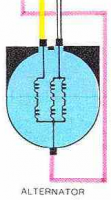
AC is simple on these, they either make 14+ volts at idle and 30+ at high RPM or they don't. Permanent magnet systems should always make juice unless the windings are shot or the magnets are dead. They are not really Alternators so much as they are AC generators. Alternators to me have a rotor spinning inside an excited electrical field that picks up induced voltage. Without an initial excite voltage, an alternator won't make juice. Generators use MAGNETS spinning inside a coil to induce the voltage, just have to spin to make juice. Course that's my farm boy logic feel free to correct me. ;)
 
AC Generator is also called an alternator...same difference.

There are permanent magnet alternators and field regulated alternators. As you said, ours our permanent magnet type.

They do not generate voltage, they generate current. The current is proportional with the RPM.

The voltage generated from the current is determined by the resistance in the system (good old ohms law).

That is why an disconnected alternator can generate 50-60 volts....

You can figure the the resistance by looking at the current and voltage.... You need 2 meters to do that.

The regulator only limits the voltage output by decreasing resistance to ground. Less resistance is less voltage.

Also, the current at a given RPM is constant.....So lets say 6 amps at 5000 RPM....Close guess....To get 14 volts, the resistance of the system is (e=IR, or R=e/I) So 14/6 = 2.33 ohms. So to keep the voltage at 14V, the system resistance needs to be 2.33 ohms. If you put on another light (brake light for instance), the resistance goes down and the voltage goes down....

It's really a simple system.....but the concept is a bit deep.

FWIW, I work on Natural Gas Turbines that use a permanent magnet alternator also, but at 96,000 RPM. They run between 50K RPM and 96K RPM to maintain the right current..... It is exactly similar to our alternator, but rather than 130 Watts, these are 60,000 Watts.

They use a rectifier to make DC, but then another whole set of circuits to make AC at a fixed voltage.

Funny how so many things are similar....

At any rate, your posting is correct Froggy...
 
mydlyfkryzis said:
AC Generator is also called an alternator...same difference.

There are permanent magnet alternators and field regulated alternators. As you said, ours our permanent magnet type.

They do not generate voltage, they generate current. The current is proportional with the RPM.

The voltage generated from the current is determined by the resistance in the system (good old ohms law).

That is why an disconnected alternator can generate 50-60 volts....

You can figure the the resistance by looking at the current and voltage.... You need 2 meters to do that.

The regulator only limits the voltage output by decreasing resistance to ground. Less resistance is less voltage.

Also, the current at a given RPM is constant.....So lets say 6 amps at 5000 RPM....Close guess....To get 14 volts, the resistance of the system is (e=IR, or R=e/I) So 14/6 = 2.33 ohms. So to keep the voltage at 14V, the system resistance needs to be 2.33 ohms. If you put on another light (brake light for instance), the resistance goes down and the voltage goes down....

It's really a simple system.....but the concept is a bit deep.

FWIW, I work on Natural Gas Turbines that use a permanent magnet alternator also, but at 96,000 RPM. They run between 50K RPM and 96K RPM to maintain the right current..... It is exactly similar to our alternator, but rather than 130 Watts, these are 60,000 Watts.

They use a rectifier to make DC, but then another whole set of circuits to make AC at a fixed voltage.

Funny how so many things are similar....

At any rate, your posting is correct Froggy...

Totes.
 
So I did some work on the bike tonight following the advice from above:
Bike off - charger connected to battery - 12.8VDC across battery terminals

Unplugged stator wire harness with bike Running
Yellow to Pink - ~40VAC @3k rpm
Yellow to White - ~40VAC @ 3k rpm

Voltage at battery with regulator plugged in (idle) - 12.15VDC
Voltage at battery with regualtor plugged in (@3k RPM) - 12.3VDC - then dropped to 12.15 when allowed to return to idle.

Voltage at battery with regulator unplugged - 12.25VDC at all RPM. Did not climbe when the bike was revved.

Here is where thigns go interesting:
I unplugged the wire harness that goes into/out of the rectifier (I just installed a new radio shack rectifier from the $50 mod thread)
With harness unplugged and probing the male side (main bike harness side) I got ~28VAC across the pink/yellow leads at idle and mid 40's VAC when revved. When I reconnect the mating harness that goes to the rectifier and back probe the female terminals, I only get 14-15VAC across the pink/yellow leads no matter what RPM.
I pulled the harness/recrtifier out of the bike to try to figure out what is causing the issue. I sanded each terminal to clean any corrosion bu that didn't change anything. I checked the continuity and resistance from the harness terminal to the rectifier post - I got 1.5 ohm from the harness pin to the corresponing pink and yellow terminal at the rectifier. I'm sure someone will ask, I've attached a pic of my radio shack rectifier showing the location of all the existing harness wires.

I'm guessing the right thing to do is to remove the harness and hardwire the rectifier, but I 'd really like to figure out the issue and maintain the flexibility that the wire harness provides.
 
So I did some work on the bike tonight following the advice from above:
Bike off - battery at 12.2VDC across battery terminals
Bike off - charger connected to battery - 12.8VDC across battery terminals

Unplugged stator wire harness with bike Running. Probed leads in harness from stator
Yellow to Pink - ~ 28VAC at idle and ~40-50+VAC @3k rpm and above
Yellow to White - ~28VAC at idle and ~40-50+VAC @ 3k rpm and above

Voltage at battery with regulator plugged in (idle) - 12.15VDC
Voltage at battery with regualtor plugged in (@3k RPM) - 12.3VDC - then dropped to 12.15 when allowed to return to idle.

Voltage at battery with regulator unplugged - 12.25VDC at all RPM. Did not climb when the bike was revved.

Here is where things got interesting:
I unplugged the wire harness that goes into/out of the rectifier (I just installed a new radio shack rectifier from the $50 mod thread)
With harness unplugged and probing the male side (main bike harness side) I got ~28VAC across the pink/yellow leads at idle and mid 40's VAC when revved. When I reconnect the mating harness that goes to the rectifier and back probe the female terminals at the harness, I only get 14-15VAC across the pink/yellow leads no matter what RPM.
I pulled the harness/recrtifier out of the bike to try to figure out what is causing the issue. I sanded each terminal to clean any corrosion but that didn't change anything. I checked the continuity and resistance from the harness terminal to the rectifier post - I got 1.5 ohms from the harness pin to the corresponing pink and yellow terminal at the rectifier. I'm sure someone will ask, I've attached a pic of my radio shack rectifier showing the location of all the existing harness wires.

I'm guessing the right thing to do is to remove the harness and hardwire the rectifier, but I 'd really like to figure out the issue and maintain the flexibility that the wire harness provides.
 

Attachments

  • IMG_20130918_200713_198.jpg
    IMG_20130918_200713_198.jpg
    550 KB · Views: 361
What happens when you run the system with the rectifier not bolted to the bike, it does NOT need to be grounded to the bike since the green is ground. I doubt your connectors are to blame, I did the exact same on my bikes.

Expect it to drop at least half of that voltage, since the AC voltage is being measured is a WAVE that moved both positive and negative and the meter measures the distance between peaks. The rectifier grabs the bottom half of that wave and redirects it to the positive and creates rippled DC or all positive voltage at about half the AC.

Voltage NOT rising after you unplugged the regulator to me means that you are running on battery at that point, it should have. It should rise several volts instead of .1-.2. Even the first test with it plugged in is not enough, lights off just the engine running.

Your readings for the alternator are good in my book, your bike might actually charge at idle. I'd lay even money on that rectifier being bad or shorted. If your meter has a DIODE setting you can test the diodes in it. Use the diagram Redliner posted above.

I would also get a good charge on that battery and take it to be load tested. Run them down once or twice they might not come back. I've had no issues with the batteries in my bikes but my buddies eats them for lunch unless he plugs his in.
 
frogman said:
I've had no issues with the batteries in my bikes but my buddies eats them for lunch unless he plugs his in.

I normally attribute such issues to improper initial setup. Those first moments in a battery's life make or break 'em.

As frogman said, measure resistance in the stator coils to be certain they haven't shorted. There is a diagram somewhere listing average Ω's for each set of pins you connect your tester to.
 
I did a few more checks -
I pulled the stator harness and probed the lead wires coming from the stator:
Pink to White - 0.6ohms resistance
Yellow to White - 1.5ohms resistance
Pink to Yellow - 1.1ohms resistance
From the research I've done, these values are on par with a good stator.

I pulled the voltage regulator leads and ran the bike - it still sits around the "off" battery voltage. With a low charge on the battery, I had 11.8V off and 11.9V with it running with the voltage reg unhooked.
I charged the battery over night and the next day tried again. 12.6V off and 12.8V with the voltage reg unhooked.

Today, I bought another rectifier from radio shack. The diode check on my multimeter said that both rectifiers were OK. I installed the new rectifier and had the same issues I was having before. With the harness unhooked, I get 28VAC at idle (probing pink to yellow in the harness going to the rectifier and 40-50VAC when revved.

Then I left the key on for about an hour while I worked on something else. I could smell something burning, but couldn't figure out what it was. I realized I had left the key on, so I turned it off, sanded my points contacts, and tried to restart the bike. It ran but wouldn't rev well. I pulled the points cover and can see each contact arcing. Then I left the key on a second time for about 30 minutes. Now the bike won't start.
 
Back
Top Bottom