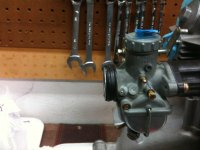
KOP that makes perfect sense. What you are doing is to change the position of the jets so that they experience the greatest pressure differential a.k.a. signal. That will change fueling and sensitivity to jetting. A small change is almost immeasurable on a butt dyno in absolute terms, but it is capable of detecting changes in responsiveness and that''s where your jetting effects are paying off.
Lats time we dyno tested a CB175 based motor with three different velocity stacks, the best was a standard Honda plastic one from inside the airbox of a CB750 but the difference was basically within the range of experimental error/variance.
Our 175 race bikes all do more that 100 em pee aitch with fairings and small rider etc. Remember that a stock motor makes about 10-11 at the rear wheel and ours make over 20 on a good day and slightly less when they are tired.
Here's one we prepared earlier...
As you can see the motor is more or less stock..............
That's a "Sloper 175" bottom end with CB200 head and custom pistons, race cam and lots of welding and machining. It's a smooth easy to ride bike but needs another 10hp to compete in that class. The exhaust is a mix of GSX400 Bandit tubes modified to fit with a custom collector and Midas special tail pipe.

Combustion chamber shape is very different to stock
For a speed run with a 200 motor there are all sorts of things to try as long as they stay within the rules. What are those rules in terms of engine classes and allowable modifications. I'm assuming that any modifications are allowed within a certain capacity class. Looks like you cn more or less do anything and choose a classification that fits what you built.