First Cafe project (CB450)

jelloelstone said:
That is likely just a hole to allow oil to pass through but dont listen to me :P , anyone that knows these engines more should chime in!
That's what I thought initially.
 
Doc. said:
That would be awesome!
Mine is open as well, doesn't look machined for anything to fit into... and checking the service manual, on fig 3.90 it looks like it's empty as well. At least at that stage of the disassembly
They mystery continues but I bet it's an oil passage as stated befor.
 
That's the hole left behind after they drilled the spindle holes for the middle idler sprocket for the cam chain, no worries it gets covered by the cylinder sleeves.
 
Haven't updated this in a while...

So I put the new valves in and of course they wouldn't seat well. Lapped the valves and still no good. I had to get the seat re-machined. I picked up the head yesterday but haven't gotten a chance to test anything due to work. If it passes the acetone test (and I'm hoping it well after being machined), she will go on the block. I'll keep you guys updated.
 
The engine is back together, but I have to take the cam followers back out to grind off the tips for clearance with the cam lobe. I was really excited to put everything together and check compression. Oh well, one day...

I also was able to free up the seized piston from the caliper. The MityVac worked well after some tinkering with it. I wish they had an attachment for a bleeder nipper as small as the ones on these calipers :o
 

Attachments

  • image-1894534080[1].jpg
    image-1894534080[1].jpg
    237.1 KB · Views: 865
  • image-2138125936[1].jpg
    image-2138125936[1].jpg
    195.1 KB · Views: 912
Quick update:

All the engine internals are in, and the cam chain is on. Next up is compression test, which I'm still not sure how to go about. Should I have oil in the engine for the test? And also, just plug in the gauge and push the kick start?
 
So you only have a kick start? That makes it tough but it is do-able. You are going to have to turn her over at least 3 or 4 revolutions rapidly per cylinder to get a good reading, so I'd have oil in it. It won't effect your readings but as long as you are kicking it over that much it will help prime the system before you actually fire her up.
I didn't go back to see if your carbs are on but if they are, make sure choke is off and have throttle wide open. You want to get as much air in as possible. Your compression gauge is the kind that just has a rubber tip not the type that actually thread into the sparkplug hole? If so, that makes it even tougher, especially for one lone guy kickin and pushing on the tester.
 
Actually I just put the starter on the case just so I can do the test with the engine sitting on the workbench. Good thing I haven't removed the starter clutch and gear yet, haha.
I'm not sure of the tester yet, I will be borrowing someone's so I won't find out until I get it. I'm hoping it's screw on.
I do not have the carbs on yet. Should I have them on for the test? I still need to rebuild them (which I created a topic about in the engine section, but no one has replied). I watched a YouTube video, so I'm planning on just unscrewing the jets and soak them in carb cleaner, and just spray around the body with the cleaner.
I'm planning on getting the Rotella T oil, you think that should be good enough, correct?

Thanks.
 
yep, yep, and yep.
I have bench tested motors using the starter, heavy gauge wire, and a battery. If all is sound internally, it will be good readings with no carbs... and Rotella is fine.
Hope the compression tester is for bikes, the standard car units sometimes don't have the adapter we need to screw into the sparkplug holes on a motorcycle engine. But you can make one out of an old sparkplug if you have to like I did.
 
Adapters can be bought on ebay. I just ordered one for a 10mm dirt bike engine

Sent from my MB525 using Tapatalk
 
Hoosier Daddy said:
yep, yep, and yep.
I have bench tested motors using the starter, heavy gauge wire, and a battery. If all is sound internally, it will be good readings with no carbs... and Rotella is fine.
Hope the compression tester is for bikes, the standard car units sometimes don't have the adapter we need to screw into the sparkplug holes on a motorcycle engine. But you can make one out of an old sparkplug if you have to like I did.
I have the original wire that was used on the starter. Did you use the solenoid? Or just went straight to the battery? And how should I ground it? Just screw the negative of the battery into the engine casing?

Sorry but I got confused there a little. So should I use the carbs or no? The internals should be sound, I did have the whole engine apart and reassembled it. I seem to trust myself, but anyone can make mistakes, haha. I have spun the crank with my hand and I was able to get it to spin a couple of times.

I'm not sure about the tester, but I'll ask. The person I'm borrowing it from (from a local forum) is also a rider and has a project dirt bike, so I hope so. Also, I thought most spark plugs were the 14mm and 18mm?

Thanks.

Maritime said:
Adapters can be bought on ebay. I just ordered one for a 10mm dirt bike engine

Sent from my MB525 using Tapatalk
Good to know. I'll keep that in mind. Thank you!
 
sorry, should have more direct.

-No carbs is OK
-If the original cables are in good shape that is fine. (I didn't want you to grab some 20g wire you had on the bench)
- You can wire direct to the starter terminal (+) and touch the ground (-) to the engine case. This keeps you from arcing on the copper starter terminal and screwing up the threads. Circut protection is a good idea, 30A inline fuse should be fine... a switch also is a nice idea if you got one that will handle the amps. But the relay isn't nessecary.
I run the ground wire to the battery and the engine case. Connect the positive wire to the battery. Connect an inline fuse to the starter terminal then touch the positive battery cable to the open end of the fuse. I do NOT touch the wires to the battery terminals last to complete the circut because sparks there can go BOOM.
 
Awesome, thank you for the great info.

Just to be clear, the bolt on the top of the starter is the positive terminal, correct? And it grounds by being bolted down to the engine?

Also, I've never paid attention to this, but how is the positive terminal on the body of the starter as well? Is there a plastic washer separating it? I'm gonna have to check that when I get home.
 
Btw, any tips on the carb cleaning? I want to do the lemon juice thing to fully clean the carbs, and I was wondering, can I just remove the jets and dump the whole body in the pot? Or do I need to remove the little things like the springs, butterfly valves, rods, etc?
 
And a quick electrical question for you gurus...

I'm not sure if I mentioned this before or not, but I will be running only a headlight, taillight, neutral light, and coils, of course, for electrical. I will not have a key, but will have a kill switch. I will be running a 15a inline fuse from the battery to the switch. Now the question; I want to also run a relay for the headlight. Since the wire coming out of the switch will power everything (everything will be connected one way or the other), where can I put a relay switch for the headlight? If I put it anywhere on the main wire, that relay becomes a switch for everything being powered. Will that still be ok? Is there a certain way I should do it? Also, what relay do you guys recommend? Will a typical 20a 12v work? And all the relays I've seen have 4 prongs, does that matter?

Thanks!
 
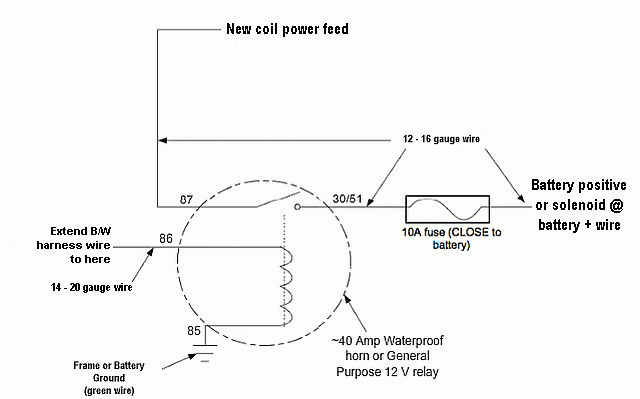
This is from DeucesWild a DOHC 750 forum originally for a coil power mod. But the basics apply to all remote relay circuts.

For those of us that don't know much about relays :

basicrelay.jpg


And a how they apply to our coils :NOTE : ALL connecting wires used should be at least 14 gauge .Terminal 30 is connected to a 10 - 15 amp in-line fuse and then to the positive post of the battery .NOTE : Terminals 85 & 86 are interchangeable . Terminal 87A IS NOT USED .Terminal 85 or 86 is frame ground .Terminal 85 or 86 ( which ever was not used for ground ) connects to the Black/white wire that you removed from the coils .Terminal 87 connects to the coil terminals that you removed the Black/white wires from .I hope this helps ... And , here's a schematic supplied by Gene :

coil_power_bypass_relay-2.gif
 
Back
Top Bottom
