Preferred splice technique?

AgentX

Over 1,000 Posts
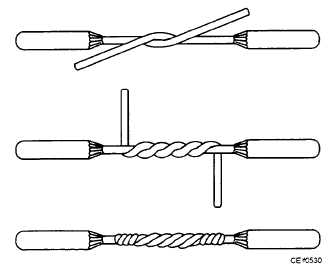
I've seen wires spliced end-to-end by twisting the two together pigtail style (obviously not ideal), twisting in-line (looks good and seems strong enough mechanically when soldered), and hooked onto each other with L shapes at the end of the line, then twisted back onto themselves.

What's your preferred technique and why? Do you always solder? Is there some kind of professional standard that can be applied, like there would be for domestic wiring?

Or do you prefer crimped connectors for some reason? Which ones?

Thanks for the insight,

AX
 
I use solder for non-stressed connections and crimped connectors for everything else.

As for soldering two wires together, I was always taught to twist each wire separately, to get all the wires into a bunch, and then twist the two together. Like this:

solder8.jpg


solder12.jpg


solder18.jpg
 
I've always used those crimped metal butt connectors for this sort of thing encased in heat shrink (slide the heat shrink on first ;))

I can't solder wire period. I've tried and tried and I just can't do it. Sounds stupid, I know. I make a mess out of things, melt the insulation etc. and never get a nice clean joint. I gave up when I tried to solder the bullet connectors on my custom wiring harness for the XS. Just bought a good proper crimping tool and it's worked great so far.
 
Sonreir said:
The trick to soldering is to not buy a cheap iron. They never get hot enough.

Exactly. A good iron is worth spending a little money on. One with an adjustable heat is best. Clean and prep of the work is really important. With solder, less is usually more, it doesn't take much to make a good connection.
 
...and don't try to solder black wires. That is heat or corrosion damage, solder will never stick. Make sure the connections are clean and shiny.
 
Hoosier Daddy said:
This is what I do, called a "Western Union Splice" after the telegraph wire connections.

Thanks for that ;)
My twisted connections always end up looking like a rats nest, and more often than not, end up loose before the solder hits it.
 
Any problems using crimped butt splice connectors on two slightly varying sizes of wire? (12/14, 16/18, etc.)

And is it possible to make a Y-join using a crimped connector? Ie, two thinner wires twisted together and crimped on one end, single fatter wire on the other, whole thing wrapped in heat shrink. Thought of soldering the two wires together but that seems to inhibit the deformation inherent in a crimped joint...maybe heat it and feed some solder in afterward?
 
Being a ham radio guy....always solder....never a doubt about the connection.

Sent from my Nexus S 4G using Tapatalk 2
 
I try to always solder all of my connections. I twist mine like Sonreir. I have had crimped connections fail before and gave up one them when I got my good soldering iron. worth it's weight
 
Tim, this may be a dumb question,(I have plenty of these) but are you using flux paste? It makes the lead flow like butter. I personally have switched to using a mini torch. No waiting for an iron to heat up and it is fast! Before twisting the wires I slide a piece of shrink wrap over the wire. Neat and clean.
 
Hm, someone here had directed me to marine wiring standards, and they specify a preference for crimps over soldered splices due to the stiffness inherent in the soldered wire and possible breakage from movement and vibration; this had led me to think crimps might work best on my bike, too. I'm using the crimp-on non-insulated butt splices with heat-shrink where necessary. A few points needed soldering for one reason or another, too...but see my earlier question about making a y-shaped join using connectors.


------

11.14.5.7 Solder shall not be the sole means of mechanical connection in any circuit. If soldered, the connection shall be so located or supported as to minimize flexing of the conductor where the solder changes the flexible conductor into a solid conductor.

EXCEPTION: Battery lugs with a solder contact length of not less than 1.5 times the diameter of the conductor.

NOTE: When a stranded conductor is soldered, the soldered portion of the conductor becomes a solid strand conductor, and flexing can cause the conductor to break at the end of the solder joint unless adequate additional support is provided.

11.14.5.8 Solderless crimp on connectors shall be attached with the type of crimping tools designed for the connector used, and that will produce a connection meeting the requirements of E-11.14.5.3.
 
Both soldering and crimping are excellent ways to connect wires if done properly. I use both techniques daily for my job. (car audio installer for 13 years)
With crimping, the proper crimping tool is essential. Using a pair of pliers is not the way to go. When a wire is crimped, the copper in the wire is exposed to air and moisture. This can lead to the wire oxidizing (turning black) and losing its conductivity. I see this often in speaker wires in doors.
My preferred method is soldering with heat shrink tubing. It "seals" the wire so the copper doesn't break down. However, an improperly soldered connection is the worst connection of all. Cold solder joints can cause a lot of problems. They may look soldered but will pass no current through them at all or work intermittently. The right heat with a soldering iron is essential.
The way I solder is to twist the wires together. (like the earlier post described on page 1) with your iron heated, put a dab of solder on the tip. Then put the tip on the wire connection, and feed the solder on to the wire. (not the tip) the wire should pull the solder into the connection. Continue feeding the solder onto the connection until the solder has worked it's way through the entire connection. Be careful not to out too much solder on the connection, you don't want any blobing.
I use 50/50 or 60/40 rosin core solder.
 
Thanks--I have been heat-shrinking over all my crimp splices and over the attachment points of all my bullet and blade connectors, and will heat-shrink over the connectors once they're snapped together in their final positions, just to hold them tight and protect the surfaces.

Is a light coating of dielectric grease over the outside of a metal connector or join before heat-shrinking a good idea to prevent oxidation? Or will it work its way into the connection point and cause resistance/loss of continuity?

Soldering has been going better for me for making y-shaped joins. My iron's not quite up to the task, but after a long time, I can get the solder to flow nicely into the joint. I think the good reviews it got online were for microelectronic work...these big wires seem a bit much for it.

Edit: and thanks again to everyone for the help--last night I fired my bike up for the first time with its home-built wiring harness!
 
The heat shrink tubing over the crimp connectors is a good idea. I have no experience with dielectric grease so I can't comment on that.

I think most of the problems people have with soldering is that they aren't using the proper heat for the job. The solder should start pulling through the connection within a second or two. Make sure you have solder on the tip before you start. Like anything, it just takes some practice to get good at it.

Good job getting your bike up and running with the new harness!! 8)
 
I have been soldering for decades. I have remains of assorted size coils in my weller gun box. That being said I have some solder that just doesn't perform well. Maybe it's not your iron or your technique. Just like anything else, if you don't buy the right materials you won't get good performance. I use 60/40 ratio tin/lead rosin core solder. Stay away from the "Lead-free" good-for-you stuff, it doesn't liquify and wont flow as well and don't use acid core as it can corrode the electrical connection in time.
 
I put dialectic grease on all of my removable connections (bullet connectors and plugs/sockets). It is used to prevent corrosion and will not affect the electrical properties.


END OF LINE
 
Back
Top Bottom