Getting back to racing post covid so I’m tearing down my CB175 to put some oversized pistons and cylinders in for GP 200. Got a surprise seeing the old pistons - both badly scored. Before I move on I‘ve gotta figure out why. Old pistons are stock with about .005 clearance. I have an oil takeoff to a 6” x 7” remote Setrab cooler. Not a lot of races on it but it was hot as hell last few outings. Maybe the wimpy CB175 oil pump can’t push enough oil through the cooler. But it’s set up with cam end oil feeds and THEY were delivering plenty of oil. Would appreciate some input.

We noticed you are blocking ads. DO THE TON only works with community supporters. Most are active members of the site with small businesses. Please consider disabling your ad blocking tool and checking out the businesses that help keep our site up and free.
You are using an out of date browser. It may not display this or other websites correctly.
You should upgrade or use an alternative browser.
You should upgrade or use an alternative browser.
GP 200 Race Prep
- Thread starter Fixit
- Start date

get a CB200 oil pump plunger and get your pump bored out to suit of just fit a CB200 pump for more volume. How hot was teh oil? We fitted an oil temperature gauge to our CB160 because it ran so hot but a 175 vert has more oil capacity and shouldn't need an oil cooler. One thing to check is the oil "filter". We had a center bolt come lose on one and that allowed oil to circulate between the sump and the pump. We were lucky that the cams don't need a lot of oil to stay alive for a while at least. You could also flush all the oilways and the cooler just in case something is blocking it.
BTW, what pistons are you going to use next?
BTW, what pistons are you going to use next?
Teaser - thanks so much for the response. Here's a pic of the work. I didn't have an oil temp gauge set up but I definitely did not feel enough heat going through the oil cooler. You can see the new pistons in the pic. Piston head and oiling based on some similar successful experiments. Putting in copper gaskets. Let a stainless steel wire ring into the top of the cast iron to deal with increased compression. I picked up a CB200 oil pump - a pretty crude unit - have to see if it can be tuned up a bit. I used to work with Frank Giannini - who focused on CB350's - and loved the big oil coolers behind the engine. A bit much for the little 175 pump I'm afraid. Frank gave it up to covid at its beginning I'm really sorry to say. I also think I'm going to install the stock cam and see if I can pick up at least a little midrange. I know that's been discussed a lot.

I'm also going to put in Cappellini's fat studs since the new pistons will come with a big jump in compression. The big studs will restrict the stud oil flow passage to the head - which has external lines so that shouldn't matter. I was thinking that the previous combination of the stud oil delivery and external lines might have been starving the bottom end and contributing to the piston scuffing. The external cam lines have a restrictor - maybe not big enough. This oiling business drives me a little crazy because I can't see it or measure it.. I'm thinking about finding a donor engine and cutting some viewing portals into it. Here's a picture of the pistons that came out!
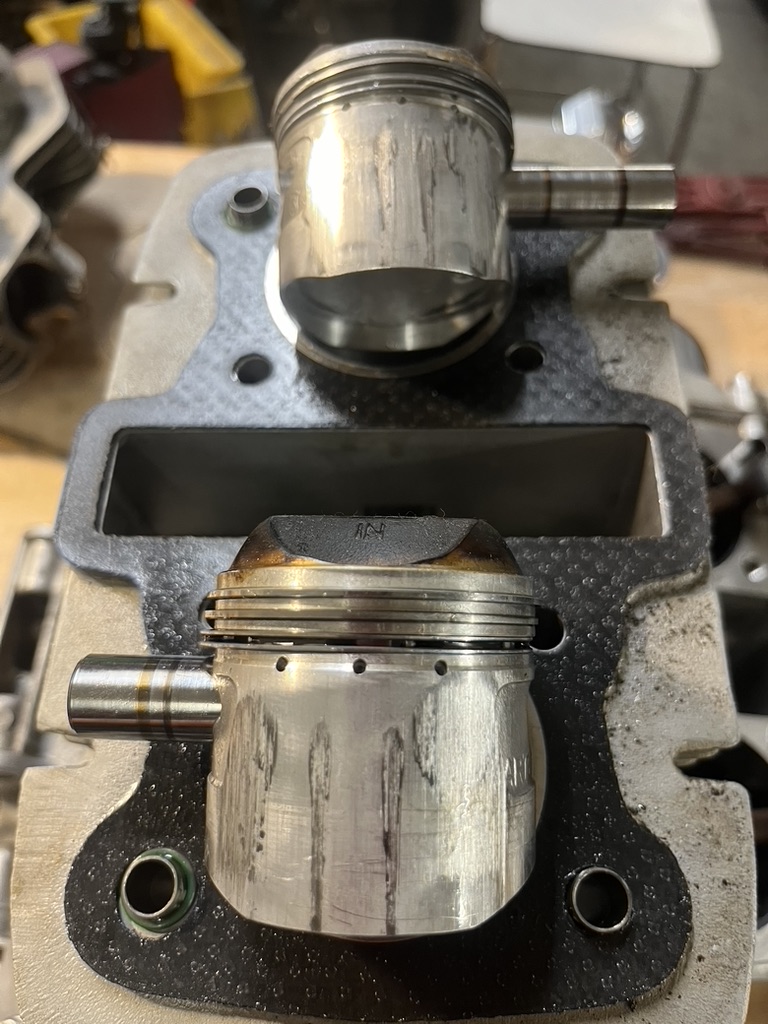
Those are seizure marks and probably 4 corners cold seize followed by more overheating and more seizing. Took pistons out of a 160 motor not unlike that. They need to be properly warmed up before taking much load even though they feel willing and ready to give their all.
Best cam for us was the street Megacycle grind. It was a good match for our port flows. personally, I hate high dome pistons because they compromise combustion and pressure rise which is what makes good power. There is always a compromise between compression and mechanical interference, but I prefer to deck the head and sometimes the cylinder and if possible machine a squish band into low crown pistons. They still require a ridiculous amount of ignition advance but not as much as with high crowns.
I also like to lighten rockers and use a single gear drive on the clutch. We don't use fat studs and so far haven't needed them.
You could bore out the oil pump body another mm or maybe more and get new pistons machined.
Best cam for us was the street Megacycle grind. It was a good match for our port flows. personally, I hate high dome pistons because they compromise combustion and pressure rise which is what makes good power. There is always a compromise between compression and mechanical interference, but I prefer to deck the head and sometimes the cylinder and if possible machine a squish band into low crown pistons. They still require a ridiculous amount of ignition advance but not as much as with high crowns.
I also like to lighten rockers and use a single gear drive on the clutch. We don't use fat studs and so far haven't needed them.
You could bore out the oil pump body another mm or maybe more and get new pistons machined.
You think that scoring was from a cold start? Maybe so. I cleaned up the 200 pump - not much material left to mill so I left it. I think to be on the safe side I’ll use smaller diameter brake lines for the oil feeds and a smaller oil cooler - maybe the cappellini cooler - slick but expensive. You have an interesting perspective on the cam and pistons. I’m using pistons modeled on some airhead pistons that Richard Moore designed and I used on a couple of bikes with very good results. I’ll give them a run and will let you know how it works out. They’re actually a little less aggressive that Rob Hall’s pistons - that have powered some pretty fast bikes. I have a Megacycle 122-10 cam that had no mid range with more or less stock pistons. I was thinking of trying it again with an intake timing of 102 degrees and see what happens. You think it’ll still be a problem with 57mm pistons?
I would try the cam you have and see how it likes it. When I built my first CB77 racer, I tried every cam in the catalog and eventually had a special cam ground that really works. I am a big fan of trying things to see what works and then I want to understand why it works. But we are all built differently. I have not tried those 57mm pistons but if I wanted a lower revving torquey motor, I might use low crown pistons in a 160 head. For higher revs, it needs more flow and Late 175 or 200 motors are much better than a 160 or sloper 175 for flow.
Tall pistons create a long bent pancake shaped combustion chamber at or near TDC which makes for less than ideal combustion. Back in the day, race pistons for our old Triumphs had huge lumps and so did CB72 race pistons, but Honda used low crown pistons on the 4s and 6s and modern motors use them too. Our issue is that the combustion chamber is tall and valve angles are wide, and that makes for some interesting challenges to get high compression as well as decent combustion.
But we can only work with what's available. On our 250, we had the combustion chambers welded and machined to a bath tub shape and modified the Wiseco low crown pistons to get a squish band and something of a crown. That way we go decent compression plus nice compact combustion chamber shape.
At that point, valve control becomes an issue because we now have a motor that like to rev and the cam chain is flapping in the breeze. A 180 degree crank will work better at higher revs than stock 360 crank but that exacerbates the valve control issue, so we need to fit a cam chain guide plus a long slipper tensioner next.
It's all about optimizing things for what your objectives are.
I am pretty use that the pistons seized first from cold start/hard running and it went from there.
Tall pistons create a long bent pancake shaped combustion chamber at or near TDC which makes for less than ideal combustion. Back in the day, race pistons for our old Triumphs had huge lumps and so did CB72 race pistons, but Honda used low crown pistons on the 4s and 6s and modern motors use them too. Our issue is that the combustion chamber is tall and valve angles are wide, and that makes for some interesting challenges to get high compression as well as decent combustion.
But we can only work with what's available. On our 250, we had the combustion chambers welded and machined to a bath tub shape and modified the Wiseco low crown pistons to get a squish band and something of a crown. That way we go decent compression plus nice compact combustion chamber shape.
At that point, valve control becomes an issue because we now have a motor that like to rev and the cam chain is flapping in the breeze. A 180 degree crank will work better at higher revs than stock 360 crank but that exacerbates the valve control issue, so we need to fit a cam chain guide plus a long slipper tensioner next.
It's all about optimizing things for what your objectives are.
I am pretty use that the pistons seized first from cold start/hard running and it went from there.
I’m with you. I’ll try the cam and see how it goes. Damn engines have too many variables to predict much. I’ve had good luck with similar pistons in the airheads with a similarly shaped head. We’ll see. The 57mm pistons displace the same volume as the stock pistons with a calculated CR of about 10:1 with a 1mm head gasket. There’s only so much room in those little heads. Maybe I could eke out a little more compression with some careful fitting but it’s likely diminishing returns. Meanwhile very interested in your head/piston experiments. Send some pics! Do you usually dyno your experiments? Awfully expensive around me. I see that dished or flat pistons and rather flat combustion chambers with center plugs are the norm in F1. I’d like to experiment with the CFD software that’s out there and see what the flame propagation looks like. I’ll see if I can have the heads scanned. I have to say that there are no big stakes in ARMHA racing and it’s great to share the experiments.
You might want to build the motor and then turn it over and see how much valve to piston clearance you have. You can either use modeling clay on the valve cut outs and measure it after, or slowly turn the motor over as it gets close to TDC and lever down on the valves to see how much clearance you have. Exhausts tend to be worse but it's either side of TDC that you are looking at.
You can slightly recess the valves which may help gas flow if it's done right and you can deepen the valve pockets in the pistons if you have minimal clearance. 10:1 is not very high but we don't want to have a 60 degree ignition timing if it's avoidable.
The issue with pancake combustion chambers is that we light the fire say 45 degrees BTDC which is close in mm to TDC, and peak pressure would be around 15 degrees ATDC and the exhaust opens quite early, so the real work of combustion is between say 15 before and after TDC which is when the piston is close to the head without a lot of space to get that fire going.
We ran dozens of dyno tests back in that day and one dyno was a Factory Pro with 5 gas analysis which allowed us to see unburned hydrocarbon levels which was eye opening. We have way to much fuel but the CO levels looked good. What was happening was the fuel droplets were too large, and what did burn showed up as more or less spot on Air:Fuel but fuel only burns on the vapor on the outside of each fuel droplet. The liquid isn't burning, the vapor is. We changed needle jet arrangements to promote better atomization and that really improved things.
Our 175 only made about 21 hp at the rear wheel but pulled great out of corners.
Keep having fun and keep us posted on your progress please
You can slightly recess the valves which may help gas flow if it's done right and you can deepen the valve pockets in the pistons if you have minimal clearance. 10:1 is not very high but we don't want to have a 60 degree ignition timing if it's avoidable.
The issue with pancake combustion chambers is that we light the fire say 45 degrees BTDC which is close in mm to TDC, and peak pressure would be around 15 degrees ATDC and the exhaust opens quite early, so the real work of combustion is between say 15 before and after TDC which is when the piston is close to the head without a lot of space to get that fire going.
We ran dozens of dyno tests back in that day and one dyno was a Factory Pro with 5 gas analysis which allowed us to see unburned hydrocarbon levels which was eye opening. We have way to much fuel but the CO levels looked good. What was happening was the fuel droplets were too large, and what did burn showed up as more or less spot on Air:Fuel but fuel only burns on the vapor on the outside of each fuel droplet. The liquid isn't burning, the vapor is. We changed needle jet arrangements to promote better atomization and that really improved things.
Our 175 only made about 21 hp at the rear wheel but pulled great out of corners.
Keep having fun and keep us posted on your progress please
Teazer - would you be kind enough to help me with the cam set up? Megacycles card below. Do I set the crank at 20.8 degrees BTC and rotate the camshaft until I have .040 clearance at the intake valve? Then check exhaust? I believe the factory spec is 10 deg. but don't know the valve opening. Maybe in the manual. Really appreciate the help.
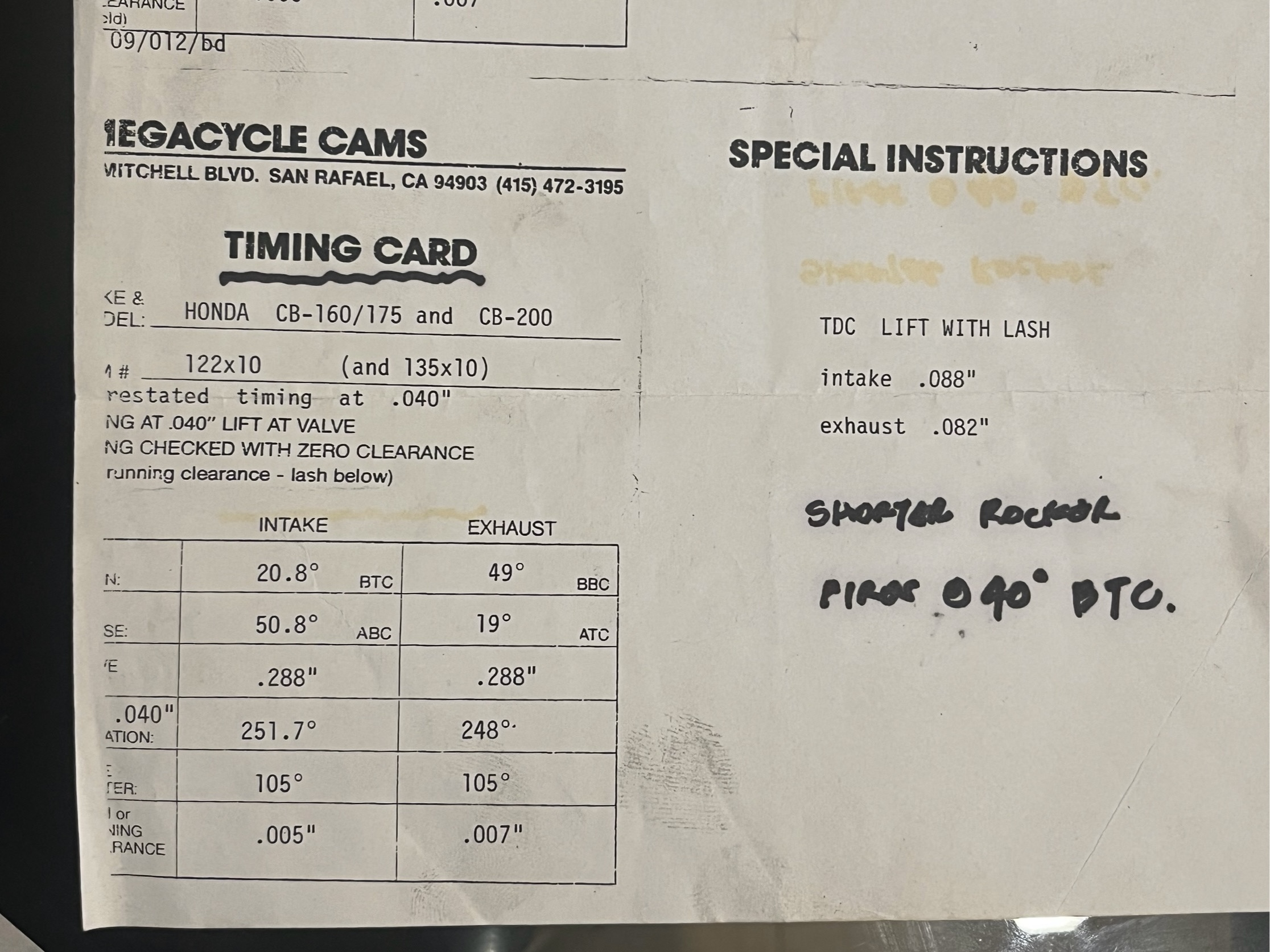
I think I found a simple way to set up the cam shaft. It actually has a name - Equal Lobe Centering - and it looks like the way the factory intended. The O on the stock cam faces up with lobes symmetrical about the shaft. At TDC that would be the valve overlap zone - where exhaust and intake are equal.
So if we make a support that sits on top of the head that holds two dial indicators over the cam lobes it can be dialed in exactly without fighting the spring tension.
Seem right?
So if we make a support that sits on top of the head that holds two dial indicators over the cam lobes it can be dialed in exactly without fighting the spring tension.
Seem right?
That is a pretty wild cam. Yes, use the stock timing mark at TDC when both valves should be equally open. That cam has 105 degree lobe centers on both lobes, so it's symmetrical. Ignore the stated timing events. If you plot actual lift at the valve every couple of degrees you will find that at .040" it's somewhat close to those points but don't worry about that. The exact shape of opening and closing ramps can throw the timing off but it's peak lift that is more important. We machine a lot off the heads and barrels and that changes the cam timing as the tensioner takes up the slack, so try to set it as you said, on the stock marks.
You will probably end up with full ignition advance somewhere around 42 to 45 degrees, but start with less and test to see what it needs.
You will probably end up with full ignition advance somewhere around 42 to 45 degrees, but start with less and test to see what it needs.
It sure loooks like classic cold seize to me, also.
How much time did that engine have on it?
I would be concerned about a .005" piston clearance unless it is a high mileage or many seasons of racing. I liked to set up my race engines with a tight .0015 clearance with cast pistons and a tight .002 for forged pistons.
Teazer is right about the breakin process, especially with tight clearances. Are your new pistons cast or forged?
How much time did that engine have on it?
I would be concerned about a .005" piston clearance unless it is a high mileage or many seasons of racing. I liked to set up my race engines with a tight .0015 clearance with cast pistons and a tight .002 for forged pistons.
Teazer is right about the breakin process, especially with tight clearances. Are your new pistons cast or forged?
Four races, a bunch of carb tuning runs, and a Dyno run. In 90’s weather. I don’t think it was abused except it was very hot. New pistons are Arias forged, .002 on the money. I think the oil circuit was too much for that little pump although the camshaft bearings had plenty of oil in em. So maybe the piston clearance was the problem. Gonna break them in easy with heat cycling. Do you have a good technique? BTW I have these beautiful CR smooth bores but I guess AHRMA has made that a clear no no. Silly though. There were smooth bores around before 68.
I think with a .002 clearance you will be fine with a normal break in process. For me, that was an easy couple of laps in the first paractice session, run the whole next practice easilly without getting the oil temp too high. After that I just send it.
I agree that you can't have too much oil pressure or volume. But your piston scuffing looks like seizure not oiling to me.
I agree that you can't have too much oil pressure or volume. But your piston scuffing looks like seizure not oiling to me.
I’ve had a lot of trouble it’s this engine. It never had any bottom or mid. Had to wring its neck and then it struggled to get back up out of turns. Tried a few carburetor/jet/manifold combos with no improvement. Had a very flat torque curve. Was producing 17.5 hp. Seemed to me that it just wasn’t pulling fuel/air below 6 or 7K. I suspect that the cam was too big for the stock displacement. Frank Giannini built the engine and I had him check the cam timing. Set up per Megacycles instructions. Still no good. We’ve now rebuilt it ourselves and checked all. Measured CR of 1:10. 26mm Keihins. We’ll see. Just has to go fast enough to be competitive.
You have too much cam for a fairly stock motor. We had a touch over 10:1 compression with flowed head and mild street cam and made 20-21 at the rear wheel with PW26 carbs from a CB77 and stock bore pistons. Those carbs are typical oval (figure 8) bore Keihin carbs and it comes out of corners much better than a similar motor we built with a hotter cam. For a million revs with decent cam chain control you can go larger on carbs and shorter on the pistons. Try more ignition advance and see if that helps low to mid range.
Of course a 175-200cc machine doesn't have a whole lot of low end or midrange to start with so a mild cam is usually better suited to that combo. I also run light rockers and hollow valve adjusting screws with a hex broached into them for adjustment to reduce valve train inertia, but that's not totally necessary.
One other thing to think about is that you can pass almost everyone in front of you as they line up to crawl around the first turn. It's so nice to see well behaved racers and so much fun to sail past on the way in.
Of course a 175-200cc machine doesn't have a whole lot of low end or midrange to start with so a mild cam is usually better suited to that combo. I also run light rockers and hollow valve adjusting screws with a hex broached into them for adjustment to reduce valve train inertia, but that's not totally necessary.
One other thing to think about is that you can pass almost everyone in front of you as they line up to crawl around the first turn. It's so nice to see well behaved racers and so much fun to sail past on the way in.
Bob Throttle
New Member
Re single primary gears. Do you just remove one of the paired crank gears and fab a spacer between the remaining gear and the oil filter cup?Those are seizure marks and probably 4 corners cold seize followed by more overheating and more seizing. Took pistons out of a 160 motor not unlike that. They need to be properly warmed up before taking much load even though they feel willing and ready to give their all.
Best cam for us was the street Megacycle grind. It was a good match for our port flows. personally, I hate high dome pistons because they compromise combustion and pressure rise which is what makes good power. There is always a compromise between compression and mechanical interference, but I prefer to deck the head and sometimes the cylinder and if possible machine a squish band into low crown pistons. They still require a ridiculous amount of ignition advance but not as much as with high crowns.
I also like to lighten rockers and use a single gear drive on the clutch. We don't use fat studs and so far haven't needed them.
You could bore out the oil pump body another mm or maybe more and get new pistons machined.