
You are using an out of date browser. It may not display this or other websites correctly.
You should upgrade or use an alternative browser.
You should upgrade or use an alternative browser.
Father Son 75 CB200T Rise From the Ruins
- Thread starter Texasstar
- Start date

The breather tube helps in wot applications, the synthetic is made for tighter clearances as in newer auto motors. Amsoil makes a motorcycle synthetic, but personally i would just go to the conventional 10w-40. The slickness of the synthetic can cause the clutch to slip also.

Texasstar
Can't is a four letter dirty word
Junior is there any other way to ride other than WOT...lol...remember we have seen you rideJunior Burrell said:the vaccum created by attaching to exhaust is not good for the low end daily drivers. If you notice,its only used in race only applications on cars.
 Zeke's bike will have two engines one for a daily rider and one to keep up with you...lol
Texasstar said:Junior is there any other way to ride other than WOT...lol...remember we have seen you ride

C12 is great fuel, but you will probably make more power on 91 or 89 octane street gas. We did. 
Oils are very subjective. I'd run a 10W-40 synthetic as long as the motor is fully broken in (no new bores or rings) and no "friction modifiers" to make the clutch slip.
BTW longer stacks on our motor made more power to 10k and short stacks were marginally worse below 10k and slightly better from 10 - 12k.
Texasstar
Can't is a four letter dirty word
seriously we are building 2 motors. This one we are tweaking to learn on. It will eventually have a better cam and compression, etc. We want to tune it as far as we can to see how much hp we can get before adding a cam, raising compression, adding new carbs. Etc.
Some of the questions I am asking are for the WOT race motor.
We found out that Jack Wilson's Texas Ceegar set 3 LSR with 3 different motors. So that must have been one heck of a chassis! One of the records was done with a 200cc tiger cub motor @130 plus. Jack was also a hot rodder
Some of the questions I am asking are for the WOT race motor.
We found out that Jack Wilson's Texas Ceegar set 3 LSR with 3 different motors. So that must have been one heck of a chassis! One of the records was done with a 200cc tiger cub motor @130 plus. Jack was also a hot rodder
Texasstar
Can't is a four letter dirty word
Thanks Teazer. Been watching this over and over! http://youtu.be/ow5cGV7bXCwteazer said:C12 is great fuel, but you will probably make more power on 91 or 89 octane street gas. We did.
Oils are very subjective. I'd run a 10W-40 synthetic as long as the motor is fully broken in (no new bores or rings) and no "friction modifiers" to make the clutch slip.
BTW longer stacks on our motor made more power to 10k and short stacks were marginally worse below 10k and slightly better from 10 - 12k.
So the problem with the Cb 200 is not that the head won't flow but that the valves won't let it??? Have so many questions. So if we made the valve seat too wide when we lapped our intake valves it can cause reversion? But can a little reversion increase hp and be the reason for us having to jet down on the dyno while seeing jumps in hp. 12-15whp by just rejetting. Can you have different seat widths to increase velocity flow for the exhaust? As you told me before we are more interested in velocity flow than just flow. A wider width for the intake and a smaller one for the exhaust? When we lapped our valves the intake it was wider than the spec because we over lapped. Did we accidentally increase velocity flow? So if you use a larger valve for the intake and have it Serdi cut and increase the compression to say 11:1 you can use a smaller exhaust valve and Serdi cut it and have two different seat widths bases on the size of the valve???? Thus increasing velocity flow?
So can we get close to having our cb flow like 4 valve head? I know you have intimate knowledge on the dohc cr72 and 77. What angle did honda have on the valve? Is my dog hunting or is he chasing rabbits?


Nice old video of Vizard talking about Minis. His comments about valve and seat shapes are important and are covered also in AG Bell's book.
1mm to 1.5mm is fine for seat width and less with a 3 or 5 angle seat/valve. Radius seats are not popular anymore as 15 degree angles basically flow the same as a radius.
When the head flows as much as you need and that's basically stock, think about valve trains and piston weight. To get it to rev, pistons must be light and rings must be thin to avoid flutter - heavy rings have more inertia than thin rings and don't seal well.
Piston to bore is the greatest source of drag even with cammed pistons, so they need to be short and even more oval than stock.
If you stick your head on a flow bench - well the bike's at least, you might be surprised to see how much it flows in relation to how much air is needed. Intakes basically flow enough already, but I may have already mentioned that. Get it on a flow bench and see both intakes and exhausts and feel free to test up to say 0.250" lift or higher.
Ours flow well at the lift our cams provide.....
Valves must be light, but titanium valves need new guides and still tend to stick. Rocker arms are also heavy and can be lightened. Titanuim valve adjusting screws and nuts are available. We had some hollowed out and broached to take a tiny allen wrench. You can make up net aluminum valve adjusting nuts too if you feel so inclined. Some of us have been doing that for decades.
Your intakes are just about the right length for the revs the motor will pull when you clean up the jetting but above 10,500 they are too long.
Any more of this and I'll have to send you a bill.
Texasstar
Can't is a four letter dirty word
which I would gladly pay but how do you put a price on something that is priceless like a "quest" or "discovery"? For that is what you have given my son and I and we really appreciate it!teazer said:Nice old video of Vizard talking about Minis. His comments about valve and seat shapes are important and are covered also in AG Bell's book.
1mm to 1.5mm is fine for seat width and less with a 3 or 5 angle seat/valve. Radius seats are not popular anymore as 15 degree angles basically flow the same as a radius.
When the head flows as much as you need and that's basically stock, think about valve trains and piston weight. To get it to rev, pistons must be light and rings must be thin to avoid flutter - heavy rings have more inertia than thin rings and don't seal well.
Piston to bore is the greatest source of drag even with cammed pistons, so they need to be short and even more oval than stock.
If you stick your head on a flow bench - well the bike's at least, you might be surprised to see how much it flows in relation to how much air is needed. Intakes basically flow enough already, but I may have already mentioned that. Get it on a flow bench and see both intakes and exhausts and feel free to test up to say 0.250" lift or higher.
Ours flow well at the lift our cams provide.....
Valves must be light, but titanium valves need new guides and still tend to stick. Rocker arms are also heavy and can be lightened. Titanuim valve adjusting screws and nuts are available. We had some hollowed out and broached to take a tiny allen wrench. You can make up net aluminum valve adjusting nuts too if you feel so inclined. Some of us have been doing that for decades.
Your intakes are just about the right length for the revs the motor will pull when you clean up the jetting but above 10,500 they are too long.
Any more of this and I'll have to send you a bill.
Texasstar
Can't is a four letter dirty word
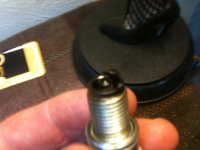
We took Lucky out for the first time last night after our dyno test. We installed new iridium plugs this is how close we got to indexing right then left. The left was not torqued right and should have been pointing to the piston. We are waiting on shims. We also installed a new battery and changed the oil. Then warmed her up and took her for a spin oh and we cleaned out filters and oiled them but squeezed and patted them dry. We only oiled only where it met the velocity stack this time.
We were told that the castrol 4t part synthetic is not what it is suppose to be so we trusted the subjective opinion of our local shop.
We were told that the castrol 4t part synthetic is not what it is suppose to be so we trusted the subjective opinion of our local shop.
Attachments


Texasstar
Can't is a four letter dirty word
Now you can probable guess our results. Yes we are running rich since our dyno was with no filters but holy moly batman Lucky ran like a scared cat being thrown in a bathtub all the way to 9500 rpm 75mph and then up to 76mph at 10500 Rpms. For every action there is an equal and opposite reaction. So we shot Les @ Vintage advantage for a quote on racing clutch friction plates and springs. If anyone has another good source for a quote that would be appreciated but Les is a good guy! We have 80'-88' for our next dyno run and we are gonna leave the filters on this time.
Next dyno run will include:
10W40 partial synthetic
Filters lightly oiled this time
Iridium plugs indexed
89 octane with a timing adjustment(maybe)
Rejet and trust the machine
Increased velocity stack length to 120mm
We are gonna wait on installing the Dyna S till later.
Next dyno run will include:
10W40 partial synthetic
Filters lightly oiled this time
Iridium plugs indexed
89 octane with a timing adjustment(maybe)
Rejet and trust the machine
Increased velocity stack length to 120mm
We are gonna wait on installing the Dyna S till later.
Attachments

Texasstar
Can't is a four letter dirty word



MJPriceisright
Coast to Coast
that undertail looks awesome.
Texasstar
Can't is a four letter dirty word
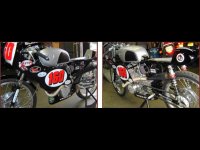
yes it does...but which exhaust produces more hp? I think from what I read from Sonreirs tutorial on how to build a cafe racer the first one does.MJPriceisright said:that undertail looks awesome.

Again... it's a lot of guesswork to see what's actually going on there, but I'd go with option number three (bike #453).
I like the straight section (turns in an exhaust system are to be avoided), it makes good use of a 2:1 design, and the exit angle of the exhaust gases are straight backwards.
Obviously, you can't see what's going on under the fairing, but lets assume it's some nice sweeping bends (no sharp turns and no changing radius) with the pipes wrapped (wrapped pipes run hotter and keep exhaust velocities up).
For maximum effort designs, use stainless steel (it retains heat better than mild steel).
Texasstar
Can't is a four letter dirty word
what do you think about us using our cl175 pipes going to a collector upsizing and using this shorty?Sonreir said:Again... it's a lot of guesswork to see what's actually going on there, but I'd go with option number three (bike #453).
I like the straight section (turns in an exhaust system are to be avoided), it makes good use of a 2:1 design, and the exit angle of the exhaust gases are straight backwards.
Obviously, you can't see what's going on under the fairing, but lets assume it's some nice sweeping bends (no sharp turns and no changing radius) with the pipes wrapped (wrapped pipes run hotter and keep exhaust velocities up).
For maximum effort designs, use stainless steel (it retains heat better than mild steel).
Attachments

Texasstar said:what do you think about us using our cl175 pipes going to a collector upsizing and using this shorty?
Have you worked out the total length of the exhaust? Also, do you know the ID of the stock headers?
MJPriceisright
Coast to Coast
Texasstar said:yes it does...but which exhaust produces more hp? I think from what I read from Sonreirs tutorial on how to build a cafe racer the first one does.
haha oh now you're talking to the wrong guy, im more of the aesthetically pleasing kinda guy.