Father Son 75 CB200T Rise From the Ruins

MJPriceisright said:
haha oh now you're talking to the wrong guy, im more of the aesthetically pleasing kinda guy.
well we are building Two motors with two different exhausts with two different goals in mind. How fast can we go with this motor modifying step by step and improving from a baseline by doing just the opposite of what some do. The only mods we have made to this motor is .75 over pistons, racing valve springs and timing chain. We are using the advice of DTTers to be an online experiment so my son gains the experience and the wisdom. To see what works and what doesn't work. What we have learned so far is invaluable and my oldest son wishes he could have done something like this for it would have made physics, science, and math more applicable.

The second motor will be a full race motor and exhaust.
 
Sonreir said:
Have you worked out the total length of the exhaust? Also, do you know the ID of the stock headers?
32mm i.d. 38mm o.d. Haven't done calculations yet.
 
Sonreir said:
High octane fuel burns slower than regular. You can probably get the same power but dropping a degree or two of advance and using 87.
"There are some tried-and-true methods for increasing the combustion speed of your mixture, however. One common way is ignition advance. By lighting the mixture sooner, you can actually begin building pressure while the piston is still accelerating toward TDC. By the time it reaches TDC, you also have a ton (literally) of PSI built up and so it pushes the piston back down with greater force." -Sonreir's how to build a functional cafe racer.

It is a shame that thread only has 12,000 views...oh we'll their loss our gain :)

Can we do the same exercise we did with the 93 octane with the 87? Return to our original setting and then advance the timing till we have an increase in idle speed and then back it off slightly?
 
Yes. You may (but probably won't) end up with a slightly lower level of advance as lower octane fuels burn more readily.

Keep an ear out for pinging while you're riding. It's a sure sign that your engine wants more octane. If you're not familiar with the sound, it's not unlike dropping a box wrench on a concrete floor.
 
Also, if you have some extra dyno time, you can set the timing using one of those infrared thermometer gun thingies..

Intentionally set the timing a between five and ten degrees retarded. Get the bike running and warmed up and get it on the dyno.

Get it rolling and perform several WOT runs under load. Have someone measure the temps of the headers at the first bend after they exit the head.

Repeat, advancing the timing by a degree or two each time. You should notice the temps on the headers dropping.

Stop this process when you notice the temps rising again. Dial it back two degrees and you're golden.

Congratulations... you're now running on the ragged edge. ;D
 
High Octane fuel does not necessarily burn slower than lower octane fuel, but that's a fair generalization for street gas, so you tweak the ignition timing so that both generate peak cylinder pressure at 14-15 degrees ATDC. Some race gas has very high flame propagation rates and some not so much.

Start with 89 octane and optimize for that fuel. remember that spark plug tips don't burn off as much carbon with street gas as they do with race gas and it's easy to confuse that and air:fuel ratios. One leaves more carbon because of thr carbon-carbon bonds.

Of those three pipes, the only way to know for sure is to try a few different lengths on the dyno. My expectation is that the first would make best power, #453 would be a goos off road exhaust but not very good on the dyno as the primaries are about twice as long as necessary and the last one is unlikely to do much of anything. That's just an opinion and your motor may see things differently with a mild cam and low compression. In fact yours may not respond much to exhaust changes at all.

Set up the headers to stop short and fit two or three lengths of alternate mid pipes to the collector and then try 2 different megaphones - short and long. Use springs to hold the parts together and weld a bent nail or spoke as the spring loop/hook.
 
Sonreir said:
Also, if you have some extra dyno time, you can set the timing using one of those infrared thermometer gun thingies..

Intentionally set the timing a between five and ten degrees retarded. Get the bike running and warmed up and get it on the dyno.

Get it rolling and perform several WOT runs under load. Have someone measure the temps of the headers at the first bend after they exit the head.

Repeat, advancing the timing by a degree or two each time. You should notice the temps on the headers dropping.

Stop this process when you notice the temps rising again. Dial it back two degrees and you're golden.

Congratulations... you're now running on the ragged edge. ;D

The first part is correct, but I respectfully disagree with the second part.

Keep in mind that pipe temps drop when the motor is detonating and CHT rises. Too much advance will kill power so that's easy to see on the dyno. Run different advance and teh one that makes most power and torque where you want it is the perfect timing for your motor.
 
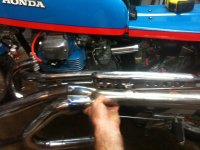
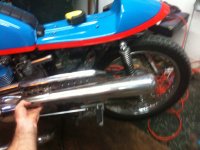
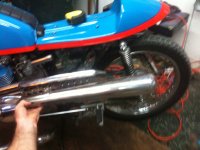
Well our neighbor Steve must be a mind reader and just when we need help or a part something or someone shows up. 17" reverse megaphone and a 2 into 1. Our headers have a 38 mm od . The outside diameter of these headers are 44mm goin into the 2-1 the od going into the megaphone is 51.66.

Is this viable for our cb exhaust?
 

Attachments

  • image.jpg
    image.jpg
    1.1 MB · Views: 312
  • image.jpg
    image.jpg
    1.1 MB · Views: 304
  • image.jpg
    image.jpg
    246.3 KB · Views: 300
  • image.jpg
    image.jpg
    1.1 MB · Views: 324
The goal of both of our new exhausts is top end torque and HP.

Stock exhaust evaluation.
Both the cl and cb exhaust id at the head is 1.16" or 29mm
Both exhaust headers get bigger as they get to the muffler
The id of the cl pipe is 32 mm-1.25" at the muffler

The overall length of the cb exhaust was 53"
The overall length of the cl exhaust was 53"

The cb had a 22" header and a 31" muffler
The cl had a 36" header and a 17" muffler

The cl appears to have a higher gas velocity???

Sonreir said in Building a Functional Cafe Racer that open pipes produce the greatest HP.

Our target redline is 10000 rpm
Our target torque is 8000 rpm (at this time because Sonreir did the calculations)

So with the stock cam here are our calculations and assumptions.
We have both cl and cb exhaust at this time to work with.
We also have a hd sportster exhaust with a reverse megaphone and a collector

Header length needs to be 15.7 inches (((850*(180+40))/10000)-3
Over all length needs to be 62.8 inches if we do a 2-1 (15.7*4)
If we were going for more low end torque we would need to use a smaller id pipe but since we are going for high end torque we will use the 1.16 id for our calculations.
The size of the pipe into the muffler or end pipe needs to be 1.31"
 
What do y'all think of this collector and 17" megaphone?
 

Attachments

  • image.jpg
    image.jpg
    774.8 KB · Views: 335
  • image.jpg
    image.jpg
    858.1 KB · Views: 315
We extended our velocity stacks to 120 mm to try and catch a pulse @ 8000rpm
 

Attachments

  • image.jpg
    image.jpg
    993.7 KB · Views: 316
For 10,000 you really should think about larger carbs - 22mm looks about right according to the rules of thumb we use for sizing carbs. Stock carbs are restricting breathing above about 7250 RPM which may explain the long flat power curve.

BTW, where did you get those cam duration numbers from in the pipe length calculation? They look like the 1mm timing check numbers rather than effective duration which is a little longer.
 
teazer said:
F


BTW, where did you get those cam duration numbers from in the pipe length calculation? They look like the 1mm timing check numbers rather than effective duration which is a little longer.
From our tech spec in our manual. Am I reading it wrong? We've created a monster! Zeke doing 2 valves on a 750 head...tonight at our local DTT gathering...
"Now that we have our pipe sized correctly, it's time to get the length of the header. The calculation for the length is fairly simple. Length, in inches, is equal to (((850 * (180 + EBBC)) / RPM) - 3. EBBC is the number of degrees before BDC that the exhaust valve opens. In my own engine, this number is 54° and so the calculation becomes (((850 * (180 + 54)) / RPM) - 3. Unlike other RPM selections, the RPM value used in this calculation should either be the redline of the engine, or the midpoint between peak torque and redline. I'll be using my redline of 11,000 RPM. Working the math through gives us an ideal primary header length of 15.1 inches. Should you ever arrive at a length of less than 15 inches, just go with 15. You don't want these things too short."
 

Attachments

  • image.jpg
    image.jpg
    251 KB · Views: 623
  • image.jpg
    image.jpg
    197 KB · Views: 304
I suspected as much. Those specs are at 1.0mm to make checking easier. The actual valve duration is considerably longer than that. And that raises the question of when does that pulse really start to generate and when do we need to get the stuffing wave back in before the door closes.

Street cams have very gentle/gradual silencing ramps to minimize wear and noise. The side effect is that they also don't generate very clear and distinct strong pressure waves which is one reason why exhaust tuning and ram intake length tuning is not nearly as effective as we might hope for. With pneumatic valves and almost instantaneous valve opening, everything changes but on a street motor, not so much.

Next thing to think about is carb size. Stock carb won't allow it to rev that high and still make power. And pistons need work to rev reliably that high too. IIRC peak gas velocity cannot exceed 0.55 Mach because a pressure wave forms at that speed and restricts flow. I work with a MEAN gas velocity of 300 ft/sec as an ideal upper limit rather than trying to measure gas velocity in a pulsing stream of unstable gas.

That doesn't mean it's not worth trying but a hacksaw and welder and dyno time are probably the only way to see what that motor actually wants. There's probably some power to be gained by getting the exhaust right.

FYI, Performance Bikes did some testing decades ago on exhaust lengths on a Rotax powered road racer and the results were not quite what one might have expected.
 
teazer said:
I suspected as much. Those specs are at 1.0mm to make checking easier. The actual valve duration is considerably longer than that. And that raises the question of when does that pulse really start to generate and when do we need to get the stuffing wave back in before the door closes.

Street cams have very gentle/gradual silencing ramps to minimize wear and noise. The side effect is that they also don't generate very clear and distinct strong pressure waves which is one reason why exhaust tuning and ram intake length tuning is not nearly as effective as we might hope for. With pneumatic valves and almost instantaneous valve opening, everything changes but on a street motor, not so much.

Next thing to think about is carb size. Stock carb won't allow it to rev that high and still make power. And pistons need work to rev reliably that high too. IIRC peak gas velocity cannot exceed 0.55 Mach because a pressure wave forms at that speed and restricts flow. I work with a MEAN gas velocity of 300 ft/sec as an ideal upper limit rather than trying to measure gas velocity in a pulsing stream of unstable gas.

That doesn't mean it's not worth trying but a hacksaw and welder and dyno time are probably the only way to see what that motor actually wants. There's probably some power to be gained by getting the exhaust right.

FYI, Performance Bikes did some testing decades ago on exhaust lengths on a Rotax powered road racer and the results were not quite what one might have expected.
Thanks Teazer! Will you be at Barber this year?
 
Since we are putting in new kevlar friction plates and better springs is this the best way to lighten the clutch basket and reduce mass off the crank? Is there anything else we should do to the clutch basket?
 

Attachments

  • image.jpg
    image.jpg
    71.7 KB · Views: 765
For the street, not much. but for the strip, dump starter and alternator and kickstarter arrangement. Single clutch gear is one I like too. Alloy wheel rims and alloy center bearing spacers also help. Aluminum footpegs help too.
 
One of our fellow DTTrrrs had a cool light seat made out of packing foam so with a little sculpting and a heat gun we made one for Lucky. Super light!
 

Attachments

  • image.jpg
    image.jpg
    1.1 MB · Views: 310
  • image.jpg
    image.jpg
    1.1 MB · Views: 296
  • image.jpg
    image.jpg
    1.4 MB · Views: 335
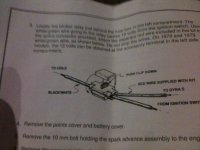
Installed a Dyna S on our CB200. After researching several electronic ignitions at Teazers suggestion we bought a Dyna S dc1-3 for a Honda Gl1000 the backing plate was a perfect fit and a direct swap for the points plate. It was also the best price we picked ours up for 125.00.

We removed the points and the timing advance mechanism. We removed the cam rotor from the advance mechanism.

We had to grind the back of the new rotor down about 3/8" and had to use a dremel to lengthen the channels in rotor.
 

Attachments

  • image.jpg
    image.jpg
    183.1 KB · Views: 306
  • image.jpg
    image.jpg
    79.4 KB · Views: 302
  • image.jpg
    image.jpg
    57.2 KB · Views: 606
  • image.jpg
    image.jpg
    123.9 KB · Views: 305
The module on the right handles cylinders 1 and 2 so we will took off the left module and save it for when we add two more cylinders :) The right module provides +/- 10 degrees adjustment... .010 movement is 1 degree.

We found the hot wire going into the coil and used the splice connector provided and connected the red wires.
We bypassed the condenser since it is no longer needed and connected the yellow wire to the output of the coil.


We statically timed and fired her up.

Now as Teazer said all e need to do is drill some vent holes in the cover and we will be "golden"

Thanks Teazer it works great! God we are lucky.
 

Attachments

  • image.jpg
    image.jpg
    178.5 KB · Views: 330
  • image.jpg
    image.jpg
    931.3 KB · Views: 323
  • image.jpg
    image.jpg
    1.2 MB · Views: 326
  • image.jpg
    image.jpg
    31.1 KB · Views: 732
Back
Top Bottom