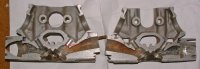
Texasstar
Can't is a four letter dirty word
Our goal is to run the BUB run at bonneville in three years when my son turns 13.danejurrous said:You going to make a run out at speed week?

Our goal is to run the BUB run at bonneville in three years when my son turns 13.danejurrous said:You going to make a run out at speed week?
 Thanks we appreciate all of you!


Thanks Sonreir. What head is that off of? What is your choice of valve spring and guides and I understand you have a motor with titanium valves?Sonreir said:It would seem to me you'd get more gains by reshaping the ports (specifically the intake).
If empirical tests are showing a loss in power with a hotter cam, the it would seem that the intake ports are not properly sized. A hotter cam will reduce power below a certain RPM, but it should also make it back (and then some) higher up in the revs.
The sizing of the intake ports should be a small as possible without restricting flow. That can be tested simply by hooking up your head to a flow bench (a home made flow bench even works here) and packing playdough into the ports until the flow rate starts to drop (then you know you've gone too far). Additionally, the shape of the intake port will be a contributing factor.
I recall reading that the ideal size for the intake port in a single valve engine is around 80% of the diameter of the valves. Furthermore, the ideal shape will be a D, with the flat side of the port being the port floor. So if your intake valves are 25mm in diameter (I think that's right, but just run with me here if I'm not), then the distance from the port floor to the port ceiling should be around 20mm.
In order to get the ports shaped properly, it isn't always necessary to resort to the addition of metal. If you're building a flat-out top speed racer, then you can expect to have this engine apart a lot of the time. Because of that, you can use methods which may not have as long of a lifespan without concern (because you'll be constantly inspecting them every time the engine is apart). There is a product called Devcon F which is an aluminum epoxy that is very resistant to heat. It can be used to fill in intake ports. It's pretty easy to work with and I recommend it. You can/should end up with something like this (though you will want a smooth transition from manifold to head, so the D shape should be a not be a sharp step):
To increase flow further, you should also grind down any casting marks from the inside of the port ceilings. Additionally, I recommend grinding down the intake valve guides (on the inside of the port) such that they are flush with the port ceiling.
Do all your tests with clay and a flow bench before moving to epoxy and I think you'll be fairly pleased with the results. If you haven't yet, take a look a three (or even five) angle grinds on the valve seats and backcutting the valve, I recommend that as well. Tuliping the valves will help, too, but it's tricky and you need a good machinist to pull it off.
Sonreir, speaking of arm chair theorizing....I was wondering if this chart was valid and if so, how to read it. I am not sure if the valve lift is correct for our cb200 but I plugged our info that I do know. This is our stock configuration using stock valves 28/25 intake/exhaust and stock 18mm carbs.Sonreir said:Please let us know how it gets on. Obviously, empirical data trumps armchair theorizing, but I'm wondering if tweaking the timing would result in same final effect?
I have not been able to track John Branson down to ask. Maybe Teazer will comment on his thoughts. John made a comment on another forum and maybe it was just a passing thought but it sounded like common sense to me. The cb200 is "constipated" according to Teazer and John at the exhaust valve. Here is the conversation...Sonreir said:I'm really surprised by the intake and exhaust valve sizes. Exhaust valve is usually around 15% smaller and this setup is nearly identical. Seems something is going on here that I don't fully understand.
i have not seen pictures but it is my understanding by what Teazer has mentioned when we took our head to a car race shop and I posted what they wanted to do...Teazer yanked our bridle like we were going off a cliff. He told us at the time it is the way in which the exhaust is flowing that is causing the turbulence or restriction. He told us at that time not to touch the floor but to raise the roof. He said that keeping the velocity flowSonreir said:What I don't understand is why the exhaust valve is the problem... Traditionally, the exhaust valve is much smaller than the intake valve and in the CB200, it's only a little smaller. It would seem to me that the ratio indicates and intake valve issue rather than exhaust...
It's not that I don't believe these guys, it's just that I'm not ready to sign up to the idea until I know the reasons behind it.
Texasstar said:He told us at that time not to touch the floor but to raise the roof. He said that keeping the velocity flow up was paramount.
the Schumann Family in your neck of the woods has a full blown high lift kit using 1.5 over raising it to 29.5 and 25.5 which lowers that to 1.15 I think they like to turn left and drag a foot though...Sonreir said:Not and uncommon modification with a hemi head. A hemisphere is the ideal shape for a combustion chamber, but it has been abandoned by most manufacturers due the limitations in flow when it comes time to design the ports and situate the valves. The one thing a hemi head does really well, however, is compression, so travelling that road is low hanging fruit.
I'm tempted to go locate a CB200 and open it up, now.
Also... it appears my earlier information was incorrect. The ratio between the intake and exhaust valves is in line with other single valve Honda engines of the day. For some reason, I had it in my head that the exhaust valve was only 1mm smaller in diameter.
Honda CB350/360 Intake Valve - 34mm, Exhaust - 29mm, Ratio: 1.17
Honda CB4500 Intake Valve - 38mm, Exhaust - 33mm, Ratio: 1.15
Honda CB160 Intake Valve - 25mm, Exhaust - 22mm, Ratio: 1.14
Honda CB175/CB200 Intake Valve - 28mm, Exhaust - 24mm, Ratio: 1.17

Sonreir we really appreciate your time and what you are teaching us. Thank you.Sonreir said:The optimum velocity changes with the lift and duration of the cam and the current revs on the motor.
Let me see if i can digest part of what you just told me...so what a charts above should look like is different velocities for each cycle..then the optimum velocity changes as we go through the motor cycles (bad joke) we should have a higher velocity through the carb, slightly slower through the intake valve and slightly slower through the exhaust valve??? Because there is a certain amount of resistance that creates velocity. To much or too little in each cycle creates a problem.Sonreir said:No problem, man. I'm learning a few things here, too. This is a great thread.
Also... I should have clarified my statement. Exhaust velocities should be around 300 feet per second at WOT at peak torque.
It's the intake velocities that tend to vary. The reasons for this become apparent when you look at when the cam opens and closes the valves.
Low engine RPMs mean the cylinders are filling less often. A low volume of air through a large volume of intake port means low air velocity. As engine speeds increase, the cylinders fill more often and the volume of air ingested in a given time increases. Your intake port stays the same size, so more volume through the same area means greater velocity.
How this velocity comes into play becomes very important. The ideal time for your intake valve to close will be when the pressure inside the cylinder is equal to the pressure within your intake port. If the valve closes too early, this represents a loss in potential power because it was possible to fit additional fuel and air into the cylinder. If the valve closes too late, your rising piston has created a positive pressure differential between the intake and the cylinder. Unburned fuel/air mix is pushed out of the cylinder and back into the intake port (this is called reversion). This is the trade off when picking a long duration cam; a lot of reversion at low RPMs which results in a drop in torque and power, but you gain at the top end because the intake valve is no longer shutting too soon. Most of the time, calculated horsepower wins out because power increases as revs increase (assuming all other variables hold constant).
One other variable to balance in this equation is the intake velocity and flow. Traditionally, velocity and flow are the opposites of one another. Velocity is attained by reducing the size of the intake, whereas flow is increased by providing intake ports that have a larger cross sectional area and/or better shape. Counter intuitively, you can actually increase overall flow with a increase in velocity as all of the air molecules will tend to travel in the same direction rather than floating around a bumping into each other (as occurs with overly large intakes). This same theory is what drives the design of velocity stacks.
The real reason for seeking a high velocity intake goes back to cam durations, however. Traditional four stroke engine theory has us believe that there are four distinct cycles of operation in the engine: Intake, Compression, Power, Exhaust. I subscribe to the idea that this is overly simplistic when it comes time to build for power.
We really need to blur the lines between the Exhaust, Intake, and Compression strokes. The reason for this blurring is that the intake valve is open for all of the Intake stroke, but also for part of the Exhaust and Compression strokes.
When the intake valve begins to open, the piston is still rising and exhaust gases are still leaving the cylinder. The reason for the early opening of the intake valve is this: Low lift flow is nearly non-existent, so by opening the intake valve early, we can ensure we have the flow we need when we want it. How quickly we transition from a low flow to high flow situation has everything to do with velocity, however. The speed at which a fluid (air is a fluid) travels and accelerates is directly related to the difference in pressure between the two locations (this is called Delta P). This means we get the best fill rate of the cylinder when the pressure within the cylinder is low and the pressure within the intake is high. This pressure within the intake port is created by a high velocity charge impacting a suddenly-closed intake valve from the previous cycle (think about a line of joggers following one another in a straight line and the lead runner runs into a wall; all the guys in the front are gonna get squished and this is the same thing that happens to the air in the intake). So this high velocity allows us to open the intake sooner and start the process sooner. As RPMs increase, we have less and less time to perform this operation, so every microsecond counts. Like racing, sometimes your overall placement will come down to your start.
Now we're on to the Intake stroke. The piston is now descending and the intake valve is now open a significant amount. High velocity is still of benefit, but this stroke is all about flow. The lift of your cam will play a significant role in this cycle. Delta P quickly shifts as the piston descends and the volume within the cylinder increases. This causes low pressure within the cylinder (when compared with atmospheric). As the air enters the cylinder, the air exits the intake, and so the differential begins to equalize and more air is pulled (by gravity) into the intake tract to replace the air entering the cylinder. This action increases your upstream intake velocity which will help the stroke.
As the Intake stroke comes to an end and the Compression stroke begins, the intake valve is still open. The reason for this has EVERYTHING to do with intake velocity. The volume in the cylinder is now decreasing as the piston rises. This causes a corresponding increase in pressure inside the cylinder which can only be overcome by pressure within the intake (which comes in the form of velocity). So long as you have greater pressure within the intake than you do within the cylinder, you should hold the intake valve open so you can keep stuffing in more fuel and air. The higher the intake velocity, the longer you can hold the valve open (or partway open). It's like stuffing suitcases into the back of your car; you can pack in many as you want so long as you have enough strength to close the trunk when you're done.
So here are the variables you're working with, listed out without too much flourish:
*The engine will want to ingest a certain amount of air at a given RPM due solely to the displacement
*The velocity at which the air enters the engine is governed by the size and shape of the intake ports and valves, any upstream obstacles such as the carbs and intake filters, and the ability of the engine to dispel exhaust gases from the previous cycle
*Because the intake design is static (excepting CV carbs), intake velocity changes as RPMs change
*The camshaft controls when the valves open and close (and how wide the valves open) and this is usually static as well
*Because damn near everything is static except velocity, a cam works best at a specific RPM band
*Changing any of the above variables will affect all of the others, but it usually holds true that a cam of higher duration and higher lift will provide better top end horsepower so long as the intake and exhaust ports/valves are not a limiting factor (either by having too little flow or not enough velocity)