
You are using an out of date browser. It may not display this or other websites correctly.
You should upgrade or use an alternative browser.
You should upgrade or use an alternative browser.
Father Son 75 CB200T Rise From the Ruins
- Thread starter Texasstar
- Start date

Texasstar
Can't is a four letter dirty word
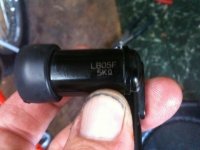
thanks Teazer and we are finally getting into a habit for shop safety! It was the easiest modification we have made thus far. It will go on the crank in our race motor!teazer said:Nice job there team Texas. and it comes with a spare module - how cool is that.
Texasstar
Can't is a four letter dirty word
This string is a journal of our journey both the successes and failures. As some of you know I didn't know the difference between a two stroke and a four stroke when we started down this path. So we just installed Iridium IX plugs with 5k ohm resistor caps which totally negated the performance benefit. When we got our Taylor spiro 8mm wires I thought the plug ends looked cheap and because I was cheap and didn't want to buy the caps for the spark plug I cut the end off and put on new NGK ends that I had purchased earlier. Those cheap looking Taylor ends were shock and heat resistant. Lesson learned and if you read this maybe you won't make the same mistake. So off to the parts store for non resistor plug ends.
Attachments


kopcicle
antidisestablishmentarian
And if you look into the ngk plug cap you will see a slot in the brass that looks like a screw driver will fit into . It does and will . Unscrew the brass and a small fuse like cylinder will fall out . Guess what ? It's the 5k ohm resistor . Replace with a coper rod/slug same diameter and length and you have a non resistor spark plug cap ....
~kop
~kop
Texasstar
Can't is a four letter dirty word
Thanks Kop!kopcicle said:And if you look into the ngk plug cap you will see a slot in the brass that looks like a screw driver will fit into . It does and will . Unscrew the brass and a small fuse like cylinder will fall out . Guess what ? It's the 5k ohm resistor . Replace with a coper rod/slug same diameter and length and you have a non resistor spark plug cap ....
~kop
Texasstar
Can't is a four letter dirty word
We will try and pick some up and see what they do on the dyno! We are waiting for our indexing 12mm washers...talk about a pain to find for a reasonable price.Sonreir said:If you can find 'em in your size, try the plugs with multiple side electrodes. They give a slight performance benefit.
Texasstar
Can't is a four letter dirty word
Gentleman I found this quote from Hondaman and was wondering your thoughts.
"I've been recently experimenting with the Dyna 3-ohm Green coils and have found that using the 10k ohm caps (see post above) can stretch the spark duration almost 10% longer with the plugs gapped at 0.045". This is a good thing, especially in the swirl-charge engines like the 750 K0-K6."
"I've been recently experimenting with the Dyna 3-ohm Green coils and have found that using the 10k ohm caps (see post above) can stretch the spark duration almost 10% longer with the plugs gapped at 0.045". This is a good thing, especially in the swirl-charge engines like the 750 K0-K6."

45 thou gap and 10K ohm resistors, what is that all about.
Get some crimp on plug caps from an auto performance store http://www.summitracing.com/search/brand/moroso/department/ignitions-electrical/part-type/spark-plug-wire-components
You can use resistor leads or solid leads, but solid copper are probably better.
3 ohm coils are OK on a race motor because it is turning higher revs and therefore has less dwell time. For a street motor, 5 ohm is better.
Texasstar
Can't is a four letter dirty word
What about for a LSR engine? Need just enough juice to get down bonneville and back. We are running a 5 ohm Dyna for our street motor.Sonreir said:I'd stay away from the 3 ohm coil unless you plan to upgrade your alternator in some way.
Texasstar
Can't is a four letter dirty word
We got our kevlar clutch friction plates and springs from Les @ Vintage Advantage. (Best price and service) we ordered Monday and voila for the weekend.)
We found the 12mm indexing washers at thunderproducts.com
Lzfh NGK non resistor screw on plug caps.
We found the 12mm indexing washers at thunderproducts.com
Lzfh NGK non resistor screw on plug caps.
Attachments


Texasstar
Can't is a four letter dirty word
We will let you know. The school of thought was to index the plugs in the same direction of the intake to syncronize and maximize the kernel. One plug may have a different index washer than the other. We have one plug close to being pointed to the intake. Now how important this is with iridium plugs I don't know. We will see on the dyno. Some drag racers say it gives them an increase in hp. There is a trade off on non indexing with a slight compression difference. We will let you know what the bang is for the buck. I firmly believe you quote below is true.Sonreir said:What's the logic behind the indexers? I would think that so long as you're not getting carbon onto the threads of the plugs and the plugs aren't contacting the pistons, you'd be better off having them as far in as possible.

danejurrous
Been Around the Block
Texasstar said:Need just enough juice to get down bonneville and back.
You going to make a run out at speed week?

Texasstar
Can't is a four letter dirty word
Our first dyno run was a learning experience. We had our timing advanced for that run and we were using 93 octane. Since we were running rich we wanted to eliminate all the potential issues of why we weren't burning that fuel. So we removed the points added the Dyna S, installed iridium plugs, extended our velocity stacks, and added non resistor plug caps. Now we are going back to our original timing with the new Dyna S but this time we will use 89 octane for our first dyno run and then check our air fuel mixture. If we are still running rich we will rejet.Sonreir said:Please let us know how it gets on. Obviously, empirical data trumps armchair theorizing, but I'm wondering if tweaking the timing would result in same final effect?
We will advance our timing on the dyno for run 2
We will index our plugs for Run 3
Here are the changes we have made for the next set of runs:
Ear plugs
20w-50 to 10w-40 partial synthetic
Indexing
Iridium plugs
Dyna S
We have more jets 80-88
We extended our velocity stacks to 120mm
We will see if that improves on our best dyno run of 15.2 whp
For our next speed run we have:
New clutch plates and springs
A 17 tooth front sprocket
Texasstar
Can't is a four letter dirty word
gotta love those hot rodders...thanks JB!Junior Burrell said:I like the hot rod tricks!!!