Father Son 75 CB200T Rise From the Ruins

Interesting to see a difference in your rocker weight measurement.
What year are your engines, and what are the casted numbers on the sides?

I wish i had two scales to validate my findings...

cb200/175 rocker weight:

Casting #
h = Hardening flash
i = intake
e = exhaust

#cl175 rocker + tappet hardware:
#21 48g + 2.5/3g = 51g (hardened exhaust)
#N19 48g + 2.5/3g = 51g (hardened intake)

Note: Both had 17g on the tappet after a balance check.

cb200:
#96 ie 47g + 3/4g = 50g (all stamped 96)
 
Texasstar said:
would the 200 oiling lend itself to better oiling a ball bearing mod for the ears and cam?

I'll get back to you on that. I have a pile of CB160/175/200 cams on the bench and it's clear that neither is without failures. On a 175, oil to the rockers is fed from one end of the cam and oil feed to the other end simply spills out past the end bearing keeping it well lubed. On the 200 they introduced a small oil feed hole in that end bush so oil would feed through the cam to the rockers and some would be left to push out and lubricate that end cap/bearing.

For a race bike, I would use needle rollers running on hardened sleeves and I'd see if I could feed oil up both rear studs like a 175/160. Sleeves are cheap and if the cam is being reground anyway, get Jim Dour at Megacycle to turn down the ends and press on the sleeves while he's doing it.

If you keep CB200 single ended oiling system, you can't use a stock hardened sleeve unless you have a hole drilled through for that oil feed. You could look at ball bearings instead, but whatever way you go you have to do something with the oil pathway. With ball bearings, theirs no oil pressure, so you need to change the end feed. With needle rollers there's more leakage, so you may need to open up the rocker oil holes a touch.
 
acm177 said:
Interesting to see a difference in your rocker weight measurement.
What year are your engines, and what are the casted numbers on the sides?

I wish i had two scales to validate my findings...

cb200/175 rocker weight:

Casting #
h = Hardening flash
i = intake
e = exhaust

#cl175 rocker + tappet hardware:
#21 48g + 2.5/3g = 51g (hardened exhaust)
#N19 48g + 2.5/3g = 51g (hardened intake)

Note: Both had 17g on the tappet after a balance check.

cb200:
#96 ie 47g + 3/4g = 50g (all stamped 96)
that is great info and our rocker arms were for a 75 cb200...we will weigh Victorias(72 cb175) rocker arms tonight and we just pulled another engine from a 70 cl175...and we have one more cb175 motor to pull.
 
acm177 said:
Interesting to see a difference in your rocker weight measurement.
What year are your engines, and what are the casted numbers on the sides?

I wish i had two scales to validate my findings...

cb200/175 rocker weight:

Casting #
h = Hardening flash
i = intake
e = exhaust

#cl175 rocker + tappet hardware:
#21 48g + 2.5/3g = 51g (hardened exhaust)
#N19 48g + 2.5/3g = 51g (hardened intake)

Note: Both had 17g on the tappet after a balance check.

cb200:
#96 ie 47g + 3/4g = 50g (all stamped 96)
keep in mind that we haven't found the obscure # required to calibrate our harbor freight scale yet. But we are more interested in the difference loss than anything. Here are our #' so far:
Ex valve - 25g
In valve -25 g
Piston w rings and dowell- 168 g
Dual valve springs- 31 g
Retainer- 5g
Keepers - -1gram
Cam w sprocket bolts-649g
Cam sprocket-128 g
 
Texasstar said:
that is great info and our rocker arms were for a 75 cb200...we will weigh Victorias(72 cb175) rocker arms tonight and we just pulled another engine from a 70 cl175...and we have one more cb175 motor to pull.

If you find a good CL175 sloper motor, I'll swap you a complete CB200 motor that's doing useful work propping up a sloper frame ...

Acquiring spare motors is always a good idea. Remember that you need the 200 oil pump in the small motor too. We bore our CB160 pumps to take the larger later piston for more oil volume. Don't tell anyone. It's a secret.
 
acm177 said:
Interesting to see a difference in your rocker weight measurement.
What year are your engines, and what are the casted numbers on the sides?

I wish i had two scales to validate my findings...
75cb200 rocker arm weight
(marked) weight
RI. (18). 53g *total including 2g screw 1 g nut
RE. (19). 53g
LI. (19). 54g
LE. (18). 53g
All dowel pins. 35g!!!!!

72cb175:

Ri (21). 50g *total including 2g screw 1g nut
Re. (20). 52g
LI. (N-18). 49g
Le. (20). 52g
All dowell pins. 19g wow!

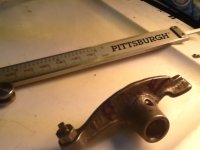
3/4 rocker arms on the cb200 have stress cracks see below.
Zeke is holding the dowell pins on the cb175 left and cb 200 right. The 200 was machined to screw a bolt in for removals and is significantly heavier than the 175.
Significant difference between the flat end of the 200 and 175. Cb175 left and cb200 right.
 

Attachments

  • image.jpg
    image.jpg
    205.5 KB · Views: 326
  • image.jpg
    image.jpg
    238.2 KB · Views: 344
  • image.jpg
    image.jpg
    147.2 KB · Views: 334
teazer said:
I'll get back to you on that. I have a pile of CB160/175/200 cams on the bench and it's clear that neither is without failures. On a 175, oil to the rockers is fed from one end of the cam and oil feed to the other end simply spills out past the end bearing keeping it well lubed. On the 200 they introduced a small oil feed hole in that end bush so oil would feed through the cam to the rockers and some would be left to push out and lubricate that end cap/bearing.

For a race bike, I would use needle rollers running on hardened sleeves and I'd see if I could feed oil up both rear studs like a 175/160. Sleeves are cheap and if the cam is being reground anyway, get Jim Dour at Megacycle to turn down the ends and press on the sleeves while he's doing it.

If you keep CB200 single ended oiling system, you can't use a stock hardened sleeve unless you have a hole drilled through for that oil feed. You could look at ball bearings instead, but whatever way you go you have to do something with the oil pathway. With ball bearings, theirs no oil pressure, so you need to change the end feed. With needle rollers there's more leakage, so you may need to open up the rocker oil holes a touch.
thanks Teazer!
 
So did honda make non flash hardened rocker arms that were heavier to compensate? What is up with the dowell pin being so much heavier and would that matter? We have stress cracks on 3 of the rocker arms just like the picture above! The cb175 rocker markers n-18 is significantly different than all the other rocker arms. We are going to disassemble the other two 175 engines this weekend.
 

Attachments

  • image.jpg
    image.jpg
    132.4 KB · Views: 331
CB200 have solid pins which are threaded to make it easy to remove them. CB/CL 160/175 are hollow.

Rocker arms - bare, sans screw and nut

N9 43/43/43/43
N18 45.5/47
N19 46/45
N21 46/44.5
N31 43.5/42
N33 46/43.5

20 48.5
21 46
22 44.5
23 43.5/44
24 45.5
38 51.5
39 50/50
40 51.5
70 47/47
77 45
78 49

Lightened 39.5/36.5/38/37.5 (not finished or matched yet)

CB160 cams have a 30mm (notional) center part where the sprocket is pressed on. Sloper 175, upright CB175 and CB200 are all 36mm (notional)

Rocker pads appear to be hard chrome plated which you can see flakes off at times. Under stress the surface underneath collapses leaving grooves in the chrome as it sinks into the collapsed base metal - brinelling is what it's called IIRC.
 
teazer said:
CB200 have solid pins which are threaded to make it easy to remove them. CB/CL 160/175 are hollow.

Rocker arms - bare, sans screw and nut

N9 43/43/43/43
N18 45.5/47
N19 46/45
N21 46/44.5
N31 43.5/42
N33 46/43.5

20 48.5
21 46
22 44.5
23 43.5/44
24 45.5
38 51.5
39 50/50
40 51.5
70 47/47
77 45
78 49

Lightened 39.5/36.5/38/37.5 (not finished or matched yet)

CB160 cams have a 30mm (notional) center part where the sprocket is pressed on. Sloper 175, upright CB175 and CB200 are all 36mm (notional)

Rocker pads appear to be hard chrome plated which you can see flakes off at times. Under stress the surface underneath collapses leaving grooves in the chrome as it sinks into the collapsed base metal - brinelling is what it's called IIRC.
as the Beatles sang number 9!!! So how many N-9's do you have stockpiled? :) Seriously now which one of the lots was the strongest? Are all the N's from Honda's racing stash as one of my friends suggested? So what is the history behind the N's? This is fascinating!


Zeke's Victoria has been rebuilt before and what we can see from your chart is that her n-18 was from an earlier motor and it looks like our scale needs to be calibrated.
 
teazer said:
If you find a good CL175 sloper motor, I'll swap you a complete CB200 motor that's doing useful work propping up a sloper frame ...

Acquiring spare motors is always a good idea. Remember that you need the 200 oil pump in the small motor too. We bore our CB160 pumps to take the larger later piston for more oil volume. Don't tell anyone. It's a secret.
We have been looking for the Holy Grail of little Cb Motors...the illusive slippery sloper 175. As an act of gratitude if we find one we will be like Abraham was with Melchizedek...we will give you our first fruits but we are keeping the pe22 carbs...For we are very grateful Teazer and as a reformed Dutch Calvinist it seems what will cb will cb or maybe cl :) also Kop has me looking for xs650 cranks..:)

Today may be the day we find the holy grail! Road trip to Austin Texas and then to the home of Blue Bell Ice-cream down in Aggie land to pick up 12 gallons of obscure Blue Bell ice cream! We throw an ice cream party for the neighborhood kids each Labor Day!

I will share one of my secret paradoxes...I find things when I am not looking for them...And if I eat bacon it helps me lose the weight from the ice cream :)

Seriously to all thank you!
 
Differences in strength are minimal. Our N9s came from the back door of Honda R&D in Japamn. Even Pops couldn't get these. Specially forged from a rare solid matrix alloy of unobtanium and ugottabejokium. I have no idea which rockers came out of each motor. We were able to pick up whole and part motors over the years and I just stripped and cleaned and stacked them away for the inevitable rainy day. Not all of them are in good condition.

If you have choices, select those with the best pad condition and of those select teh lightest 4 and then lighten them. Sides of the beam can basically be removed and the top of the beam can be thinned out a little. There's some meat on the pad than can be trimmed and a [hyperbole] ton [/hyperbole] that can come off the threaded end.

We went down that slippery sloper and fitted 5 speed 175s in out pair of CB160s. Not much use in a vertical frame. In fact people fit vertical motors in sloper frames to get the light frame and better head.
 
teazer said:
Differences in strength are minimal. Our N9s came from the back door of Honda R&D in Japamn....Specially forged from a rare solid matrix alloy of unobtanium and ugottabejokium.
lol
 
So we are sitting at our favorite breakfast place in Austin Texas eating poppyseed pancakes and we google vintage Japanese bikes and up pops Limey. It just so happens that Limey has a passion for what he calls the greatest 650 that Triumph should have built...the XS650.
Serendipity was on our side for the biggest goodwill in Austin was by Limey so the gals went over there while we visited Limey (Chris).

We walked into Limeys and right next to his desk was a cb175. We asked him about it and he said, "the 175-200s are the bane of my existence." Chris is a nice modest bloke hailing from south London...but you can tell he is a Texan. His shop is over the top..a tz frame, polished td3 drum on the bench, a Superhawk motor with roller rocker arms, a fully restored Superhawk, and take a look at his machining tools! He showed us his pride and joy...Strawberry Shortcake a bike he built for a build off against a triumph 650 for a drag race and his 68hp Hornet.

We made a new friend and Chris offered Zeke a job to work on 175's for him. Lol. He also sold us a set of brand new Mikuni vm20's for a hundred bucks...that were on the 175 for 5 minutes. We will post all our research on how to tell the difference between a real mikuni and a knock off. One more thing to test on the dyno. The vm20 and the keihin 20 are suppose to flow the same cfm. The vm20 has a 22mm slide and the keihin has a 18mm slide...we know which one has a higher velocity.

We walked back to the van with carbs and the gals had bought us some new pots so we wouldn't use the house ones to boil simple green and soak carbs...lol

You can read about Limey's build at http://www.limeybikes.com/
 

Attachments

  • image.jpg
    image.jpg
    247.1 KB · Views: 341
  • image.jpg
    image.jpg
    167.2 KB · Views: 333
  • image.jpg
    image.jpg
    207.3 KB · Views: 324
  • image.jpg
    image.jpg
    220.9 KB · Views: 328
reds said:
Nicely done bikes
Agreed and they are more beautiful in person. Limey has built his first Texas flat track racer so we are excited to go watch it run down in Waco Texas!
 
We learn something new every day. Limey likes Mikuni carbs and hates Keihins so when somebody is passionate about something we listen. He told us the VMs have an "enrichment" device and not a choke like a mini carb within a carb.

Here is how you can tell if a Mikuni is a Mikuni. First thing we noticed is that they weigh a ton. They are about a 100 grams heavier each thank the Keihin. The vm20-273 has an "enrichment" device. Mikuni has stamped the model number right below this device on the intake side of the carb. Oh and it says Mikuni on the side. What is interesting is that every single part has a sharpie mark green, blue, etc even on the inside of the cap.

The carb slides are HUGE and measure 22.98mm. The inlet diameter is 43mm just like the vm22. According to what I have read they flow the same cfm as the keihin 20.
 

Attachments

  • image.jpg
    image.jpg
    158.6 KB · Views: 333
  • image.jpg
    image.jpg
    170.1 KB · Views: 334
Here is our comparison of the Keihin 18 , 20, and Mikuni vm20-273
Pe 18. Pe 20. Vm20
Inlet. 32mm. 32mm. 43mm
Weight. 472g. 472g. 557g
Intake. 21.68mm 21.68.mm 20.62mm
Venturi waist 16.3mm. 16.3mm. 19.78mm
Slide. 18mm. 18mmm. 22.99mm

*The cb 175 manifold is smaller on the head side and the cb200 is larger on the head side.

Cb175 manifold carb side 22.43mm
Cb 175 manifold head side 21.7mm
Cb200 manifold carb side 22.53 mm
Cb200 manifold head side 22.75 mm

Interesting observation the PE intake side is oval and not round and is slightly taller 21.9 than its width.
 

Attachments

  • image.jpg
    image.jpg
    235.9 KB · Views: 315
  • image.jpg
    image.jpg
    218.9 KB · Views: 326
  • image.jpg
    image.jpg
    235.9 KB · Views: 328
Back
Top Bottom