Sharp corners tend to generate cracks, but round corners are harder to lock in place, so you want "fairly square" corners with a small radius. Keeper angle must match the top cap, but unless it is way too shallow and pulls through, I don't see much difference between designs. I figure that anything offered by a reputable manufacturer will be OK.
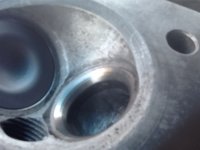
Back the valve seat/throat area. That's the point. When you start to analyze teh port it becomes clear that there are several things wrong and some can be corrected and some would require a complete re-design, so we have to make a decision as to what to change and then we test it to see if we were right.
We'd like to see exhaust ports flow around 81% of an intake on the bench BUT if the intake flows more than the motor can use, aim for 81%^ of the flow needed to support the HP target. Any higher on either port and gas velocities will be low.
Let's say on a particular head that the inlet flows say 60CFM at .200" lift and the exhaust flows 40CFM. we would be aiming for 81% or 60 or 49 CFM. Let's say that motor needs say 55 CFM to make say 35HP at say 13,000 then we don't really need 49 CFM in the exhaust. We really only need 81% of 55 or 45 CFM. Our target then is around 45 CFM in the exhaust to let all the gas the motor can use exit stage left.
If that head still only flows say 42 CFM after porting, we'll need a very efficient exhaust to create negative (sucking) waves to drag the exhaust gas out to make it work better. If the exhaust already flowed say 55CFM, then porting it won't help much because it already has sufficient exhaust capacity.
That's why I say it's not about maximizing (making everything as big as possible) but about optimizing (making the most out of what you have).



 yippe Kay yey!