Father Son 75 CB200T Rise From the Ruins

First day of Fifth grade and I gave him his text book. He got the significance of learning tinkering from Alexander Graham Bell...sometimes it seems like a big cosmic joke ;)

One year from today we will be at the BUB run at Bonneville. I won't tell what Kop says it looks like with me riding Lucky...but it involves a monkey and a football :) I told Zeke he was going to miss the first week if school next year :)
 

Attachments

  • image.jpg
    image.jpg
    1 MB · Views: 316
We have put modified CB500 pistons into CB160 with 175 liners and modified Wiseco Kawasaki 615 pistons into a 175 with shortened 200 liners.

CB200,CB500, CB77, Kawasaki 550 all have 15mm pins
CB160 and 175 have 14mm pins.

You can machine 160/175 rods to take 15mm pins and you can machine and bush CB200 rods to take 14mm pins.

If you use CB200 rods it is easier to look for pistons with 15mm pins but they are heavier and that defeats the objective. Bigger heavier pistons tend to use larger pins but I have yet to hear of a pin failure. Piston failure yes, pin failure is extremely rare.

With a 200 the rods, piston and barrels are all taller than 160/175 and that makes the interchange of parts a little problematic.

Many big bore kit pistons for mini bikes look suitable, but they have low crowns, low deck height and 13mm or 14mm pins.

I don't believe that piston weight has much to do with the revs until we are talking very high rpm. A 200 has a long piston skirt which creates a lot of drag and it has fat rings which create friction and flutter at higher revs. In addition the cam chain flaps around like a politicians lips.
 
Teaz among the many things I don't know ....
Never had a cb200 crank apart .
Is the center pin indexed by spline or key ?
what size are the big end rod pins ?
what is the center to center distance of the rod ?

~kop
 
On another note. Most of the cb200 race bike that I have observed have gone down in size (Id) of the header to increase velocity...what if we weld a tongue on the floor of the inside of our cb200 headers (they are 1.25 id) have the tongue give the exhaust a big French kiss and raise the floor of the exhaust chamber while creating a reversion damn in the pipe. What would a staggered step do? Where the roof dumps the gas into the header before the damn would? I have a set of cb200 headers to tinker with...
 
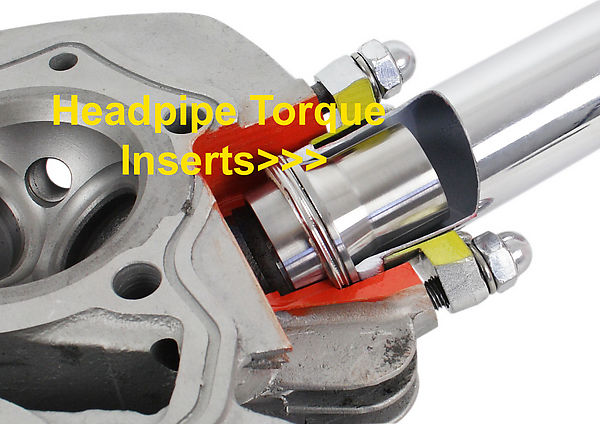
You might benefit from something like this:

07-0769.jpg


It's basically a small length of smaller diameter pipe that gets sandwiched in between your headers and the head. The sharp step change in diameter helps to prevent reversion at lower RPMs and can help with bottom end torque.
 
Sonreir said:
You might benefit from something like this:

07-0769.jpg


It's basically a small length of smaller diameter pipe that gets sandwiched in between your headers and the head. The sharp step change in diameter helps to prevent reversion at lower RPMs and can help with bottom end torque.
hi Mat my name is Pat and I am a revaholic.


are they raising the floor in this pic to increase bottom end torque whereas we want to increase torque at wot max Rpms...that fifth gear in the 200 is a dirty dog. We need to increase torque at 8000 to 11k...for that gear. We are screaming 10.5 k in 4th with both a 16/35 and 17/35 gearing. I am beginning to think your suggestion on the 24 mm

flatsides may be the answer...

I read somewhere that creating a bigger step at the top of the exhaust chamber created more torque at higher Rpms.
 

Attachments

  • image.jpg
    image.jpg
    540.7 KB · Views: 308
pacomotorstuff said:
GPz550 pistons have 14mm pin dia and GPz650 pistons have 15mm pin dia. I don't have the compression height measurement for either piston but I have been lead to understand there is at least one CB175 around here running with GPz550 pistons - which makes them around 216cc if I punched my calculator buttons right.
I don't know how the 650 pistons would work in a 200...
I'd be thinking maybe sleeves from the Kaw were used on the 175 as well but don't know for certain.
Haven't checked them out re:pin and comp height, but maybe pistons from a GS550 (2 valve) are a candidate as well?
BTW, my 175 twin is a "manly" (LOL) 187cc after boring...
Great thread, really enjoy it.
Pat

Quite a great project you folks down in the Lone Star state have going on and I hope you have continued success with it.
I have a little info to add to the above post.
The KZ models 400, 440, 650, 750 and GPZ750 all have 15mm pins except for the GPZ750 turbo has 16mm.
They also have the same pin height of .960 in./24.4mm or .665 if using a caliper measuring top of pin bore to top of piston.
Cyl. bore is 400/64mm, 440/67.5mm, 650/62mm, 750/66mm.
Stock pistons are hard to locate. Wiseco has 2 over for the 650 and 3 over for the 750 and the turbo also.
Stock comp. is 9.5 on the 650 and 750, Wiseco claims 10.25 on thiers.
Combustion chamber volume is in the 24 - 26cc.
The 400/440 have a taller dome and a deeper combustion chamber at 34/36 respectively.


.
 
At higher RPMs (and higher exhaust gas velocities) the gases will hug the port roof. The speed at which the gases are traveling creates subjects them to centrifugal forces as they're forced around the bend in the port. That's largely why raising the roof is of benefit; you're reducing the angle the gases are forced to follow.

The speed at which exhaust gases exit the cylinder are directly proportional to the difference in pressures between the inside of the cylinder and the inside of the exhaust port. Reducing the port angle reduces pressures within the exhaust port. Likewise, opening the exhaust valve sooner means exhaust gases are at higher pressures within the cylinder (though this can kill power if taken to an extreme).

By reducing the port angle, you reduce pressures which are preventing cylinder from emptying properly. Just like putting a kink into a garden hose, putting a kink into your exhaust port (as is the stock design) prevents the exhaust gases from making a straight shot out of the cylinder. The goal is to keep the angle as straight as possible for as long as possible so that by the time the gases start bunching up in the port, the valve is already on its way to closing.
 
Sonreir said:
At higher RPMs (and higher exhaust gas velocities) the gases will hug the port roof. The speed at which the gases are traveling creates subjects them to centrifugal forces as they're forced around the bend in the port. That's largely why raising the roof is of benefit; you're reducing the angle the gases are forced to follow.

The speed at which exhaust gases exit the cylinder are directly proportional to the difference in pressures between the inside of the cylinder and the inside of the exhaust port. Reducing the port angle reduces pressures within the exhaust port. Likewise, opening the exhaust valve sooner means exhaust gases are at higher pressures within the cylinder (though this can kill power if taken to an extreme).

By reducing the port angle, you reduce pressures which are preventing cylinder from emptying properly. Just like putting a kink into a garden hose, putting a kink into your exhaust port (as is the stock design) prevents the exhaust gases from making a straight shot out of the cylinder. The goal is to keep the angle as straight as possible for as long as possible so that by the time the gases start bunching up in the port, the valve is already on its way to closing.
I understand that...what about a larger step leading into the exhaust header at the top...like if the header was oval instead of round????
 
Nebr_Rex said:
Quite a great project you folks down in the Lone Star state have going on and I hope you have continued success with it.
I have a little info to add to the above post.
The KZ models 400, 440, 650, 750 and GPZ750 all have 15mm pins except for the GPZ750 turbo has 16mm.
They also have the same pin height of .960 in./24.4mm or .665 if using a caliper measuring top of pin bore to top of piston.
Cyl. bore is 400/64mm, 440/67.5mm, 650/62mm, 750/66mm.
Stock pistons are hard to locate. Wiseco has 2 over for the 650 and 3 over for the 750 and the turbo also.
Stock comp. is 9.5 on the 650 and 750, Wiseco claims 10.25 on thiers.
Combustion chamber volume is in the 24 - 26cc.
The 400/440 have a taller dome and a deeper combustion chamber at 34/36 respectively.


.
thank you Nebraska Rex!
 
Someone can correct me if I'm wrong, but I don't think a step will do much for top end. The step is in place to combat reversion and will help most in the bottom and mid range.

Even though your engine is maximum effort, you don't really lose much (or even anything is many situations) by including the step, so it's common practice to have one.
 
kopcicle said:
Teaz among the many things I don't know ....
Never had a cb200 crank apart .
Is the center pin indexed by spline or key ?
what size are the big end rod pins ?
what is the center to center distance of the rod ?

~kop

Center pin is not pinned or splined. It's a press fit and has to be correctly indexed. Rod length, pin diameter etc I'll have to look up.
 
Sonreir said:
Someone can correct me if I'm wrong, but I don't think a step will do much for top end. The step is in place to combat reversion and will help most in the bottom and mid range.

Right on.
 
teazer said:
Right on.
the number is 250-300 fps. Can you create a step header with dual exaust to keep the velocity constant?

I'm assuming that the cl by design intent was suppose to be sportier thant the cb??? Here are some interesting stats. Having a 40" tappered header would definately create low end torque according to Bell. We see this where our max torque is taking place @6300 rpm. The cl exhaust is 1.15 id and the exaust port and at the 40 inches mark where the muffler attaches it is 1.25 id.

Then the cl pipe goes to massive expansion into a muffler that has two drilled out baffles and then merges into a tail pipe that is 1.15 Id....keeping the velocity up...the total length is 58"

Does that cl muffler create an H effect with one large chamber with two baffles inside drilled out and then comes out a 1.17 id tailpipe. Now the cl360 has two pipes at the muffler for comparison creating the same effect???


Why use a megaphone if you are trying to maintain 300' per second and not stay with a straight pipe to maintain constant velocity? Is the goal to have 300' per second at the end of the exhaust and will this give the best scenario for the scavenger effect? Low pressure at the end?


According to Mr. Bell if we want to to tune at wot then the header would need to be .95 id and for each .125" increase in header size we would push when max torque occurs by 600 rpm. The cl is already oversized by .20" and so is the cb header. The header length on the cb is 22" into a 21" muffler.

We made max torque 10.5 at 6300 rpms...so in order to push that up to say 7700 rpm we need to run a shorter header. However the cl exaust is in effect tapered correctly... To keep velocity optimum???

Did we eliminate the scavenger effect by removing the muffler???
For wot what would happen if we put an X collector at 40" to create a vacuum?

I guess what i am asking is....Where is the cl exhaust becoming ineffective for wot and can it be improved upon with and x collector? Will another exhaust improve upon what honda has done for a WOT application? Maybe only the dyno will tell because I know you won't give us the answer nor do I want you too :)

Give me an H give me and X looks like the cb exhaust with the 16 inch headers are going step by step to the Dyno.

I tell my son Teazer won't give us the answer but he will lead us to the Dyno :)
 

Attachments

  • image.jpg
    image.jpg
    337.4 KB · Views: 302
None of has all the answers :-)

A few random thoughts:

Pipes are little more complex than they may at first appear. For instance on a straight pipe gas velocity steadily drops as it travels along the pipe because of friction.

Gentle taper gives the same effect as a frictionless straight pipe

A slightly larger taper generates a long pulse of low magnitude.

Straight pipes entering a larger volume muffler act as if the pipe was cut there form a wave propagation perspective. Muffler outlet is basically a pressure bleed and can be smaller than one might imagine without materially hurting power. Stepped headers create anti reversion dams and also allow for an increase in diameter as the exhaust gas cools and slows down.

Roger Slater used an X tube crossover on the SFC Laverda racers back in the day.

Exhaust tuning on a four stroke is not as useful as on a two stroke but can help a little but not as much as people seem to think. As soon as you think you have this stuff clear, look at the exhausts of current MotoGP bikes. Similar bore/stroke, similar revs and radically different exhaust solutions.

Final answer - see what the dyno says about your particular combo. It may be different to mine and still work. I use a 2 into 1 with merge collector.

1" is the diameter a couple of people have come up with for that motor and they are probably right.
 
And some answers are anti-climatic like finding out dear old dad is Darth Vader. How many years of therapy will that take? The older I get the more questions I have...I guess that is what eternity is for...or to give white people an opportunity to learn how to dance ;)
 
teazer said:
. A 200 has a long piston skirt which creates a lot of drag and it has fat rings which create friction and flutter at higher revs. In addition the cam chain flaps around like a politicians lips.
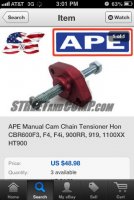
will this manual one silence the political chatter?
 

Attachments

  • image.jpg
    image.jpg
    51 KB · Views: 720
  • image.jpg
    image.jpg
    70.6 KB · Views: 731
Texasstar said:
will this manual one silence the political chatter?

I'm not sure that is possible, but I have faith. That replaces the hydraulic (automatic) adjuster on some bikes. Not a real problem on ours but worth keeping in mind.
 
Back
Top Bottom