Father Son 75 CB200T Rise From the Ruins

Merry Christmas!m y'all!
2249c15e3e7dc2abc95f69eb6d5a0739.jpg

Our friend Michael gave us a painting he has been working on for 3 years. This is the first moment that Zeke pulled Lucky from the darkness
57b47c0dd2cbde7bd30aff53da1530ff.jpg


Sent from my iPhone using Tapatalk
 
Texasstar said:
thanks Crazypj how familiar are you with Harley/Aermacchi sprints?

Haven't looked at one for many years
Simple enough motor though, what do you need to know?
 
Texasstar said:
Merry Christmas!m y'all!
Our friend Michael gave us a painting he has been working on for 3 years. This is the first moment that Zeke pulled Lucky from the darkness.

Hi Texasstar, HAPPY HOLIDAYS to you too and thanks for the return message . . As I mentioned, I read that you might have your son try for a land speed record [but I'm not sure which bike it would be on], so I thought I would mention a few things that might help you get there in case you weren't aware of them, and as you probably know, every bit helps in this type of undertaking . . I am definitely not the worlds foremost expert on this, and I see you have gotten a "TON" of great help from Teazer and many others, but I thought I would post a few things that might not have been mentioned.


ENGINE COMPRESSION

Run the most you can for the octane you are using . . The amount of compression you are concerned with is dynamic compression, and the amount your engine has can be approximated if you have a computer dyno program like desktop dyno 2000 and the cam specs and static compression and bore and stroke etc.

For example, I would guesstimate that if the squish zone between your piston and combustion chamber in your cylinder head on your 175 engine is good, you can probably run at least 11.0:1 with a Megacycle X1 street cam, and maybe 12.0:1 with their X9 and X10 race cams with your C12 race gas . . No need using that unless it needs it, so I would make sure it needs it if you haven't yet.


TIMING VS COMPRESSION

There is a balance between the two which must be achieved, however, in general, you will get more power if you opt for more compression at the expense of having to run less timing . . For example, if you have an engine with 8.5 compression that you can run 40 degrees of total timing on, and an engine that has 10.0:1 but only 20 degrees of total timing, the 10:1 engine will make more power if all else remains the same, but at some point there will be a diminishing return.


SPARK PLUG

I would run one that is 1 step colder than stock to reduce the potential for preignition/detonation . . I would also cut the ground strap back to make it a side gap type, however, I have not done this on a fine wire type electrode so it will be a test case if you use that type . . This "unshrouds' some of the spark thereby exposing more of the spark to the fuel per se . . If you have an ignition that is higher voltage than a stock one, run the plug gap around .010" wider than the stock spec.

EXAMPLE

s-l225.jpg


MULTI FIRE IGNITION

Buy one, it will make you happy . . Multi fire ignitions will increase power on non fuel injected, non computer controlled engines, and the bigger the cam, carb and intake, the more they will help . . Call MSD for info on the units on page 18 and 19 in the link below . . You can run the unit that is designed for single cylinders if the plugs fire at the same time but the voltage may be a little less than advertised which is no big deal.

https://www.msdpowersports.com/uploadedFiles/MSDPowersportscom/Content/2012_Powerports_Catalog_W.pdf


LOW FRICTION PARTS SUGGESTION

Right side crankshaft ball bearing p/n 6305 - Ceramic balls with Moly coating and chromed races . . Don't press on the outer race because it may damage the balls . . $105

http://www.microbluebearings.com/categories/CERAMIC-BALL-BEARINGS/6300-SERIES-CERAMIC-BALL-BEARINGS/


TUNGSTEN DISULPHIDE COATING

Here's one affordable secret to reduced friction and reduced parts wear that virtually no one knows about including many performance engine builders . . Have your high load parts coated with Tungsten Disulphide . . It has a load capability of over 100,000 psi and a typical dynamic coefficient of friction of only .035 which is less than Moly, and it is only .05 microns thick after application . . A cf as low as .005 has been obtained.

It is impinged on the material at around 700 mph but does not abrade the surface.

Ball bearings are sprayed while assembled and spun during the process but needle bearings can't be done, nor would they benefit from it much anyway.

It works best when run against itself which would be the case in ball bearings or a camshaft and rocker arms where both mating surfaces are coated . . It will also virtually eliminate galling between the cam bearings and camshaft if it is applied to both surfaces providing both surfaces are in xlnt condition to start with.

I would not apply it to flat tappet cams because it may be so "slippery" that the lifters can not rotate properly.

The oil does not penetrate the Tungstenite, it gets trapped between the Tungstenite particles which increases lubricity which then reduces wear.

PARTS TO TUNGSTENITE

Cam, cam bearings, rocker arm pads and rocker arm bore and rocker shafts.

Left side crankshaft needle bearing outer race - Tungenstenite the inside or the whole thing.

Left side needle bearings - Ask if they can do uncaged/open needle bearings.

Both 5th gears on trans.

Primary gear on crank and clutch hub gear.

Piston rings and piston skirts . . Don't put anything on the barrel other than a proper hone.

Wheel bearings.


LIGHTWEIGHT PARTS

I see you are a machinist so you probably already know the following, but check the agencies/clubs you will be part of to see if it is legal.

Titanium, axles, swingarm pivot bolt, engine bolts, fork clamp bolts and steering stem etc . . Do your calculations, then bore the inside of the bolts to the larger bolts to the appropriate size to reduce weight even further.

As you probably know, Titanium threads can gall, so I would get the parts anodized before use or possibly coated with Tungstenite, however, I have never put Tungstenite on bolts, so if you do this, remember to check the torque periodically as you don't want them to loosen.

If you don't have access to Titanium, online metals has fair prices on it.

http://www.onlinemetals.com/?gclid=CPzmjpOT88kCFYqGfgod7qQKGg


This place has nuts and bolts but you may find others that have better pricing.

https://www.probolt-usa.com/titanium.html


Billet aluminum tripple trees.


ENGINE HEAT

If the engine runs hotter than you want, you can simply extend the existing fins on the head and cylinder by around 1/2 - 5/8" on each side.


OIL COOLER

I would definitely run one.


HIGH SPEED STABILITY

I read you installed a steering damper on one of the bikes which is an xlnt idea, however, it is also obviously a good idea to reduce the factors that can contribute to high speed instability.


1. TIRES - I would run moderately low profile ones, especially for high speed runs . . For a land speed record, I would also run narrow ones because they will reduce drag.


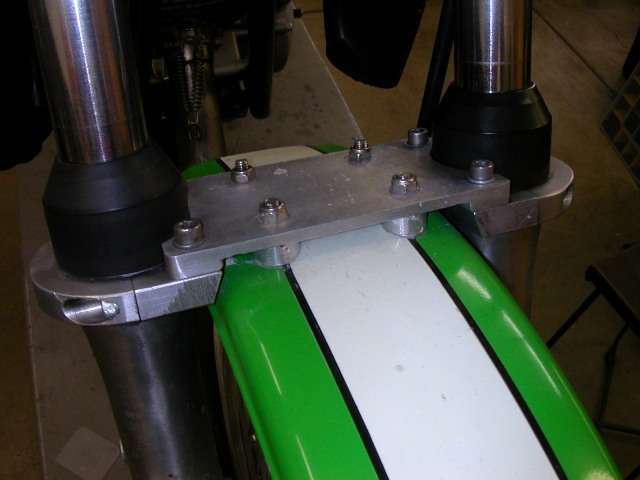
2. FORK BRACE - I would use one . . Here's a fancy one my friend made.

fork%20brace%20f9r.jpg


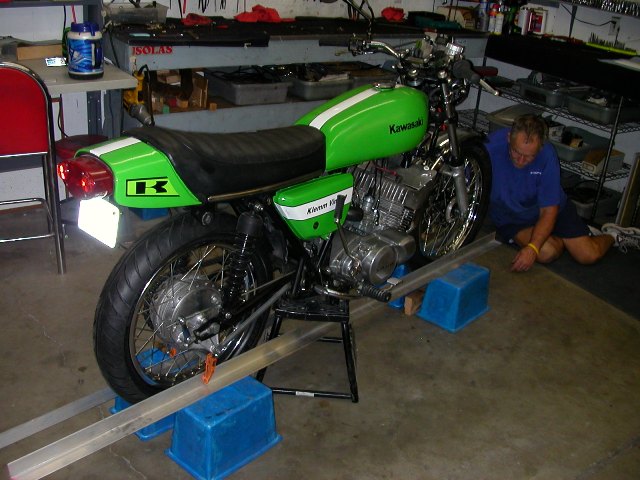
3. WHEEL ALIGNMENT - This is critical at high speeds, but unfortunately, you can't rely on the axle adjusters . . You can try string or lasers . . Below is how my friend does his.

From Harry Klemm

"While it doesn't look very high tech, we have aligned numerous motorcycles in this way, and eliminated the high speed head shake of every single bike.

Once we have the perfect alignment, we put a notch in the top flat of both axle adjuster bolts. Doing so allows us to easily see that we are turning both sides to the exact same rotational spot during future chain adjustments.

As a test, we intentionally mis-adjusted one axle adjuster 1/2 turn from our perfect setting, and then rode the bike. That mis-adjustment induced a noticeable head shake at speeds above 90mph. We brought the bike back and re-set it to the perfect setting....it then ran 110+ with no head shake at all."

DO NOT believe the adjuster marks on the swing arm... they are NEVER correct.

project%20001.jpg
 
barnett468 said:
Hi Texasstar, HAPPY HOLIDAYS to you too and thanks for the return message . . As I mentioned, I read that you might have your son try for a land speed record [but I'm not sure which bike it would be on], so I thought I would mention a few things that might help you get there in case you weren't aware of them, and as you probably know, every bit helps in this type of undertaking . . I am definitely not the worlds foremost expert on this, and I see you have gotten a "TON" of great help from Teazer and many others, but I thought I would post a few things that might not have been mentioned.


ENGINE COMPRESSION

Run the most you can for the octane you are using . . The amount of compression you are concerned with is dynamic compression, and the amount your engine has can be approximated if you have a computer dyno program like desktop dyno 2000 and the cam specs and static compression and bore and stroke etc.

For example, I would guesstimate that if the squish zone between your piston and combustion chamber in your cylinder head on your 175 engine is good, you can probably run at least 11.0:1 with a Megacycle X1 street cam, and maybe 12.0:1 with their X9 and X10 race cams with your C12 race gas . . No need using that unless it needs it, so I would make sure it needs it if you haven't yet.


TIMING VS COMPRESSION

There is a balance between the two which must be achieved, however, in general, you will get more power if you opt for more compression at the expense of having to run less timing . . For example, if you have an engine with 8.5 compression that you can run 40 degrees of total timing on, and an engine that has 10.0:1 but only 20 degrees of total timing, the 10:1 engine will make more power if all else remains the same, but at some point there will be a diminishing return.


SPARK PLUG

I would run one that is 1 step colder than stock to reduce the potential for preignition/detonation . . I would also cut the ground strap back to make it a side gap type, however, I have not done this on a fine wire type electrode so it will be a test case if you use that type . . This "unshrouds' some of the spark thereby exposing more of the spark to the fuel per se . . If you have an ignition that is higher voltage than a stock one, run the plug gap around .010" wider than the stock spec.

EXAMPLE

s-l225.jpg


MULTI FIRE IGNITION

Buy one, it will make you happy . . Multi fire ignitions will increase power on non fuel injected, non computer controlled engines, and the bigger the cam, carb and intake, the more they will help . . Call MSD for info on the units on page 18 and 19 in the link below . . You can run the unit that is designed for single cylinders if the plugs fire at the same time but the voltage may be a little less than advertised which is no big deal.

https://www.msdpowersports.com/uploadedFiles/MSDPowersportscom/Content/2012_Powerports_Catalog_W.pdf


LOW FRICTION PARTS SUGGESTION

Right side crankshaft ball bearing p/n 6305 - Ceramic balls with Moly coating and chromed races . . Don't press on the outer race because it may damage the balls . . $105

http://www.microbluebearings.com/categories/CERAMIC-BALL-BEARINGS/6300-SERIES-CERAMIC-BALL-BEARINGS/


TUNGSTEN DISULPHIDE COATING

Here's one affordable secret to reduced friction and reduced parts wear that virtually no one knows about including many performance engine builders . . Have your high load parts coated with Tungsten Disulphide . . It has a load capability of over 1000,000 psi and a typical dynamic coefficient of friction of only .035 which is less than Moly, and it is only .05 microns thick after application . . A cf as low as .005 has been obtained.

It is impinged on the material at around 700 mph but does not abrade the surface.

Ball bearings are sprayed while assembled and spun during the process but needle bearings can't be done, nor would they benefit from it much anyway.

It works best when run against itself which would be the case in ball bearings or a camshaft and rocker arms where both mating surfaces are coated . . It will also virtually eliminate galling between the cam bearings and camshaft if it is applied to both surfaces providing both surfaces and in xlnt condition to start with.

I would not apply it to flat tappet cams because it may be so "slippery" that the lifters can not rotate properly.

The oil does not penetrate the Tungstenite, it gets trapped between the Tungstenite particles which increases lubricity which then reduces wear.

PARTS TO TUNGSTENITE

Cam, cam bearings, rocker arm pads and rocker arm bore and rocker shafts.

Left side crankshaft needle bearing outer race - Tungenstenite the inside or the whole thing.

Left side needle bearings - Ask if they can do uncaged/open needle bearings.

Both 5th gears on trans.

Primary gear on crank and clutch hub gear.

Piston rings and piston skirts . . Don't put anything on the barrel other than a proper hone.

Wheel bearings.


LIGHTWEIGHT PARTS

I see you are a machinist so you probably already know the following, but check the agencies/clubs you will be part of to see if it is legal.

Titanium, axles, swingarm pivot bolt, engine bolts, fork clamp bolts and steering stem etc . . Do your calculations, then bore the inside of the bolts to the larger bolts to the appropriate size to reduce weight even further.

As you probably know, Titanium threads can gall, so I would get the parts anodized before use or possibly coated with Tungstenite, however, I have never put Tungstenite on bolts, so if you do this, remember to check the torque periodically as you don't want them to loosen.

If you don't have access to Titanium, online metals has fair prices on it.

http://www.onlinemetals.com/?gclid=CPzmjpOT88kCFYqGfgod7qQKGg


This place has nuts and bolts but you may find others that have better pricing.

https://www.probolt-usa.com/titanium.html


Billet aluminum tripple trees.


ENGINE HEAT

If the engine runs hotter than you want, you can simply extend the existing fins on the head and cylinder by around 1/2 - 5/8" on each side.


OIL COOLER

I would definitely run one.


HIGH SPEED STABILITY

I read you installed a steering damper on one of the bikes which is an xlnt idea, however, it is also obviously a good idea to reduce the factors that can contribute to high speed instability.


1. TIRES - I would run moderately low profile ones, especially for high speed runs . . For a land speed record, I would also run narrow ones because they will reduce drag.


2. FORK BRACE - I would use one . . Here's a fancy one my friend made.

fork%20brace%20f9r.jpg


3. WHEEL ALIGNMENT - This is critical at high speeds, but unfortunately, you can't rely on the axle adjusters . . You can try string or lasers . . Below is how my friend does his.

From Harry Klemm

"While it doesn't look very high tech, we have aligned numerous motorcycles in this way, and eliminated the high speed head shake of every single bike.

Once we have the perfect alignment, we put a notch in the top flat of both axle adjuster bolts. Doing so allows us to easily see that we are turning both sides to the exact same rotational spot during future chain adjustments.

As a test, we intentionally mis-adjusted one axle adjuster 1/2 turn from our perfect setting, and then rode the bike. That mis-adjustment induced a noticeable head shake at speeds above 90mph. We brought the bike back and re-set it to the perfect setting....it then ran 110+ with no head shake at all."

DO NOT believe the adjuster marks on the swing arm... they are NEVER correct.

project%20001.jpg
Thank you for the Christmas gifts. The best gifts are free! Zeke has been trying on full leathers lately after Peter our friend gave Zeke a description of what it was like to have cotton fibers scrubbed from your skin with a wire brush. I am not a machinist but our friend Benjamin is.

Lucky is running 10:1 (CB 200) and Victoria is running 9:1. Lucky has stock oversize Pistons with a high dome whereas Victoria is running a slipper racing piston with a low dome and excellent flame propagation. Looks like we will be stripping Lucky down for an engine rebuild in the near future...now that we have learned a little more.

Thank you for all the info lots to chew on...merry Christmas!


Sent from my iPad using Tapatalk
 
Texasstar said:
Thank you for the Christmas gifts. The best gifts are free! Zeke has been trying on full leathers lately after Peter our friend gave Zeke a description of what it was like to have cotton fibers scrubbed from your skin with a wire brush. I am not a machinist but our friend Benjamin is.

Lucky is running 10:1 (CB 200) and Victoria is running 9:1. Lucky has stock oversize Pistons with a high dome whereas Victoria is running a slipper racing piston with a low dome and excellent flame propagation. Looks like we will be stripping Lucky down for an engine rebuild in the near future...now that we have learned a little more.

Thank you for all the info lots to chew on...merry Christmas!

no prob, you're welcome . . i'll post some more tomorrow.

you are really missing out on a noticeable bit of performance running 9.0 on victoria, and all that race gas is doing for you is smelling good and draining your wallet, you should easily be able to run 89 octane in that . . this is an example where the compression is WAY too low for the octane you are running and you are far far better off reducing your timing and increasing the compression . . if you do that, you will thank me because you will be shocked how much better it will be throughout the entire rpm range with another 2 points in compression, plus it will have better throttle response and i guarantee it will easily break 100 mph under the same circumstances that it did 99 mph under.

also, run your tires as high as is safe if you aren't already and that will probably get you another 1.5 mph.

when you road race, you would start out at slightly low pressure like 28 because the pressure will increase the hitter the tire gets . . this is just a ball park starting point and you can go up 2 lbs and down 2 lbs when it is hot or cold to see which is best.

i will post some info on harry tomorrow, he's actually pretty funny.
 
barnett468 said:
no prob, you're welcome . . i'll post some more tomorrow.

you are really missing out on a noticeable bit of performance running 9.0 on victoria, and all that race gas is doing for you is smelling good and draining your wallet, you should easily be able to run 89 octane in that . . this is an example where the compression is WAY too low for the octane you are running and you are far far better off reducing your timing and increasing the compression . . if you do that, you will thank me because you will be shocked how much better it will be throughout the entire rpm range with another 2 points in compression, plus it will have better throttle response and i guarantee it will easily break 100 mph under the same circumstances that it did 99 mph under.

also, run your tires as high as is safe if you aren't already and that will probably get you another 1.5 mph.

when you road race, you would start out at slightly low pressure like 28 because the pressure will increase the hitter the tire gets . . this is just a ball park starting point and you can go up 2 lbs and down 2 lbs when it is hot or cold to see which is best.

i will post some info on harry tomorrow, he's actually pretty funny.
but it is worth the smell lol! Ask the guys we were trying to get the compression up with that low dome piston. There are other options but we ran out of time for the COTA test.

We need to go back to the Dyno with some 89 octane. I will let you know. We got 21 whp with the T4 unleaded and 23whp with the U4.4 and we have some MR12 I think we got a little better. We ran the T4 at COTA but we were going to switch to the MR12 but we stopped because the wind picked up. If you read the 175 string the Bostrom's gave us a complete briefing where we were scrubbing speed. It was pretty much what you had said. Frame alignment, the tread on our front tire, suspension set up-the cb350 forks vs the ohlins on back, dustbin needed to be reinforced. The actual speed was 103 when you take the cosine effect on radar into the equation. They said 99 made better TV. We were elated it was only our second build. We have been told you can only deck .120" before you run into cam chain issues and we were at that limit. We have some slightly higher domed pistons on the bench in the shop. We also have another cb160 head that is decked and will get us to 11.3-1 compression. However it doesn't breath near as well as the cb200 head. Need to put that on and go back to the Dyno just for grins.


Sent from my iPad using Tapatalk
 
barnett468 said:
TIMING VS COMPRESSION

There is a balance between the two which must be achieved, however, in general, you will get more power if you opt for more compression at the expense of having to run less timing . . For example, if you have an engine with 8.5 compression that you can run 40 degrees of total timing on, and an engine that has 10.0:1 but only 20 degrees of total timing, the 10:1 engine will make more power if all else remains the same, but at some point there will be a diminishing return.

Valve timing will also play a part in determining your best ignition timing. In general, higher compression needs less timing because the fuel/air mix is more dense and the flame front travels more quickly. Also, in general, higher duration cams require more advanced timing (at lower rpms) for the same reason. A built motor will often have a higher advance at idle than a stock engine.
 
Texasstar said:
but it is worth the smell lol! Ask the guys we were trying to get the compression up with that low dome piston. There are other options but we ran out of time for the COTA test.

We need to go back to the Dyno with some 89 octane. I will let you know. We got 21 whp with the T4 unleaded and 23whp with the U4.4 and we have some MR12 I think we got a little better. We ran the T4 at COTA but we were going to switch to the MR12 but we stopped because the wind picked up. If you read the 175 string the Bostrom's gave us a complete briefing where we were scrubbing speed. It was pretty much what you had said. Frame alignment, the tread on our front tire, suspension set up-the cb350 forks vs the ohlins on back, dustbin needed to be reinforced. The actual speed was 103 when you take the cosine effect on radar into the equation. They said 99 made better TV. We were elated it was only our second build. We have been told you can only deck .120" before you run into cam chain issues and we were at that limit. We have some slightly higher domed pistons on the bench in the shop. We also have another cb160 head that is decked and will get us to 11.3-1 compression. However it doesn't breath near as well as the cb200 head. Need to put that on and go back to the Dyno just for grins.


Sent from my iPad using Tapatalk

its great that you are getting so much help and good info here . . i saw you mention that the training institute wouldn't accept your son or something so you ended up finding this place and i assure you, they did you a favor . . no one person [other than smokey yunick, lol] knows it all so here you get info based on a huge range of first hand real world experiences . . since i dont know exactly what you know, please forgive me if i mention things you are already aware of.

training institutes are great and i encourage people that are new to go to one to get a basic background but n your case, you got the same thing here plus some additional info that was specific t your goal that you wouldn't have gotten there and i definitely know they probably never even heard of tungsten disulphide.

i saw teazer mention that he was not enamored with coatings and there are some that are more of a gimick than actually helpful and as he mentioned, some quickly wear off which can be the case with the teflon you coated your pistons and rings with on victoria.

the tungsten ain't gonna come off, and in fact, formula 1 engines also use coatings . . the primary benefit "normal" people get from the coatings is greatly reduced engine wear and the greatest benefit is achieved on the cam and rockers due to the enormous amount of force there is between the two, especially with racing springs.

the friction reduction doesn't really increase power/rpm by very much, but as i mentioned and as it seems you know, every little bit helps in a serious endeavor like yours and it all adds up, and the good thing about coatings is that they are affordable these days . . the tungsten coating used to cost many times more than it does now so only people like nasa and boeing and nascar and f1 racing teams could afford it.

CYLINDER HEAD SWAP

the more info the better and i encourage people to do TONS of testing, unfortunately, dyno testing is expensive and not many can afford it . . in your case, no matter what the results of the head swap are, i guarantee you with 110% certainty that you will get more power with more compression so imo, the best thing for you to do is get the 9.0 head up to closer to 11 and then do a comparison because it will be comparing only the difference in flow which will be a far more meaningful result and will save you one step . . in other words, i would do the things that i know must be done anyway before i did more testing.


GAS VS HP

One of the reasons your hp varies with different fuels is because they burn at different rates [flame speed] so when you use a different fuel, you must do another ignition timing test to find the best setting like you did before, and you could spend months on the dyno doing testing if you really wanted to . . some mfg's will tell you what their flame speed is if you call their tech line but i wouldn't get to obsessed with it, i would just pick one and stay with it . . also, different fuels require different jetting.

once your bike is tuned, you do not want to start changing fuel or valve settings, however, the ignition timing and jetting should be optimized for atmospheric conditions for optimum perf and since timing is complicated to mess with in the field . . the jetting and tire pressure should be the only things you change.


JETTING

In general, the higher the elevation, the leaner the jetting needs to be, therefore, you need an assortment of jets when you go places and check your plug color and max rpm and mph etc.

i'll be back in a couple hours with more stuff.
 
Sonreir said:
Valve timing will also play a part in determining your best ignition timing. In general, higher compression needs less timing because the fuel/air mix is more dense and the flame front travels more quickly. Also, in general, higher duration cams require more advanced timing (at lower rpms) for the same reason. A built motor will often have a higher advance at idle than a stock engine.

yes, the valve timing affects dynamic compression which is why i mentioned that he needed the timing events if he wanted to use a computer program to calculate the theoretical dynamic compression at different rpm's.

i curve my advances so they are the best overall setting for a particular app . . drag race engines don't have variable ignition timing, they set it the total advance to produce the most power and say screw it to the rest because the engine will never operate in the lower rpm range where different timing would be beneficial . . Texasstar and his son zeke locked the timing on victoria [their 175] and it now idles at 2250 rpm if i recall correctly.

the combustion chamber shape also affects how much advance can be run . . in, general, a heart shaped chamber requires less timing . . one reason for this is because it mixes the fuel better than other shapes which improves the mixtures combustibility which increase its flame speed per se.
 
barnett468 said:
its great that you are getting so much help and good info here . . i saw you mention that the training institute wouldn't accept your son or something so you ended up finding this place and i assure you, they did you a favor . . no one person [other than smokey yunick, lol] knows it all so here you get info based on a huge range of first hand real world experiences . . since i dont know exactly what you know, please forgive me if i mention things you are already aware of.

training institutes are great and i encourage people that are new to go to one to get a basic background but n your case, you got the same thing here plus some additional info that was specific t your goal that you wouldn't have gotten there and i definitely know they probably never even heard of tungsten disulphide.

i saw teazer mention that he was not enamored with coatings and there are some that are more of a gimick than actually helpful and as he mentioned, some quickly wear off which can be the case with the teflon you coated your pistons and rings with on victoria.

the tungsten ain't gonna come off, and in fact, formula 1 engines also use coatings . . the primary benefit "normal" people get from the coatings is greatly reduced engine wear and the greatest benefit is achieved on the cam and rockers due to the enormous amount of force there is between the two, especially with racing springs.

the friction reduction doesn't really increase power/rpm by very much, but as i mentioned and as it seems you know, every little bit helps in a serious endeavor like yours and it all adds up, and the good thing about coatings is that they are affordable these days . . the tungsten coating used to cost many times more than it does now so only people like nasa and boeing and nascar and f1 racing teams could afford it.

CYLINDER HEAD SWAP

the more info the better and i encourage people to do TONS of testing, unfortunately, dyno testing is expensive and not many can afford it . . in your case, no matter what the results of the head swap are, i guarantee you with 110% certainty that you will get more power with more compression so imo, the best thing for you to do is get the 9.0 head up to closer to 11 and then do a comparison because it will be comparing only the difference in flow which will be a far more meaningful result and will save you one step . . in other words, i would do the things that i know must be done anyway before i did more testing.


GAS VS HP

One of the reasons your hp varies with different fuels is because they burn at different rates [flame speed] so when you use a different fuel, you must do another ignition timing test to find the best setting like you did before, and you could spend months on the dyno doing testing if you really wanted to . . some mfg's will tell you what their flame speed is if you call their tech line but i wouldn't get to obsessed with it, i would just pick one and stay with it . . also, different fuels require different jetting.

once your bike is tuned, you do not want to start changing fuel or valve settings, however, the ignition timing and jetting should be optimized for atmospheric conditions for optimum perf and since timing is complicated to mess with in the field . . the jetting and tire pressure should be the only things you change.


JETTING

In general, the higher the elevation, the leaner the jetting needs to be, therefore, you need an assortment of jets when you go places and check your plug color and max rpm and mph etc.

i'll be back in a couple hours with more stuff.
Well 3 years ago we didn't know a two stroke from a 4 stroke and we are always eager to learn. We do have Smokey's book. :) and hopefully a little of his spirit.

The tungsten disulphide is intriguing tell us more...like cost and application methods etc.


Sent from my iPhone using Tapatalk
 
Texasstar said:
Well 3 years ago we didn't know a two stroke from a 4 stroke and we are always eager to learn. We do have Smokey's book. :) and hopefully a little of his spirit.
yes, i saw that you asked about cams for a 2 stroke because you wanted to beef up your weed eater so you could get the yard work done faster.
hysterical.gif


sorry, couldn't help myself . . obviously nobody knows nothing about anything when they start out and if i didn't laugh at my stupidity, i'd probably cry, lol.


Texasstar said:
The tungsten disulphide is intriguing tell us more...like cost and application methods etc.

i'll be back in around an hour with more info, but the world of coatings is an incredibly confusing one, i know a bit about them because of what i have done before and can give you a lot of info, but in general, its really best to try and simplify things and not start using a different coating on every different part.

they have thermal barriers that go on top of the piston and inside the combustion chamber that increase the heat in the chamber which will increase power but we're talking maybe a 2 - 3 hp increase in a 500 hp engine so the value just isn't there for normal people.

also, some coatings go on thicker than others so yo need to account for their thickness and because of that, i typically prefer the thinner ones.

there are companies that apply moly and they will tell you that t is better than tungsten and it is certainly a great product and in fact, moly and tungsten come from the same chemical per se, and the difference between the two is almost insignificant.

by the way, some production superbikes come with ceramic crank bearings but they are not coated.

back shortly with more info.
 
I know tungsten disulphide as a mold coating and release. It last more than a year under those circumstances. I had no idea people were using them in engines. In the ceramic world, there are lines of coatings called HUC (heat unity coatings). They promote fuel efficiency and more even burning through their reflective qualities. I'm curious about the similarities.
 
deviant said:
I know tungsten disulphide as a mold coating and release. It last more than a year under those circumstances. I had no idea people were using them in engines.

very few people are because they simply don't know about it . . yeah mold release, engine protection, the mars rover has it on their wheel bearings that run dry . . it has so many apps you could probably use it as a desert topping.
 
barnett468 said:
very few people are because they simply don't know about it . . yeah mold release, engine protection, the mars rover has it on their wheel bearings that run dry . . it has so many apps you could probably use it as a desert topping.
what is the significance of your handle barnett468?
 
Back
Top Bottom