Hi Texasstar, HAPPY HOLIDAYS to you too and thanks for the return message . . As I mentioned, I read that you might have your son try for a land speed record [but I'm not sure which bike it would be on], so I thought I would mention a few things that might help you get there in case you weren't aware of them, and as you probably know, every bit helps in this type of undertaking . . I am definitely not the worlds foremost expert on this, and I see you have gotten a "TON" of great help from Teazer and many others, but I thought I would post a few things that might not have been mentioned.
ENGINE COMPRESSION
Run the most you can for the octane you are using . . The amount of compression you are concerned with is dynamic compression, and the amount your engine has can be approximated if you have a computer dyno program like desktop dyno 2000 and the cam specs and static compression and bore and stroke etc.
For example, I would guesstimate that if the squish zone between your piston and combustion chamber in your cylinder head on your 175 engine is good, you can probably run at least 11.0:1 with a Megacycle X1 street cam, and maybe 12.0:1 with their X9 and X10 race cams with your C12 race gas . . No need using that unless it needs it, so I would make sure it needs it if you haven't yet.
TIMING VS COMPRESSION
There is a balance between the two which must be achieved, however, in general, you will get more power if you opt for more compression at the expense of having to run less timing . . For example, if you have an engine with 8.5 compression that you can run 40 degrees of total timing on, and an engine that has 10.0:1 but only 20 degrees of total timing, the 10:1 engine will make more power if all else remains the same, but at some point there will be a diminishing return.
SPARK PLUG
I would run one that is 1 step colder than stock to reduce the potential for preignition/detonation . . I would also cut the ground strap back to make it a side gap type, however, I have not done this on a fine wire type electrode so it will be a test case if you use that type . . This "unshrouds' some of the spark thereby exposing more of the spark to the fuel per se . . If you have an ignition that is higher voltage than a stock one, run the plug gap around .010" wider than the stock spec.
EXAMPLE
MULTI FIRE IGNITION
Buy one, it will make you happy . . Multi fire ignitions will increase power on non fuel injected, non computer controlled engines, and the bigger the cam, carb and intake, the more they will help . . Call MSD for info on the units on page 18 and 19 in the link below . . You can run the unit that is designed for single cylinders if the plugs fire at the same time but the voltage may be a little less than advertised which is no big deal.
https://www.msdpowersports.com/uploadedFiles/MSDPowersportscom/Content/2012_Powerports_Catalog_W.pdf
LOW FRICTION PARTS SUGGESTION
Right side crankshaft ball bearing p/n 6305 - Ceramic balls with Moly coating and chromed races . . Don't press on the outer race because it may damage the balls . . $105
http://www.microbluebearings.com/categories/CERAMIC-BALL-BEARINGS/6300-SERIES-CERAMIC-BALL-BEARINGS/
TUNGSTEN DISULPHIDE COATING
Here's one affordable secret to reduced friction and reduced parts wear that virtually no one knows about including many performance engine builders . . Have your high load parts coated with Tungsten Disulphide . . It has a load capability of over 1000,000 psi and a typical dynamic coefficient of friction of only .035 which is less than Moly, and it is only .05 microns thick after application . . A cf as low as .005 has been obtained.
It is impinged on the material at around 700 mph but does not abrade the surface.
Ball bearings are sprayed while assembled and spun during the process but needle bearings can't be done, nor would they benefit from it much anyway.
It works best when run against itself which would be the case in ball bearings or a camshaft and rocker arms where both mating surfaces are coated . . It will also virtually eliminate galling between the cam bearings and camshaft if it is applied to both surfaces providing both surfaces and in xlnt condition to start with.
I would not apply it to flat tappet cams because it may be so "slippery" that the lifters can not rotate properly.
The oil does not penetrate the Tungstenite, it gets trapped between the Tungstenite particles which increases lubricity which then reduces wear.
PARTS TO TUNGSTENITE
Cam, cam bearings, rocker arm pads and rocker arm bore and rocker shafts.
Left side crankshaft needle bearing outer race - Tungenstenite the inside or the whole thing.
Left side needle bearings - Ask if they can do uncaged/open needle bearings.
Both 5th gears on trans.
Primary gear on crank and clutch hub gear.
Piston rings and piston skirts . . Don't put anything on the barrel other than a proper hone.
Wheel bearings.
LIGHTWEIGHT PARTS
I see you are a machinist so you probably already know the following, but check the agencies/clubs you will be part of to see if it is legal.
Titanium, axles, swingarm pivot bolt, engine bolts, fork clamp bolts and steering stem etc . . Do your calculations, then bore the inside of the bolts to the larger bolts to the appropriate size to reduce weight even further.
As you probably know, Titanium threads can gall, so I would get the parts anodized before use or possibly coated with Tungstenite, however, I have never put Tungstenite on bolts, so if you do this, remember to check the torque periodically as you don't want them to loosen.
If you don't have access to Titanium, online metals has fair prices on it.
http://www.onlinemetals.com/?gclid=CPzmjpOT88kCFYqGfgod7qQKGg
This place has nuts and bolts but you may find others that have better pricing.
https://www.probolt-usa.com/titanium.html
Billet aluminum tripple trees.
ENGINE HEAT
If the engine runs hotter than you want, you can simply extend the existing fins on the head and cylinder by around 1/2 - 5/8" on each side.
OIL COOLER
I would definitely run one.
HIGH SPEED STABILITY
I read you installed a steering damper on one of the bikes which is an xlnt idea, however, it is also obviously a good idea to reduce the factors that can contribute to high speed instability.
1. TIRES - I would run moderately low profile ones, especially for high speed runs . . For a land speed record, I would also run narrow ones because they will reduce drag.
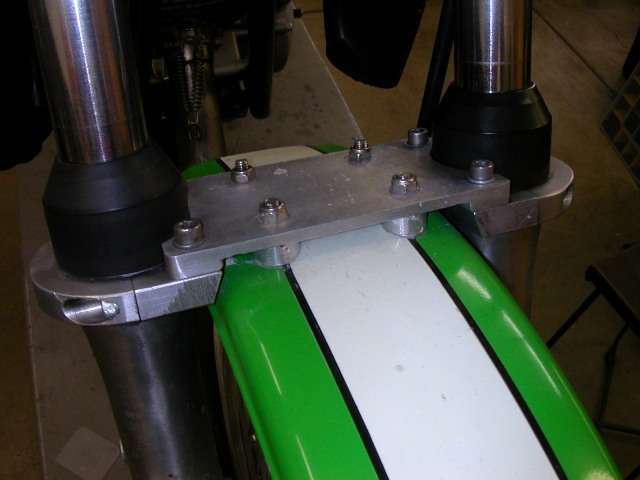
2. FORK BRACE - I would use one . . Here's a fancy one my friend made.
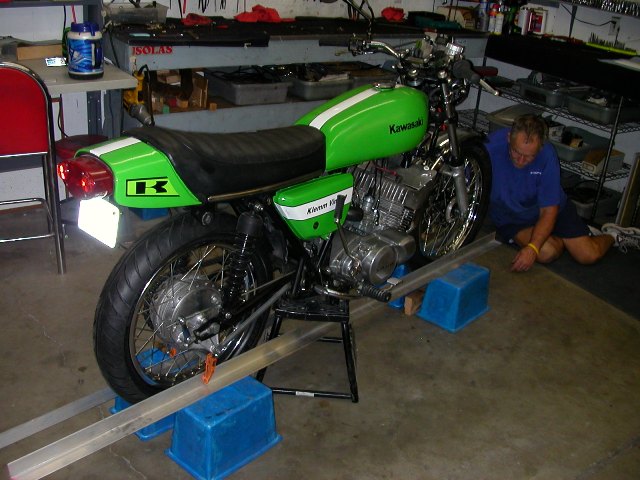
3. WHEEL ALIGNMENT - This is critical at high speeds, but unfortunately, you can't rely on the axle adjusters . . You can try string or lasers . . Below is how my friend does his.
From Harry Klemm
"While it doesn't look very high tech, we have aligned numerous motorcycles in this way, and eliminated the high speed head shake of every single bike.
Once we have the perfect alignment, we put a notch in the top flat of both axle adjuster bolts. Doing so allows us to easily see that we are turning both sides to the exact same rotational spot during future chain adjustments.
As a test, we intentionally mis-adjusted one axle adjuster 1/2 turn from our perfect setting, and then rode the bike. That mis-adjustment induced a noticeable head shake at speeds above 90mph. We brought the bike back and re-set it to the perfect setting....it then ran 110+ with no head shake at all."
DO NOT believe the adjuster marks on the swing arm... they are NEVER correct.





 and hopefully a little of his spirit.


