It would seem to me you'd get more gains by reshaping the ports (specifically the intake).
If empirical tests are showing a loss in power with a hotter cam, the it would seem that the intake ports are not properly sized. A hotter cam will reduce power below a certain RPM, but it should also make it back (and then some) higher up in the revs.
The sizing of the intake ports should be a small as possible without restricting flow. That can be tested simply by hooking up your head to a flow bench (a home made flow bench even works here) and packing playdough into the ports until the flow rate starts to drop (then you know you've gone too far). Additionally, the shape of the intake port will be a contributing factor.
I recall reading that the ideal size for the intake port in a single valve engine is around 80% of the diameter of the valves. Furthermore, the ideal shape will be a D, with the flat side of the port being the port floor. So if your intake valves are 25mm in diameter (I think that's right, but just run with me here if I'm not), then the distance from the port floor to the port ceiling should be around 20mm.
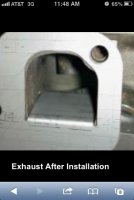
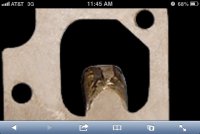
In order to get the ports shaped properly, it isn't always necessary to resort to the addition of metal. If you're building a flat-out top speed racer, then you can expect to have this engine apart a lot of the time. Because of that, you can use methods which may not have as long of a lifespan without concern (because you'll be constantly inspecting them every time the engine is apart). There is a product called Devcon F which is an aluminum epoxy that is very resistant to heat. It can be used to fill in intake ports. It's pretty easy to work with and I recommend it. You can/should end up with something like this (though you will want a smooth transition from manifold to head, so the D shape should be a not be a sharp step):
To increase flow further, you should also grind down any casting marks from the inside of the port ceilings. Additionally, I recommend grinding down the intake valve guides (on the inside of the port) such that they are flush with the port ceiling.
Do all your tests with clay and a flow bench before moving to epoxy and I think you'll be fairly pleased with the results. If you haven't yet, take a look a three (or even five) angle grinds on the valve seats and backcutting the valve, I recommend that as well. Tuliping the valves will help, too, but it's tricky and you need a good machinist to pull it off.