Father Son 75 CB200T Rise From the Ruins

teazer said:
They are big seats but quite narrow where they sit over a TD3/TZ/RD frame. They should fit on a CB without too much trouble. I can check if you like. I have a spare 160/175 frame and one of those seats on the shelf for another project.
That would be great! Thank you!
 
Tackling another problem on our Cb200. Is the gold valve cartridge emulators the best solution to keep the cb200 from bottoming out?

http://www.racetech.com/HTML_FILES/EMULATORGV.HTML

We also need to solve the problem with the front brake. Keep in mind that Zeke wants to also road race Lucky.

Best road racing school? http://www.cmraracing.com/
 
Sonreir said:
It would seem to me you'd get more gains by reshaping the ports (specifically the intake).

If empirical tests are showing a loss in power with a hotter cam, the it would seem that the intake ports are not properly sized. A hotter cam will reduce power below a certain RPM, but it should also make it back (and then some) higher up in the revs.

The sizing of the intake ports should be a small as possible without restricting flow. That can be tested simply by hooking up your head to a flow bench (a home made flow bench even works here) and packing playdough into the ports until the flow rate starts to drop (then you know you've gone too far). Additionally, the shape of the intake port will be a contributing factor.

I recall reading that the ideal size for the intake port in a single valve engine is around 80% of the diameter of the valves. Furthermore, the ideal shape will be a D, with the flat side of the port being the port floor. So if your intake valves are 25mm in diameter (I think that's right, but just run with me here if I'm not), then the distance from the port floor to the port ceiling should be around 20mm.

In order to get the ports shaped properly, it isn't always necessary to resort to the addition of metal. If you're building a flat-out top speed racer, then you can expect to have this engine apart a lot of the time. Because of that, you can use methods which may not have as long of a lifespan without concern (because you'll be constantly inspecting them every time the engine is apart). There is a product called Devcon F which is an aluminum epoxy that is very resistant to heat. It can be used to fill in intake ports. It's pretty easy to work with and I recommend it. You can/should end up with something like this (though you will want a smooth transition from manifold to head, so the D shape should be a not be a sharp step):

d_shape.jpg


To increase flow further, you should also grind down any casting marks from the inside of the port ceilings. Additionally, I recommend grinding down the intake valve guides (on the inside of the port) such that they are flush with the port ceiling.

Do all your tests with clay and a flow bench before moving to epoxy and I think you'll be fairly pleased with the results. If you haven't yet, take a look a three (or even five) angle grinds on the valve seats and backcutting the valve, I recommend that as well. Tuliping the valves will help, too, but it's tricky and you need a good machinist to pull it off.

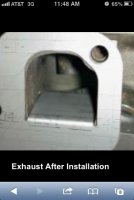
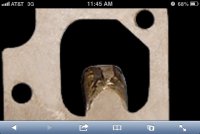
will the defcon f work on the exhaust ports?
 
Has anyone seen stingers or port plates fab'd for a motorcycle exhaust?
 

Attachments

  • image.jpg
    image.jpg
    30.5 KB · Views: 876
  • image.jpg
    image.jpg
    31.4 KB · Views: 907
Is this true and what would the step look like at peak rpm?

"One of fourstroke tuning books that I've got (by A. Graham Bell!) reckons that at low RPM the main flow of exhaust gas is along the floor of the port therefore if the step is created there it will improve the bottom end. At high RPM the flow is along the roof, a step there improves BHP around peak revs.

I lot of motorbike engines seem to have the setp all the way round the port."
 
Devcon F won't stand the heat in an exhaust port but is fine on the intake side. We use it to repair crankcases after a rod blew through - and it was still there ten years later. And of course for intake ports and two stroke crankcases etc. I'd avoid it in the exhaust.

Don't sweat the exhaust port too much. It will flow more than enough with attention to details. Sonreir (Matt) is right that conventional wisdom has exhaust valves sized at around 81% of intake but that doesn't apply directly to the port. Clean it up and flow test it and see what that's like. the D shape doesn't help flow. It reduces reversion. Different factor but still important. You could achieve the same effect with stepped headers.

Grab a Cb350 front end with drum brake - or something similar.
 
Which one is the best and why? (Photo courtesy of Michael Moore)
 

Attachments

  • image.jpg
    image.jpg
    650.9 KB · Views: 360
Teazer what can Yamaha 250 like this do top speed if built correctly to run production class at bonneville? This is Rusty Bradley's street bike.
 

Attachments

  • image.jpg
    image.jpg
    119.1 KB · Views: 973
That's an early YDS1 or 2 - I'd have to check to be sure which from which the TD1A/TD1B and TD1C were derived. And there was the YDS1R which was the first production racer from Yamaha.

In theory it should be possible to achieve TD1 levels of performance, so 115 or so should be possible, but they are not reliable and tend to spit the clutch right off the end of the crank which was where it used to be mounted. Unless you are limited to 1962/3 model year I'd start with something more modern which would make more power and be more reliable.

BTW, the Vesco seat is just a touch less than 7 1/2" wide and a C160 frame is right around 7" wide.

For LSR you might also look at late model RS125 seats. I have used early slab tailed RS125 seats on CB160s.
 
teazer said:
seat is just a touch less than 7 1/2" wide and a C160 frame is right around 7" wide.

For LSR you might also look at late model RS125 seats. I have used early slab tailed RS125 seats on CB160s.
these?
 

Attachments

  • image.jpg
    image.jpg
    42.1 KB · Views: 757
  • image.jpg
    image.jpg
    44.2 KB · Views: 792
  • image.jpg
    image.jpg
    149.4 KB · Views: 315
  • image.jpg
    image.jpg
    18.4 KB · Views: 757
This pick was taken the year I was born...same seat and fairing that lucky will have :)
 

Attachments

  • image.jpg
    image.jpg
    212.3 KB · Views: 322
The idea behind (all puns intended) is to close the gap back there to make air flow smoother. Little seat bumps don't flow as well as bigger seat humps in terms of aerodynamics.
 
Take a look at the back end of a Hayabusa. They were wind tunnel tested with the specific goal of beating Honda's Super Nighthawk's top speed. Only a few more ponies than the CBR1100, but 10mph faster top speed.
 
Dalio. Wilson, Bradley, Scurria, Munro, and now Vesco. Lucky is teaching us about GRIT! The spirit of the salt. The spirit of the road racer. This is why Don Vesco still holds the 250cc streamliner record today. He never gave up after falling...oh and the record was set using one of Teazer's faves a yamaha twostroke TD2-250. Who is that guy with "true grit" standing next to that Yamaha?

http://youtu.be/I4BM7BGG4hI
 

Attachments

  • image.jpg
    image.jpg
    203.9 KB · Views: 881
  • image.jpg
    image.jpg
    204.5 KB · Views: 880
  • image.jpg
    image.jpg
    36.7 KB · Views: 827
Kop says we need to think about how the air is coming off our back leg. All the record setting small bikes have big butts. The Harley big butt seat is one of them. Which we will never use out of respect to Pete Dalio and Jack Wilson)

Sonreir says to look at a water drop. Now with the Peel 1 we are there for our fairing.

Our first goal is to do the ton...bonneville is secondary. For our journey we would like to pay homage to those who have helped push us. (In other words we have had a tz tail push up to this point)

Would this TZ250 tail close the air off the leg better than the TZ vesco big butts?
 

Attachments

  • image.jpg
    image.jpg
    40.3 KB · Views: 754
  • image.jpg
    image.jpg
    132.7 KB · Views: 301
  • image.jpg
    image.jpg
    53.6 KB · Views: 801
Which? The #812 seat is TZ250H IIRC, the same as the one on the left in the next picture. That TZADS1 anti-draft was designed for Daytona and is worth looking at. I have two on the shelf that need various degrees of repair.

The seat on that TZ125H is an odd one. Looks like a one off small version of the 250 seat.

Vesco's big butt seat was also designed to smooth the airflow behind the rider and I suspect that results would be similar with either a Vesco or anti draft.

Kop and Sonreir are both correct that the back end of a bike is at least as important as the front.

http://www.blogcdn.com/green.autoblog.com/media/2006/12/x04mo_gm039.jpg

http://www.kasravi.com/cmu/tec452/Aerodynamics/VehicleAero.htm

http://www.aerospaceweb.org/question/aerodynamics/sports/sphere-airfoil-comparison.jpg

It is important to clean up the flow. At 100 MPH, drag around the rider's legs arms and hands is not a major issue, but the as speeds rise, it plays a part. A good front fender will help and almost any largish seat will work too.
 
Tony was keeping this little Cb as a project bike. If you walk into L and L you know what bikes belong to Tony. One day we walked and there she was on the other side! Zeke wanted to take Lucky by L and L Cycle to thank Tony for selling Lucky to us.
 

Attachments

  • image.jpg
    image.jpg
    192.4 KB · Views: 313
teazer said:
Which? The #812 seat is TZ250H IIRC, the same as the one on the left in the next picture. That TZADS1 anti-draft was designed for Daytona and is worth looking at. I have two on the shelf that need various degrees of repair.

The seat on that TZ125H is an odd one. Looks like a one off small version of the 250 seat.

Vesco's big butt seat was also designed to smooth the airflow behind the rider and I suspect that results would be similar with either a Vesco or anti draft.

Kop and Sonreir are both correct that the back end of a bike is at least as important as the front.

http://www.blogcdn.com/green.autoblog.com/media/2006/12/x04mo_gm039.jpg

http://www.kasravi.com/cmu/tec452/Aerodynamics/VehicleAero.htm

http://www.aerospaceweb.org/question/aerodynamics/sports/sphere-airfoil-comparison.jpg

It is important to clean up the flow. At 100 MPH, drag around the rider's legs arms and hands is not a major issue, but the as speeds rise, it plays a part. A good front fender will help and almost any largish seat will work too.
Thanks Teazer! We have been listening carefully to what everyone has been telling us. Sonreir had us looking at a water drop. So we observed rain drops. Kop has us looking a P-51 wing and blowing smoke on a ball.

When we looked at the big butt seats out there they didn't close the air like your picture of a foil, or the wing, or a rain drop. According to Kent at Airtech the TZ ads1 has an advantage over the Vesco Big Butt and the Harley Big Butt!!! It cleans up the flow better!

Thanks guys! Kop, Sonreir, and Teazer we are listening to you! Now for the fender...
 
Back
Top Bottom