
You are using an out of date browser. It may not display this or other websites correctly.
You should upgrade or use an alternative browser.
You should upgrade or use an alternative browser.
Father Son 75 CB200T Rise From the Ruins
- Thread starter Texasstar
- Start date


Texasstar
Can't is a four letter dirty word
The piston picture I posted was off Hansen's Facebook page.teazer said:Get a new gasket made between .030 and .040mm thick.
BTW, what are those pistons or who sells them?
Ok we will order a .040" from Cometic for this engine and head...
Attachments


The reason that there is an angle on a squish band is because as the gas moves in from the bore to the inner edge of the band, the area gets smaller and that causes a choke effect. It is effectively making a smaller and smaller space for the squished gas to pass through.
We could rationalize that it would increase gas velocity and would act as a nozzle, but in reality it slows down gas discharge and wastes energy. How much of a difference is needed? On a very narrow squish band it's not much of a factor. On a wider band two strokes have used 1 degree for ages, but I'm sure there's room to try different angles.
There are two main reason why a hemi head works. First it's that lack of shrouding that Matt mentioned and the other factor is that it has the lowest ratio of surface area to volume. What that means is that for a given volume (CR) it has the smallest surface are exposed to flame and the least amount of heat lost into the metal of the head.
That light slipper piston is very nice.
Both factors improve efficiency, but - and there's always a but - valve angles are ridiculous and gas flow is poor and they are not good with 4 valves, so another strike there.
We have a sem-hemi squish design and our task is to make the most of that. A cb200 has teh same basic small combustion chamber first introduced on a CB125 and CB160 with 41 and 50mm bores. That chamber is still small, so there's a noticeable squish band available for improvement.
Texasstar
Can't is a four letter dirty word
Thanks guys we are making a mold out of wax so seeing is believing for Zeke as we read your posts together. I read to my oldest son Lord of the Rings, The Narnia Chronicles, and The Screw Tape Letter as a child. Zeke gets y'all...teazer said:If you machine 1mm off the head, the stock "squish band" or chamfer starts to disappear and a new one has to be machined at your design angle

Attachments

Texasstar
Can't is a four letter dirty word
Teazer we just read this again and I wanted to clarify that you meant .030-.040 inches and not mm?teazer said:Hold on a moment.
CB honda twins do not have a full hemi quiescent combustion chamber. They have a narrow squish band like the pic of that EVO cross section. To get compression up, we start by machining the pistons to get the squish band to the shape/angle we want and by so doing, the crown gets to be slightly taller but only by say 0.5 -1.0mm
Step 2 is to deck the block so that the outer edge of the piston is flush with the gasket surface.
Step 3: your head ( well the bike's) goes on a milling table and the mill is centered using the barrels and dowels so that the next cut is concentric with the bore.
Step 4: machine a new squish band into the head at 1 degree larger than the piston. There must be a difference to maintain the correct mean squish velocity, but it's only around 1 degree.
Step 5: machine "some" off the head to bring the width of the squish band back to the same as the bore. If you plan on machining more than about 1mm off the head, might be best to reverse steps 4 & 5
Get a new gasket made between .030 and .040mm thick. Less than that and the piston will hit the head on the exhaust stroke. Two strokes don't but 4 strokes have that lazy exhaust stroke with no compression to cushion the blow. In general, the narrower the squish band, the tighter it can be (within limits) There is software out there to calculate MSV. Bigger engines need more squish clearance as do engines with wide squish bands.
That should leave the valves just touching pistons around TDC. You can either machine deeper pockets for the valves or recess the valves slightly into the head. We have to do both to get enough clearance.
You will also need what used to be called Fire Notch to clear the plug which will now have negative clearance to the piston.
You will also notice that the EVO head is not perfectly round but the sides of the chamber are narrower than the dimension across the valves. It's a multi-spherical design that is somewhere between a bathtub and hemi and works quite well. That can be achieved with a little weld after you take out the valve seats.
BTW, what are those pistons or who sells them?



caveman592
Been Around the Block
Excuse me for jumping into the conversation but I have a quick question. It seems from the discussion that a hemi head is best for detonation/compression but fails in that it doesn't breathe well. So my question is would a hemi head be best design if it had something attached to it to pull air and exhaust through and make it breathe better such as a turbo or supercharger? Feel free to pm me an answer if you don't think it should be part of the thread but I didn't really know who to ask so I just put it to the good people here.
Texasstar
Can't is a four letter dirty word
check out Sonreir's build. http://www.dotheton.com/forum/index.php?topic=38872.120caveman592 said:Excuse me for jumping into the conversation but I have a quick question. It seems from the discussion that a hemi head is best for detonation/compression but fails in that it doesn't breathe well. So my question is would a hemi head be best design if it had something attached to it to pull air and exhaust through and make it breathe better such as a turbo or supercharger? Feel free to pm me an answer if you don't think it should be part of the thread but I didn't really know who to ask so I just put it to the good people here.
Sonreirs bike is a 360. Sonreirnis going for 130+ mph. I have seen some other threads with guys attempting to turbo a smaller bike like ours and have not seen empirical data for a cb175/200 improving on a n/a of 25-27 whp that some of the guys have posted.
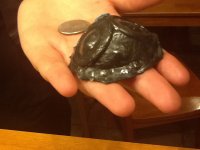
You can tell by holding the combustion chamber mold in you hand why everything matters. It is astounding for a liitle chamber to produce so much fun.
Texasstar
Can't is a four letter dirty word
Today is dyno day! Here are our calculations for our intake length and I have referenced Sonreirs Doing it right...http://www.dotheton.com/forum/index.php?topic=39814.45
We are shooting to catch the 4th pulse @10k rpms our intake came duration is 220 degrees
Intake 5 degree open and 35 close.
10000/60=166 rotations per second
X 360 degrees=60000
500 degrees /60000=.0083 sec
340.3 m/s (speed of sound) x loss factor 90% = 306.3 m/s
306.3 x .0083= 2.54 m /2 =1.27 m
1.27 / 4 pulse = 317mm or 12.48 inches total intake length
It will also catch the 5th pulse at 8k rpms with an intake length of 318mm...12.51 inches
Attachments


Texasstar
Can't is a four letter dirty word
We measured from the center of the valve to the end of the velocity stack. Hopefully we will see something at 8k and 10k.Sonreir said:Depending on the wave number, they can show up as anywhere from 1% - 4% gain in power. Depends on how precise the dyno is.
We are gonna dial in the jetting then remove the stacks and tubes for another run, then just the velocity stacks on the carbs like last time.
Caveman:
Hemi head breathers great but poor detonation control because of the quiescent chamber shape. Valve angles are high and that makes for packaging problems.
Turbos and other forced feeding techniques always add HP to any engine.
Engines really aren't about a perfect solution, but rather they are about the most optimal compromise for a given set of variables. We have a semi hemi head and there are many things we can do to make the most of what we have.
Texas:
Yes Inches not mm. Good catch.
Those are some ugly valve pockets. They need to be blended into the chamber shape a little better. Nice molding.
Texasstar
Can't is a four letter dirty word
Wow! Did we walk away scratching our heads. We increased from 15.2 to 16.51 wheel horse power.
We were running slightly lean so we jetted up to 88's instead of 85's. We then advanced our timing about a quarter of an inch and we lost one hp. We then retarded our Dyna-S electric ignition a quarter of an inch from were we started today and we ended up at 15.09 hp. We then removed the extension from our velocity stacks and ended up with 16.51 hp... And ended up running rich. We also ended up at our stock static timing with no advance.
We have 19 different run sheets and we will post them later. Give us a description on what we did. Teazer those cb750 velocity stacks are amazing thank you.
Don't thank me. Thank the engineers at Honda Central back in 1969 or so.
I love the theory and spend hours researching before I go to the dyno or the strip and get real facts which don't always match the theory - usually because the theory is incomplete. It's all part of the search for knowledge.
1/4" is a big adjustment on timing but it suggests that your timing is close to what the motor wants and in the final analysis, that's what it's all about.
caveman592
Been Around the Block
Thanks guys.
Texasstar
Can't is a four letter dirty word
dyno run comparisons
July-89 octane, dyna s, iridium plugs, indexed, 10w-40
run 19 -16.51 whp 88 jets, static time mark, cb750 velocity stack on carb...total intake length stock running slightly rich
run 6 - 15.69 whp 85 jets, timing advanced, cb750 vs with extension total intake length 12.5 inches running slightly lean
June-93 octane, timing slightly advances, stock points, plugs. 20w-50
run 3- 14.90 95 jets
run 4- 15.20 90 jets
We also did 15 runs at different rpm ranges this is the only bmp file the other files are dyna files and the free viewer is sub par for screen shots...in other words it doesn't work on a Mac.
Thank YOU for all of your help! We got our David Vizard book in the mail today so we are off to hit the book!
Our last run only took 10 seconds compared to all the other runs taking 14+.
Attachments

Texasstar
Can't is a four letter dirty word
Dang that is so fun! Hearing protection made it much more tolerable. I dropped a jet into the Dyno wheel and we got to see the inside of the Dyno today...clutz.teazer said:Don't thank me. Thank the engineers at Honda Central back in 1969 or so.
I love the theory and spend hours researching before I go to the dyno or the strip and get real facts which don't always match the theory - usually because the theory is incomplete. It's all part of the search for knowledge.
1/4" is a big adjustment on timing but it suggests that your timing is close to what the motor wants and in the final analysis, that's what it's all about.
The Dyna S is soooo sensitive (i don't know how to move my hand in those small increments) and we wanted to find the extremes today where the power dropped off dramatically. We will be taking an engraver to that plate in the near future.